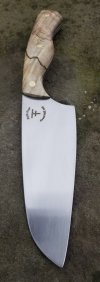
Surface finish on using/pro chef knives

Joined
Apr 27, 2009
Messages
991
I'm planning a run of chef knives that are using grade knives. They will probably be my demo knives but also a sample of knives designed for working use. It needs to be a belt finish on the knives. I keep running across hints of guys saying that a low grit finish sticks less. Has anyone run experiments with this? Where can some function be gained before it just becomes a excuse?
 
I mirror polish my carbon blades for stain resistance and it works great
I wouldn't on stainless.
It doesn't even look nice on stainless imo
 
I do most of mine to 600 grit but I did have one request for a mirror polish so I did it. Food sticks like glue. Full flat grinds so not ideal.

I really want to try an S grind.
 
This is a timely topic for me as I have been trying (struggling) to get a scratchless mirror finish on a kitchen knife for no reason other than aesthetics. To find out it will just be a sticky mess is a blessing, haha. Thanks guys!
 
Pretty similar to Stacy only I go to 220 gator before the Scotchbrite. These two went to a pro.

szxKG57.jpg
 
We need a tutorial on how to do a "belt" finish that does not look like ass. That sees to be what I end up with when I try. :p
 
I think the way to go is what Nathan the Machinist has going which is longitudinal grinding.

For me at least at the very end with slow speeds and a padded platten I think I can get that hand sanded look.

I have been doing blended no plunges anyway. I think I would have to be careful of rounding the corners of the ricasso area as it leads into the scales. Hmm maybe superglue some sacrificial mild steel to protect them?

Well I know what I am doing this Friday!
 
We need a tutorial on how to do a "belt" finish that does not look like ass. That sees to be what I end up with when I try. :p
How I machine finish a kitchen knife. This is what I do on plungeless stainless steel blades. Hopefully some find this useful. Here's what I do.
1. grind my blade horizontally. Belt progression is 60/120 Ceramic. Finish each grit drawing the blade horizontally with the butt lifted to give a 45+- degree angle. this helps to make sure the bevels are flat.
2. After addressing the flats and bevels on each grit, up to 120, holding the knife vertically with a magnet: I will rock the blade slightly from the flats to the bevel to wash out the 45 degree plunge.
2. Switch over to Norax a165 grinding vertical. I address the flats all the way to the tang to ensure the tang is flat and my "ricasso" area will be good in the end. Here is important to make sure you have a dead flat surface where your scales will be. (Hopefully, you didn't take that 45 degree plunge up past the handle area)
3. After addressing the flats and bevels on each grit, up to A30, I will rock the blade slightly from the flats to the bevel.
*All of the vertical grinding can be done on a flat platen, however after a165, I switch to a 12 contact wheel. It takes a really careful technique. You want to draw lightly, quickly and evenly from ricasso to tip. If you pause, you will create a divot in the flats. If you've ever sanded a hardwood floor with a drum sander this is something you are INTIMATELY familiar with. Be especially alert at the tip so you don't round it off. I actually rest it on my index finger and let that finger contact the belt as i draw it off. The high grit norax belts don't bother my finger in the slightest. *
You can stop here if you want, I do the following:
4. Very fine scotchbrite belt loaded with black compound.
The above belt progression is what I do for pretty much all my knives, just no vertical grinding on field knives. And on non-Kitchen cutlery, I often use a well broken in cork belt loaded with black compound instead of the Scotchbrite. It leaves a slightly finer finish.
Hope someone finds this helpful.

 
Last edited:
Whats the steel? I have been preferring a minimum of 400 grit finish to help prevent corrosion on carbon, while a fine scothcbrite finish on stainless is seeming to work very well. Stickiness is a result of several different factors but I find the geometry of the knife more important than the finish. For example, a very flat full flat grind is gonna be sticky whether its a mirror or a satin finish.
 
Whats the steel? I have been preferring a minimum of 400 grit finish to help prevent corrosion on carbon, while a fine scothcbrite finish on stainless is seeming to work very well. Stickiness is a result of several different factors but I find the geometry of the knife more important than the finish. For example, a very flat full flat grind is gonna be sticky whether its a mirror or a satin finish.
if you are asking me, AEB-L or Nitro-V. They both finish the same to my (mediocre) eye.
 
I was asking the OP ...for using grade knives I do think the choice of steel being stainless or not is an important factor. If the OP does choose something like 20CV or M390, gator belts dont seem to cut it on the hardened steel. I had to use some 220 grit SC belts before the scotchbrite
 
Back
Top