Tale of 2 blades (My very first and WIP second...) (lots of pics so 56k beware!)

Joined
Apr 10, 2010
Messages
31
Hey there all! I finally completed my first blade, and currently working on my second.

Details:
1st blade - 1095 steel, 1/8"t, cocobolo handle, suguha-ish hamon (Apple Cider etched and polished), Stainless corby bolts.

FWIW - forgive the quality of the photos. My significant other took the camera with her on vacation, so I had to use my blackberry instead. Not the best of photos, but it gets the job done.

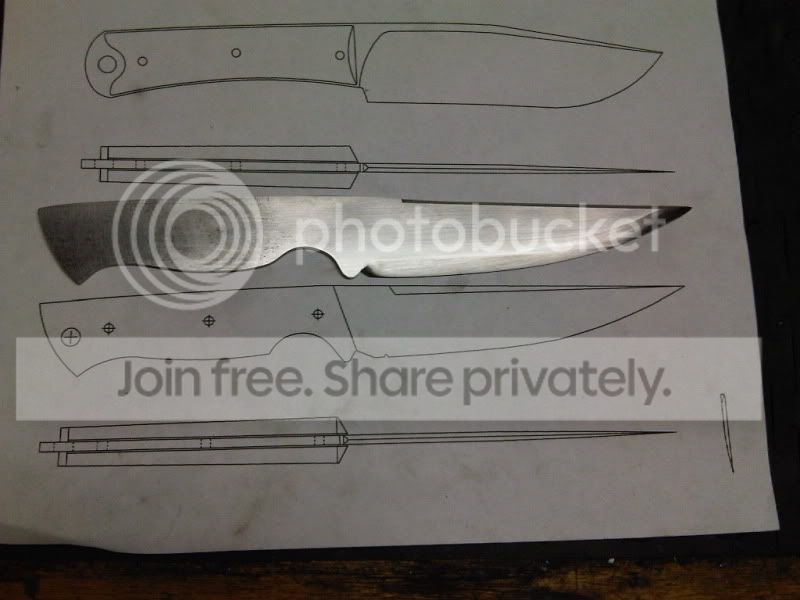
Here's the blade profile ground.
Blade2-Template.jpg


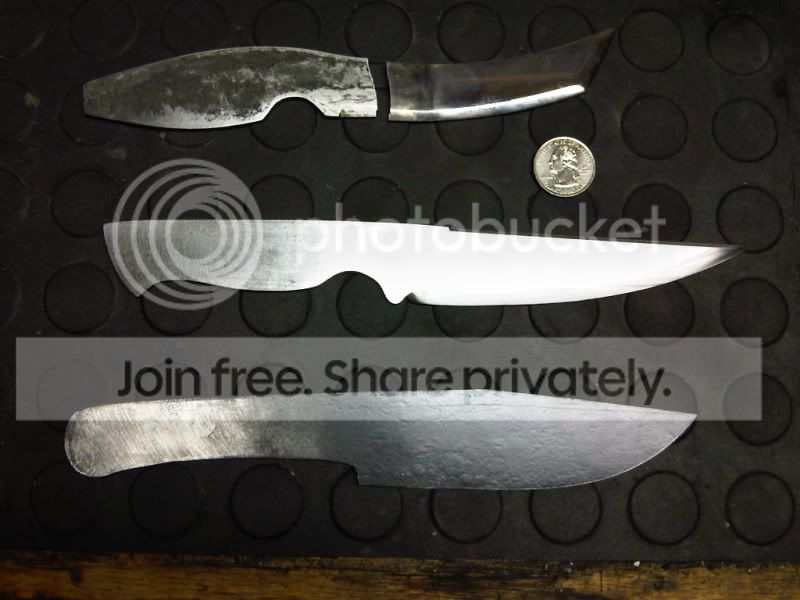
Blade in question is in the center. Blank on the bottom is my second blade which is detailed later. Blade on top was an experiment that failed - I tried to straighten a slight warpage...before tempering. Yup - SNAP! Bladsmth set me straight on that affair.
NewBlades.jpg


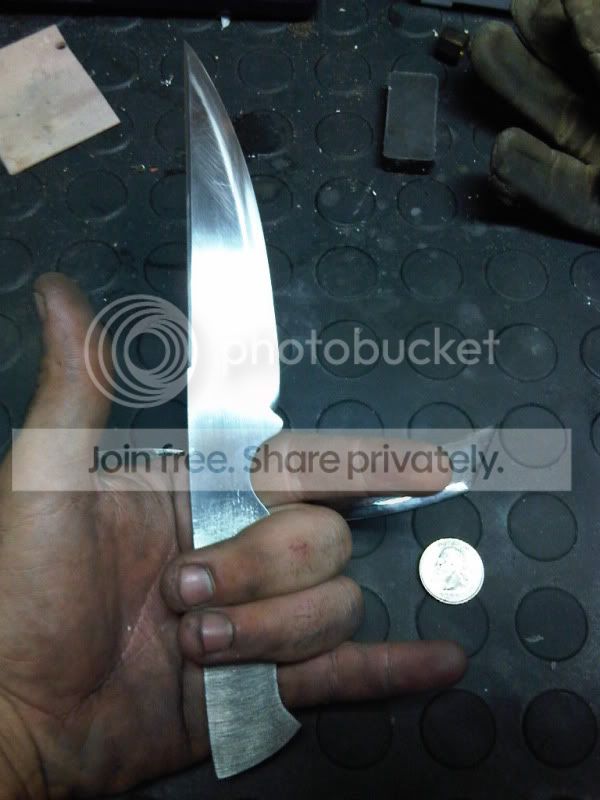
Here's the blade in my (dirty) hand just prior to heat treat.
Blade2-Fit.jpg


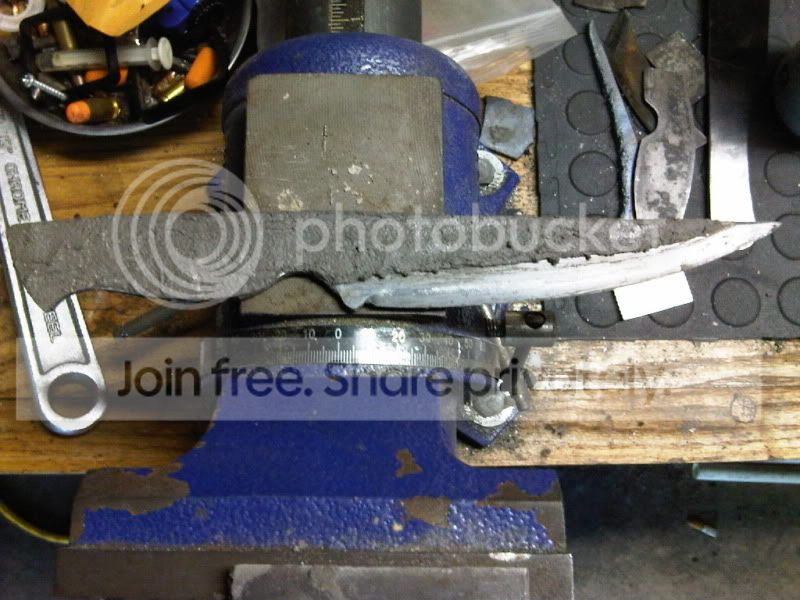
Here's the blade all clayed up and ready for heat treatment. Bladsmth was again instrumental in getting this one done properly! (Thank you again guy!)
Blade2-RightSide-Clayed.jpg


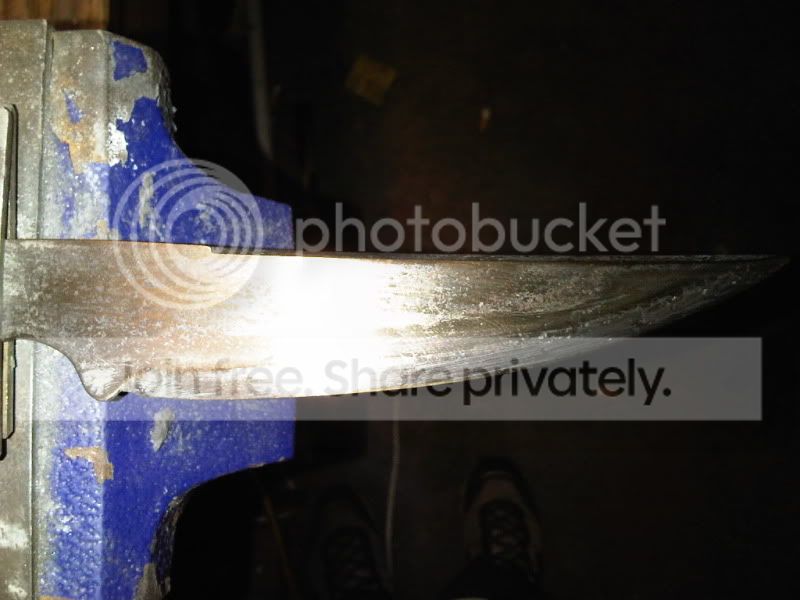
Blade just after tempering. The majority of the blade has a straw-colored oxidation on it (~450degF), while the blade edge had a more spring-blue temper (which worried me a little). I've adjusted my tempering temp to avoid this on the second blade.
Blade2-RightSide-Tempered.jpg


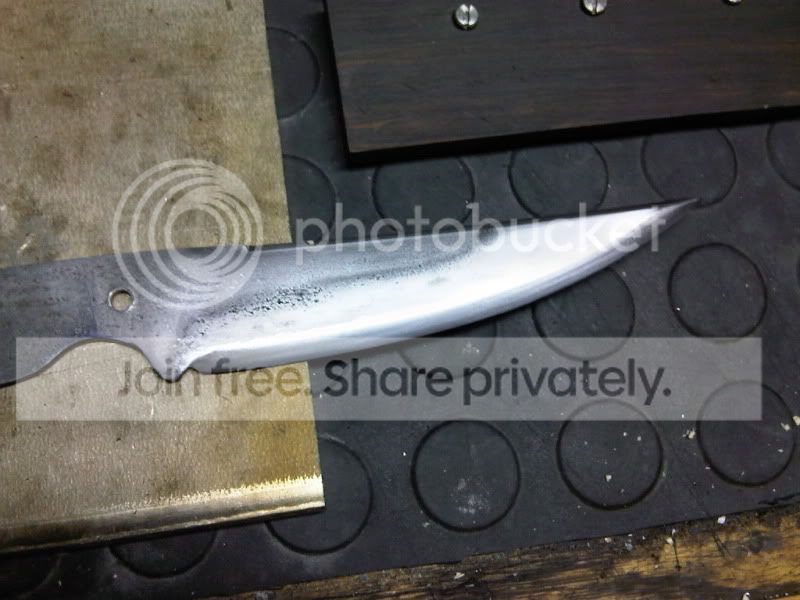
Here's the blade after playing with a Ferric Chloride etch and polish. The effect of FeCl was interesting, but was a little too monochromatic for me so I started over again at 240g and polished back to 1200g, then gave it an Apple Cider Vinegar etch. Effect of the vinegar was a LOT more to my liking! Brought out a lot more hamon detail.
Blade2-RightSide-FeClEtched.jpg


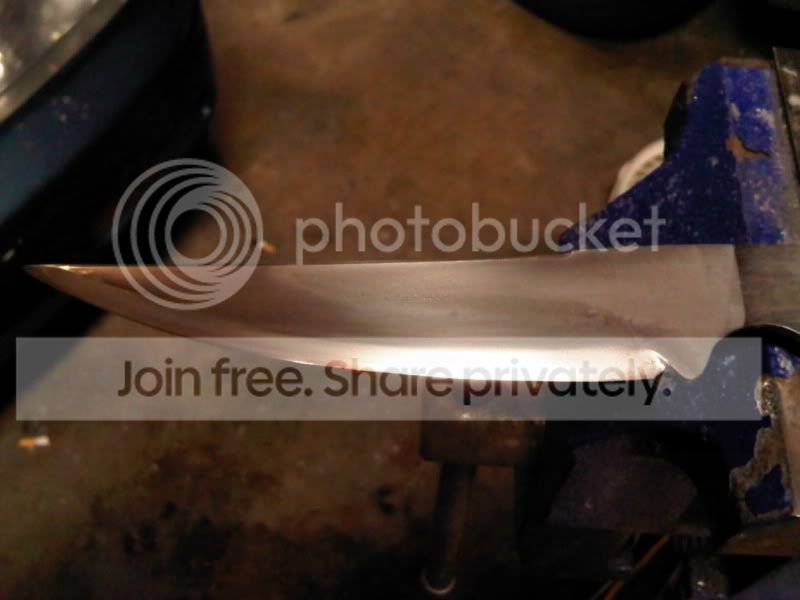
Here's the blade after an initial Apple Cider etch. I hit it with simichrome, etch, simichrome, etch, etc for about 20cycles. I was using a 50/50 mix of water & vinegar and warmed it, and the blade, on my stovetop. Warm (140deg-ish) vinegar was applied to the blade with a cottonball.
Blade2-LeftSide-FaintHamon.jpg


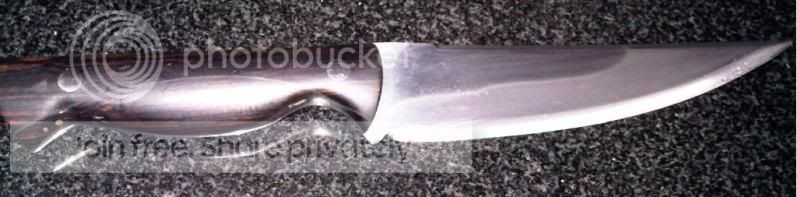
And in the end I "tossed on" the cocobola scales, ground to fit, polished, and here's the end result of about 30hrs of labor. (The pics don't do the blade any justice. The hamon line has a nice silver line on the blade that looks like it wants to jump off the blade, with some slight irridescence on the spine-side of the hamon line. I'll get some better pics up when I have my other camera).
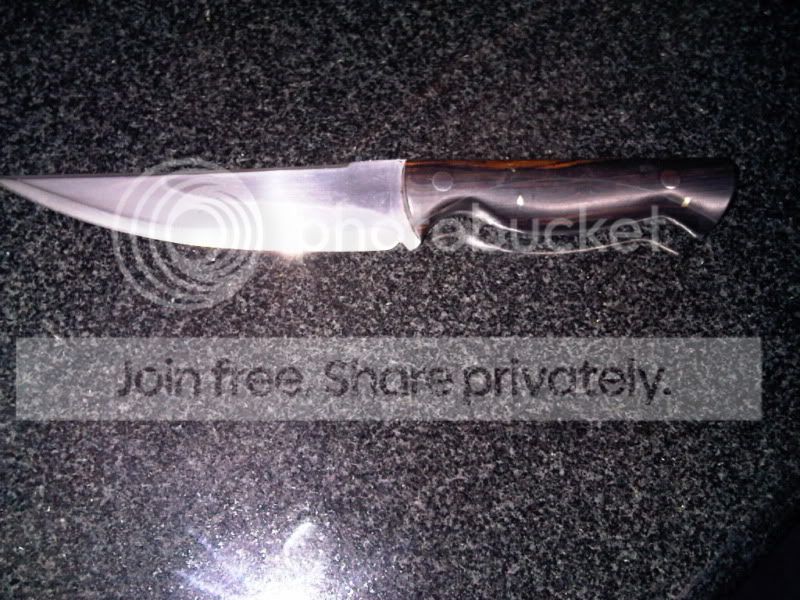
Blade2-RightSide-Finished.jpg


Blade2-LeftSide-Finished.jpg


To me the blade looks beautiful, but it's not without flaws. I still need to sharpen it, I'm still working on my profile-grinding technique (it would look better with an actual flat-grind), and I won't do what I did on the handle again. If you look carefully you can see the ends of little brass pins in the handle. I wanted to have a bit of spacer material look like an inlay, so I cut the scales in half and glued them back together with black spacer material in between. I used little brass pins to help hold the peices of scale together while the epoxy cured. During grinding/sanding of the handle I removed too much material and hit the brass pins. The brass clashes with the bright blade and SS corby bolts too much. The effect of the faux-inlay is neat, but flaws the handle if ground too deep. Oh well - learning experience.

Second post will be about my second blade...
 
Now - the second blade (which is currently in the tempering oven finishing its seond 2hr temper cycle).

This is the same blade seen in the very first photos above - the wider drop-point fighter looking blade. The blank can be seen above, but I didn't snap any photos of the blank after profile grinding.

With the success of the hamon on the first blade above I went ahead and tried something a little more flamboyant. This would bite me in the ass it seems...

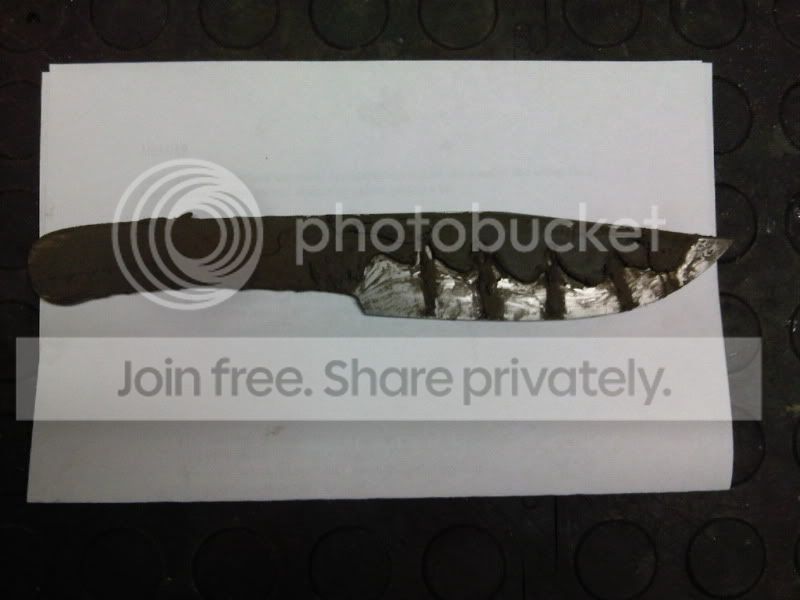
Here's the right side of the blank clayed up and ready for heat treat.
Blade3-RightSide-Clayed.jpg


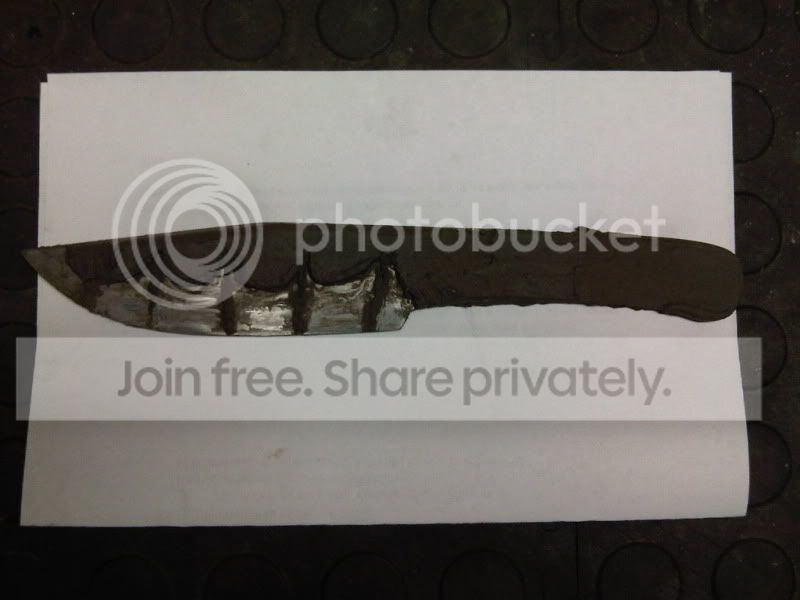
And here's the left side clayed up.
Blade3-LeftSide-Clayed.jpg


As you can see the hamon should have a more "flame-like" effect if successful. The narrow lines of clay extending from the hamon area to the blade edge were my attempt at Ashi lines. Turns out the damned refractory clay I'm using is both too thick and gritty for fine detail. Even when I watered it down a little to spread it better it flowed too much for sharp ashi lines. I need to try some satanite or rutland's stove cement next time. The clay lines are also not 100% symmetrical on either side of the blade. I tried to get them exact, but they were still off by 1/16" to 1/8". This also may have come back to bite me in the ass as you will see later.

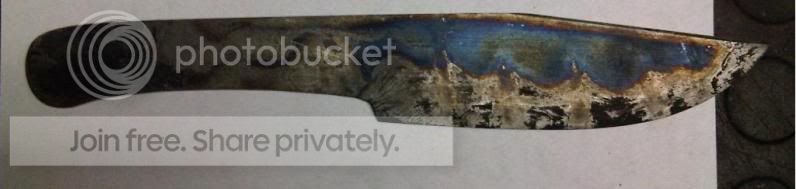
Here's the blade just after heat treat and prior to temper. You can get an idea of the hamon by looking at the blue tempered area. I heated the blade to 1,475 in my forge, soaked it for 5mins or so, then gave it an interrupted quench in 100deg brine. When I did the quench on my first blade above I held it in for 5sec, pulled it out for 3sec, then back in until cool. Turned out the hamon line jumped up under the clay line by 1/8" or so. To avoid this on this second blade I queched it in brine for 3sec, out for 3sec, then back in until cool. On both blades I used the same forge temp, same brine temp, but altered the interrupt timing since Bladsmth stated that a slight variation in your timing will have a major effect on the hamon. He was right.

Blade3-RightSide-Quenched.jpg


Blade3-LeftSide-Quenched.jpg


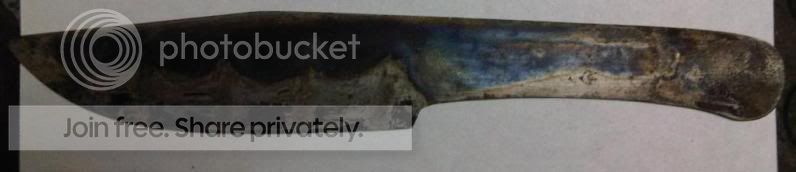
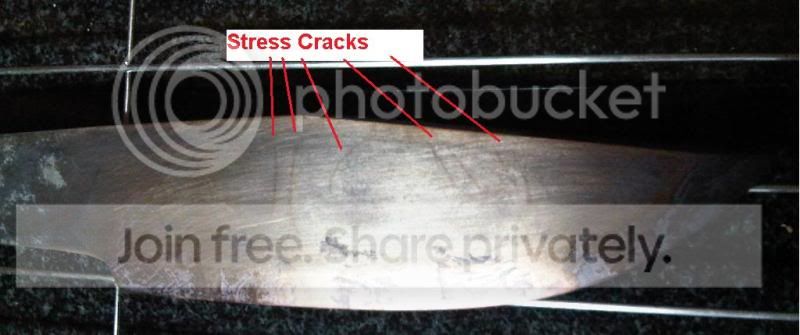
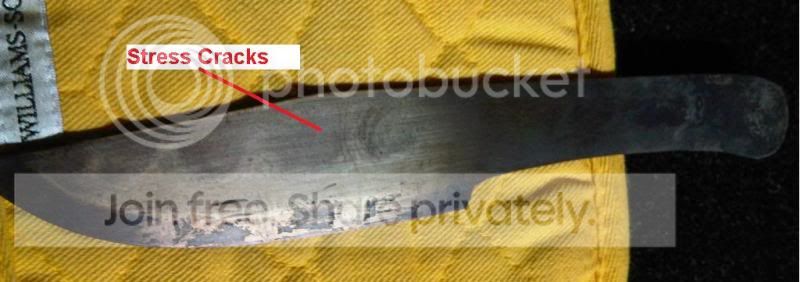
Here's the blade on it's first cool-down cycle after first temper. (I temper for 2hrs @ 450deg, 30min cooldown to room temp, another 2hr temper @ 450deg, and then a final cooldown. It's in my oven right now finishing its second cycle). Here's where it gets interesting. When I was scraping off the clay after the quench I noticed some swirl marks that look like surface cracks. When I saw this my heart hit the floor. I was hoping for the best, but after the first temper these surface cracks became more apparent as the heat highlighted a fair bit. They can be seen below in the pics as faint, brown, hair-line fractures.

Blade3-RightSide-Tempered.jpg


Blade3-LeftSide-Tempered.jpg


My question is are these cracks fatal? I'm not sure of their depth and am hoping that they'll get removed during the polishing stage, but I'm not holding my breath. I didn't bang the blade around just prior to tempering, and I scuffed it as light as I could with 220g to get some bare metal exposed so I could see the oxidation color, so I'm assuming these cracks were caused by the clay not being completely symmetrical. Next time I won't make such dramatic waves in the clay.

Has anyone had any luck with these cracks not compromising the whole blade? I can see the hamon right after I hit it with 240g, so the it's going to look pretty damn neat when polished up!

Thanks all for taking a look!
 
Are you sure they are cracks?? They do not make sense to me. The area under the clay should have not had a problem. I guess they could have traveled from the hard portion but they still do not make sense. What grit did you finish the blade to prior to HT? I would recommend taking it to 150 grit. You need not go above that but this will prevent stress risers. I did not see what you quenched them in. What are you using as a medium? I am still perplexed by the positioning of the cracks. I can only assume they were there prior to HT. That is the only explanation that makes sense to me. I have had one blade spiderweb on me. But I am pretty sure it was because it was an over stressed spring. This is the drawback of using used material. Another question is were did the steel come from? are you sure it was 1095? Hamons are a bear. They are much more difficult than making damascus. Keep trying, it is addictive.
 
Well, 3rd knife is a complete failure. After 2nd temper I hit it with the grits (up to 1200) and then a couple of quickie FeCl etches to see if there was anything worth developing.

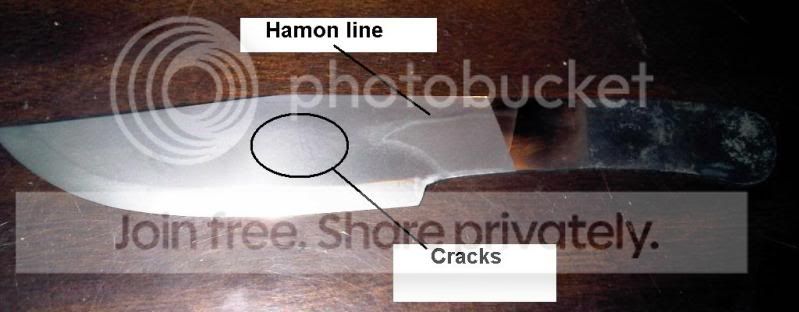
Turns out there isn't. At all. The hamon jumped all the way to the tang! I screwed up royally somewhere...or maybe this particular blank was a little higher on the carbon than the other. (I got four 1095 blanks from Texas Knifemaker's Supply here in Houston. Perhaps I'll try some 108x instead. I have one more blank so we'll see what happens). Here's the 3rd knife after etches and a number of polishes with Flitz:

Blade3-FailedHamon.jpg


I have no idea how the hell the hamon line jumped all the way back there. the rest of the blade has that hazy, satiny, stainless steel look like the whole blade got hardened. Did a file test just after quenching and it skated on the blade edge, but not on the spine. Did it again after temper and it bites into the blade edge and spine the same. Might have screwed that up as well. (My temper oven currently has an accuracy of +/-50deg. Need a toaster oven).

The medium I used to quench was a 10% brine - same medium I used on the first blade and came out ok. The only thing I did differently was make a different clay line for the hamon, and alter my quench timing (previous knife was 5 sec in, 3 out, then back in until cool. For this 3rd blade I did 3sec in, 3 out, and back in until cool).

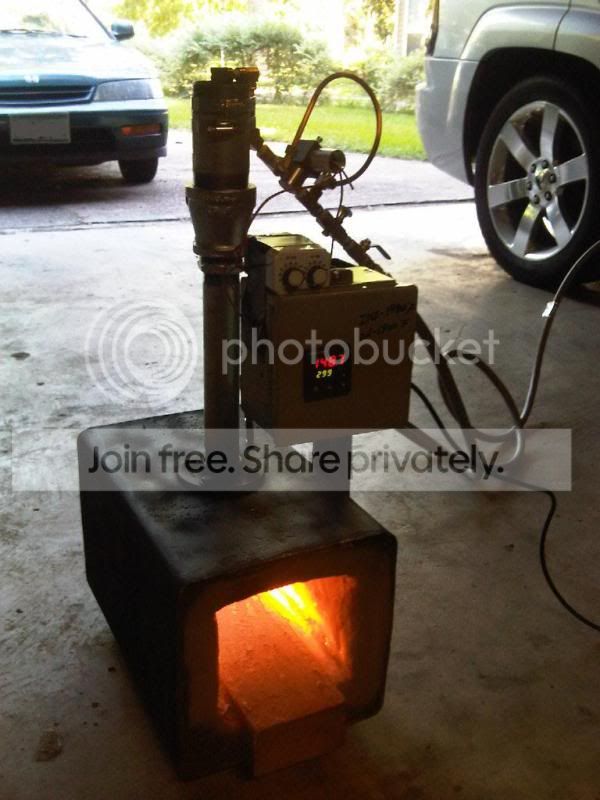
My forge is a PID controlled propane unit I built a couple weeks back:

Forge3.jpg


In the forge I'm using a 3" muffler (exhaust tubing) to even out the temps a bit, and a second PID contoller with remote K-type thermocouple to monitor the interior temp of the muffle. Again, worked perfectly like last time.

There are definitely pronounced surface cracks on both sides of the blades. I'm guessing that my upstrokes in the clay were too drastic and stressed the metal between the upstrokes too much, and they cracked. (The cracks flow through the areas between the upstrokes in the clay). There's also a major surface crack on the tang that runs perpendicular to it.

Time for the next one! Running a 33% success rate...which I hear is pretty typical.
 
im puzzled?? i have never had 1095 do that to me i use it daily,well i lied one time it did,with a water quench hehehe,you need a forge life would be much easier on you doing hamons,i dont know if this will help heres some pics of mine, im far from a know it all but this may help

http://www.bladeforums.com/forums/album.php?albumid=877

Nice blades! Love the hamon lines! My very first failed blade had a clay thickness of around 0.25". Had a pretty pronounced hamon line after an ATF quench, but it didn't like a brine quench too much. I was then told that I would have better results with a thinner layer of clay (1/16" to 1/8") and an interupted quench (5sec in, 3 out, back in until cool). Used it on the the second blade (or what I refer to as my first successful blade). How thick is your clay and what are you using? Is that steel 1095? Are you quenching in oil, water, or brine?

I might back off the brine for awhile and see what I can get with my can of ATF. Also need to switch to a clay that's a little more "hamon friendly". The stuff I use now (furnace mortar) works well for straight-line suguha hamons, but is a pain to form complex clay lines. I'm also going to ease up on the drastic clay line and go back to something a little more subtle. Pretty sure the major upstrokes in the clay caused some serious stress issues.

Too many combinations....this is going to take some time to sort out hehe! :D
 
My guess would be too much clay and/or too hot . The heat problem could explain the cracks, too.

BTW, you should have triple normalized the blade prior to HT by cycling down to sub critical. This will produce a fine grain with no stresses.

Put a wash of clay over the entire blade. Then put an 1/8" of clay to form the hamon . The hamon line will be somewhere just behind the edge of the thicker clay, so don't get too far back . Your blade has the clay way too far back in my experience.

As to the clay, I recommend satanite. That furnace cement you used looks way too thick and heavy. It probably lifted off the blade in the quench.

Set your forge to 1450 F and let it run for 15 minutes to heat the lining ( this is always important for any HT). Apply the clay as suggested and let it dry well before HT. Bring the blade up to heat, avoiding having the flames shoot directly down on it. After five minutes, shut off the gas and let the blade sit for one full minute before removing it and quenching in the 120-130 F brine. The one minute soak in just the hot oven will assure that the blade is not super-heated by the flames.The hot liner will maintain the 1450F temp just fine for the 60 seconds. If it drops in temp a bit, that is fine. If you have a good quality laser pyrometer, you could check the forge temp when the flame is off to see how accurate it is to the PID setting.
Using a muffle is also a good idea.

Lets talk about what is happening in the blade when you quench it in brine -

Here is a description of some of the structures we are dealing with:
Austenite This phase is only possible in carbon steel at high temperature. It has a Face Center Cubic (F.C.C) atomic structure which can contain up to 2% carbon in solution.

Ferrite This phase has a Body Center Cubic structure (B.C.C) which can hold very little carbon; typically 0.0001% at room temperature. It can exist as either: alpha or delta ferrite.
Cementite Unlike ferrite and austenite, cementite is a very hard intermetallic compound consisting of 6.7% carbon and the remainder iron, its chemical symbol is Fe3C. Cementite is very hard, but when mixed with soft ferrite layers its average hardness is reduced considerably. Slow cooling gives course perlite; soft easy to machine but poor toughness. Faster cooling gives very fine layers of ferrite and cementite; harder and tougher
Pearlite A mixture of alternate strips of ferrite and cementite in a single grain. The distance between the plates and their thickness is dependant on the cooling rate of the material; fast cooling creates thin plates that are close together and slow cooling creates a much coarser structure possessing less toughness. The name for this structure is derived from its mother of pearl appearance under a microscope. A fully pearlitic structure occurs at 0.8% Carbon. Further increases in carbon will create cementite at the grain boundaries, which will start to weaken the steel.
Martensite If steel is cooled rapidly from austenite, the F.C.C structure rapidly changes to B.C.C leaving insufficient time for the carbon to form pearlite. This results in a distorted structure that has the appearance of fine needles. There is no partial transformation associated with martensite, it either forms or it doesn't. However, only the parts of a section that cool fast enough will form martensite; in a thick section it will only form to a certain depth, and if the shape is complex it may only form in small pockets. The hardness of martensite is solely dependant on carbon content, it is normally very high, unless the carbon content is exceptionally low.


As the 1095 steel is heated changes occur in the structure. As it crosses 1400F it converts into austenite. This sits at 1450-1475F for five to ten minutes to allow all the excess carbon to get distributed.
If the temperature lowers after this soak, nothing happens until it crosses about 1350F. At that point the austenite would convert back into cementite and ferrite, which would form pearlite. If the cooling rate drops fast enough, however, the austenite is super-cooled and does not convert. To do this we have to drop 1095 from about 1400F to below 900F in 0.7 seconds. That is why brine is used. Fast oil will do it,too, but for obtaining a hamon, the more rapid rate is often needed on the heat shielded blade (clay coating).

Once below this "pearlite nose" the supercooled austenite is pretty stable for a while. But, when it reaches 450F a rapid and violent conversion takes place as the FCC austenite instantaneously converts into BCC martensite. Where this happens it happens all at once....where it doesn't happen you get pearlite...... where the two meet is the hamon. In the hamon some of the martensite needled are sticking into the pearlite, creating the ghostly look.

Now, this conversion from FCC to BCC is not only rapid ( at the speed of sound) but also has a change in volume. This movement causes the sori to form on a sword....warping of blades....and the cracks to form too. Having the quenchant warm helps, having the steel as close to 1350-1400F as it enters the quench,and praying to whatever Deity you favor are all equally important to ending up with a lovely hamon, a straight blade, and everything staying in one piece. (those vertical notches in your clay coat were probably the source of the cracks, as they made places for stress to pull the metal apart)

This contrast of structures and temperature differences between the hard,brittle martensite and the softer and hotter pearlite under the clay can pull the blade apart. To avoid this and allow the desired structures to form where we want them the brine quench is "interrupted". The blade is quenched for a period long enough to get the edge to form martensite (.7 seconds) plus enough time to drop the edge and part of the rest to a temperature between 900 and 500F. This will ease the stress of the conversion when the edge reaches 450F. The blade is then placed back into the quench to finish cooling. This "Interrupted quench" usually goes something like IN-1-2-3-OUT-1-2-3-IN to cool. It takes some experimentation to get the quench timing right.

Quenching in fast oil will work, and may get a hamon , but the contrast could be less bold. Using ATF will probably get you a blade that is mainly pearlite, as it is not a fast enough quenchant to miss the pearlte nose.
 
Good info! Deffinitely some food for thought there.

On my setup I was indeed using a muffle, and I let the forge stabilize at 1450 to 1475 before putting the blade in. The clay on the blade was left to dry for a period of 2 days to make sure it wouldn't puff up or spall off, but I think you're right - the clay might have lifted in the quench.

I wasn't very explicit in the full heat treat I did on this blade. Before cutting the blank out of the bar I annealed the bar @ 1500, left it in the forge, capped off the ends with cermic wool, and then let it come to room temp.

After profiling the blade, and just prior to quenching, I gave it a good 3-step normalize to ease the stresses. 1st @ 1600, then air cool. 2nd @ 1450, then air cool. 3rd @ 1300 and air cool. I knocked off the decarb, sanded to 240g, and coated the blade with clay.

Next time I won't get so ambitious with the clay line and I'll be using Satanite. This stuff I have has the consistancy of junky peanut butter and is a pain to get it to spread properly. I'll leave it for straight hamons LOL!
 
yeah i always hold my blades edge up moving them blade back and forth threw the forge till it becomes nonmagnetic them staight into the quench, if you heating the blade on its side you heating the intire blade even though the uncoated part of the blade gets hotter it makes the hamon move either up or back making it not a hamon no more just a round spot were it was the coolest on the steel
 
yeah i always hold my blades edge up moving them blade back and forth threw the forge till it becomes nonmagnetic them staight into the quench, if you heating the blade on its side you heating the intire blade even though the uncoated part of the blade gets hotter it makes the hamon move either up or back making it not a hamon no more just a round spot were it was the coolest on the steel

I do the same - edge up. I need to make a little holder out of some low-carb steel to hold the blade vertical in the forge. For the moment I just stick my tongs in a bit, open the jaws, and use it to keep the blade upright. No problem with this method...but the tongs do get a little warm hehe.

I ordered 5lbs of satanite, and a pint of APG #36 for good measure. Will try them both before ordering larger quantities. I also put in a nice order for some quality 1095 with Aldo.

On another note - I hardness tested both blades today. On my first successful blade (the only one in the pictures above WITH a handle) the spine came in at 34HRC, and the blade 58 HRC. The most recent failed blade measured 61HRC all along the blade except behind the hamon line waaaaaay back on the tang. Behind the hamon line it came in at 35HRC. The clay deffinitely came off during quench!!
 
Back
Top