I have a question for all you guys out there. I love tanto style blades, and own several knives with the style. The knife in question is a crkt m-16-14D. It has a grind on only one of it sides, and what looks like the slightest bit of a grind on the other side. By grind, I mean the angle that the blade is sharpened at I guess. Someone feel free to correct me on terminology. My question is is it possible to resharpen the blade so that it is ground down on both sides? I would have to somehow grind the serration as well I guess, but that's the question. If anyone knows the benefits or disadvantages of the different types of grind, I would love to hear about it. Thanks.

-
The BladeForums.com 2024 Traditional Knife is available! Price is $250 ea (shipped within CONUS).
Order here: https://www.bladeforums.com/help/2024-traditional/
You are using an out of date browser. It may not display this or other websites correctly.
You should upgrade or use an alternative browser.
You should upgrade or use an alternative browser.
Tanto Blades
- Thread starter buds007
- Start date
- Joined
- Sep 5, 2005
- Messages
- 2,826
Yes, lots of us that have CRKT knives have complained about this. Alas, it is as it should be. Chisel grinds are ground on one side. Knivesplus reports:
We have recently had a few returns on knives from customers who think the knife or knives they received are defective. The reason for return is that they feel the knife was not sharpened properly. One note in a returned package from our customer stated: "the factory failed to sharpen both sides of the edge properly." Upon receiving these knives back for inspection it was determined that the edge was properly sharpened and what the customer was seeing as a defect was in fact a chisel ground edge.
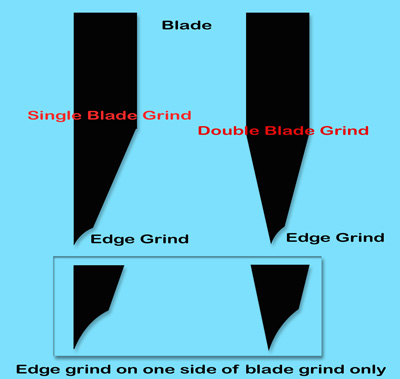
Single blade grind: this bevel/grind has a blade grind on one side of the blade only. The opposite side of the blade is flat all the way to the cutting edge and the edge grind is only on the beveled side. This is the standard and true configuration of a chisel grind.
Double blade grind: this bevel/grind had a normal double blade grind where only one side has an edge grind. This is a new configuration of a chisel grind and really isn't a true chisel grind but has the single cutting edge grind configuration. The edge on both styles may be polished on the back side and appear to be ground but usually isnt.
www.knivesplus.com/knivesplus-faq.html
We have recently had a few returns on knives from customers who think the knife or knives they received are defective. The reason for return is that they feel the knife was not sharpened properly. One note in a returned package from our customer stated: "the factory failed to sharpen both sides of the edge properly." Upon receiving these knives back for inspection it was determined that the edge was properly sharpened and what the customer was seeing as a defect was in fact a chisel ground edge.
Single blade grind: this bevel/grind has a blade grind on one side of the blade only. The opposite side of the blade is flat all the way to the cutting edge and the edge grind is only on the beveled side. This is the standard and true configuration of a chisel grind.
Double blade grind: this bevel/grind had a normal double blade grind where only one side has an edge grind. This is a new configuration of a chisel grind and really isn't a true chisel grind but has the single cutting edge grind configuration. The edge on both styles may be polished on the back side and appear to be ground but usually isnt.
www.knivesplus.com/knivesplus-faq.html

- Joined
- Jun 2, 2007
- Messages
- 1,354
A true chisel grind according to the master that developed it correctly, is ground on one side and DOES NOT have a secondary bevel like the one pictured in the photo above. A lot, if not most makers that make a chisel grind blade put a secondary bevel on the blade which prevents the blade from being as screaming scarp as it could be if properly ground with no secondary bevel. This type of ZERO grind as people call it must be sharpened working the entire bevel and laying the bevel completely flat if sharpening by hand. 
Depending on who heat treated the blade, a disadvantage of a chisel ground blade might be somewhat fragile and should not be used as a pry bar. When you cut a piece of wood, do not use a side to side rocking motion as that can also damage the edge much quicker than a blade that's symmetrically ground. But again, it depends on the heat treaters ability.
When properly ground, this type of true chisel ground blade is EXTREMELY Sharp.
Depending on who heat treated the blade, a disadvantage of a chisel ground blade might be somewhat fragile and should not be used as a pry bar. When you cut a piece of wood, do not use a side to side rocking motion as that can also damage the edge much quicker than a blade that's symmetrically ground. But again, it depends on the heat treaters ability.
When properly ground, this type of true chisel ground blade is EXTREMELY Sharp.
- Joined
- Sep 5, 2005
- Messages
- 2,826
Thanks, Leu. That was the only comparitive chart that came up when I Googled it. I neglected to say that many of us have found the best way to sharpen a primary-only chisel grind blade is to just sharpen it as we would a standard V-grind blade. Given my best efforts, I've found no special instructions packed with either CRKT's Slidesharp, nor Spyderco's Sharpmaker knife sharpeners.
I've come more greatly appreciate good V-grinds.
I've come more greatly appreciate good V-grinds.
- Joined
- Jun 2, 2007
- Messages
- 1,354
Come to think of it duh! When you have a V Grind that is also sharpened with no secondary bevel, it's every bit as sharp as a chisel grind and less messy to sharpen than a chisel grind which would be somewhat scratched up on the flat side. most people would just end up putting a secondary bevel on the backside eventually.

- Joined
- Aug 24, 2007
- Messages
- 43,271
A true zero grind, chisel or "V" ground, should be sent back to the maker for sharpening unless you have the skill to do this yourself. Most folks can't. I was told this is the main reason more knives are not made with the zero grind- too hard for the owner to sharpen. Man, I love em!
Lycosa
Lycosa

- Joined
- Sep 5, 2005
- Messages
- 2,826
So why do companies use chisel grind blades to begin with? CRKT uses CG on all of its serrated blades, then it sells a popular sharpener with guides that won't sharpen most of its knives! The only way to get one of those sharp is to sharpen both sides.
Also, if I were going to have a CG on a knife, I'd like to have the bevel on the other side. I love V-grinds.
Also, if I were going to have a CG on a knife, I'd like to have the bevel on the other side. I love V-grinds.
- Joined
- Aug 24, 2007
- Messages
- 43,271
Most folks don't like chisel grinds. For utility, you want a V grind. A chisel grind will pull when cutting. Another reason people don't like them is aesthetics, they're ugly, you'll hear. Beauty is in the eye.... The chisel grind came about as a simple design; to make and sharpen. Once you begin to understand them, the more you will like them.
Lycosa
Lycosa
- Joined
- Jun 2, 2007
- Messages
- 1,354
Sorry for not reading the thread completely, but does your chisel grind have a secondary bevel or not? if it does, then you'd sharpen it like any other blade. If it has no secondary bevel, you'd have to work the entire bevel that has been ground and strop or do a very light pass on the flat side and lift up the blade just a slight bit so you don't scratch up the flatside.
- Joined
- Sep 5, 2005
- Messages
- 2,826
After all is said and done, I still fail to see the advantage of the chisel grind. V-grinds can be quickly and efficiently sharpened by virtually any sharpening system available. Also, if one is right-handed, the knife will be held in the right hand with the ground portion underneath. Thus, what you're cutting will be limited in the angles used in cutting. If you're trying to shave thin slices of wood for kindling, won't the ground portion of the blade slide all over the area you're trying to cut? Wouldn't it be better for the ground part of the blade were facing up? Isn't that how one would use a chisel, flat part down?
Only a few sharpening systems will sharpen chisel grind knives, and those that do require that you clamp the blade and go through an inconvenient setup. Most, I think, would prefer a few swipes over ceramic rods.
Or am I missing something?
Only a few sharpening systems will sharpen chisel grind knives, and those that do require that you clamp the blade and go through an inconvenient setup. Most, I think, would prefer a few swipes over ceramic rods.
Or am I missing something?
- Joined
- Jun 2, 2007
- Messages
- 1,354
Ground for a right handed person, a chisel grind would have the bevel on the right side of the blade with flat side to the left. Now if you had it ground so you could do some sort of reverse draw, then you'd grind the bevel on the left hand side of the blade with flat side to the right.
chisel grind, V Grind, it really doesn't make a whole lot of difference as when you tilt the chisel grind a little, it's like you're now cutting with a V ground blade as the wood does not know whether you're using a chisel grind or v grind. The only advantage of a chisel grind (when ground correctly) is that it only has one point of drag where the bevel becomes the flat on whatever side it's ground on. The flat side has no drag at all as it's FLAT! Some people think it makes a lot of drag, but they are WRONG!
Add a little swedge on the backside of the spine that stops just a short of where the blade makes a drastic curve, and now you've got a blade that will practically penetrate byself once the blade is trusted past the point where the swedge starts as now there is no resistance stopping the blade.

chisel grind, V Grind, it really doesn't make a whole lot of difference as when you tilt the chisel grind a little, it's like you're now cutting with a V ground blade as the wood does not know whether you're using a chisel grind or v grind. The only advantage of a chisel grind (when ground correctly) is that it only has one point of drag where the bevel becomes the flat on whatever side it's ground on. The flat side has no drag at all as it's FLAT! Some people think it makes a lot of drag, but they are WRONG!
Add a little swedge on the backside of the spine that stops just a short of where the blade makes a drastic curve, and now you've got a blade that will practically penetrate byself once the blade is trusted past the point where the swedge starts as now there is no resistance stopping the blade.
- Joined
- Jun 2, 2007
- Messages
- 1,354
What's to study? The pointy end goes into the bad guy! lol