"Temper-line" on axes

Joined
Dec 20, 2015
Messages
1,677
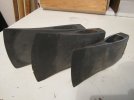
A seemingly simple question-what Exactly(in metallographic terms) is this,such sharply defined line on many axes?

And another less definite q.,to what type of quenchant,heating method,or any other particulars of an HT method can this be attributable?(barring just plain ol' bimetallic juncture,some rather identical-looking effects being just that).

The photo was taken at random,but this effect is rather common;normally it becomes visible after a mild etch.Thanks in advance to anyone who may have any ideas on this.
5555.jpg
 
My guess (and it's just a guess) is that they are made of two different metals, probably a mild steel body with a high carbon insert.

Another way would be to edge quench, then use the residual heat in the body to temper the edge...

Like I said though, these are just guesses
 
If you clean up the bottom or top edges, you can see the hard steel extend further into the body beyond the line on the sides.
 
My guess (and it's just a guess) is that they are made of two different metals, probably a mild steel body with a high carbon insert.

Yes,some are definitely composite...And sometimes it's very difficult to call,too,for aside from the usual methods of inserted bit(a cleft-weld of whatever sort)they used some odd,one-off "patented" electric welds,surprisingly early in history...

But some are known to be a monosteel forging...And as you say,almost definitely differentially HT'd...
And so,if as you say further they were "auto-tempered",is that what you think has caused the visible line to be so curved?

Thank you for your input,it's a weirdly tricky issue...
Historically the tool-making industry has favored low-alloy medium-carbon steel for axes.So That contrasting of a line is somewhat surprising...and the curvature is also kinda odd..
 
If you clean up the bottom or top edges, you can see the hard steel extend further into the body beyond the line on the sides.

Yes,this is what my own assumption was,to look for the traces of a cleft-weld of either kind("in-laid" or "over-laid" bits were both common,the latter more so in US manufacturies).
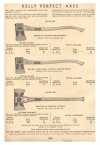
But then i was alerted to a number of variants of an electrically accomplished butt-weld techniques...Here's an example in a scan from 1939 Kelly Mfg.:
Simmons Keen Kutter Catalog 1939 Part_0145.jpg
Note the paragraph in the top left corner...The "line" is also present in their drawings,if one looks close...albeit it's straight across...
 
Yessir,it is...But as funky as composites used to get,and as hard as they're to i.d. at times,there seems to also have always been the mono-alloy axe heads,the last few decades increasingly so.

So what would cause a,say,1050-ish alloy to "auto-hamonize" for lack of better term to such a degree of abruptness of transition?
From what i gather those knifemakers that deliberately strive for a visible transition line work at it quite hard,and it involves both the strict HT sequence as well as a fairly high degree of finish.
And here we see an oddly stark visible demarcation,and a two-tone one at that...Should there not be some transitional area somewhere in between the (presumed)tempered martensite and ...(whatever the other side would be),and all of it at 80 grit or whatever,with only a very casual vinegar etch?
 
Back
Top