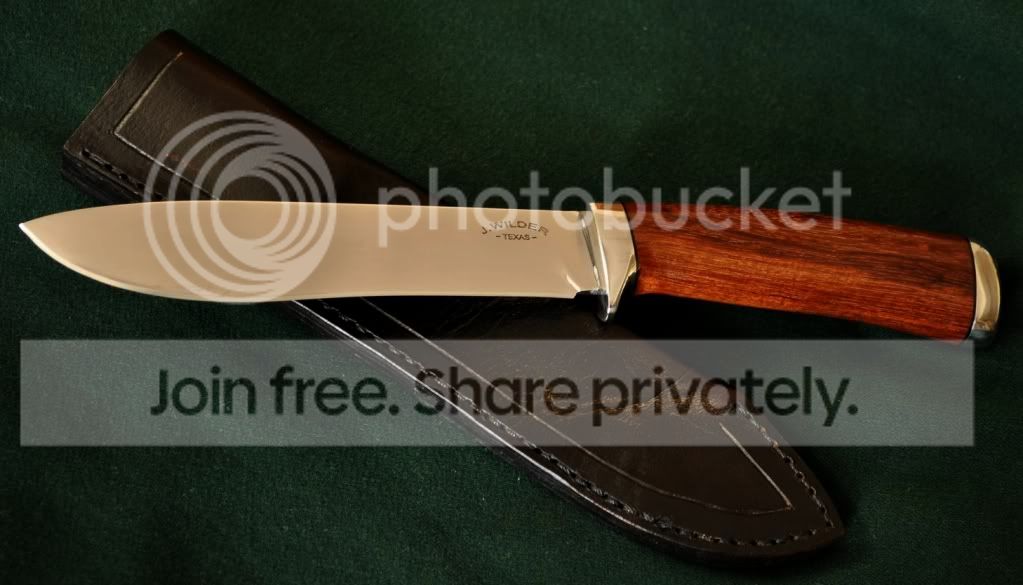
Texas Butterknife WIP

Joined
Jun 27, 2006
Messages
2,331
I love seeing other WIP's and know this is nothing like Nick's, but I'll post it anyways.

It started with a bar of 1/8"x1.5" ATS-34. I didn't have a design in mind. I just let my muse take me wherever she pleased and this is what I came up with at first.
6inHiddenTang001.jpg


I really didn't like the design all that much and asked for suggestions HERE

After a bit of playing on the Craftsman 2x42, this is what I came up with
100_3106-1.jpg


I know you're supposed to draw the design first and shape the blade second, but I did it backwards.
NealsKnife001-1.jpg


I drilled out 1/8" holes in the SS guard and I am filing it out here to get a good fit
100_3124-1.jpg


I am not good at eyeballing dimensions, so I scribed lines on the under side of the guard to get a rough shape.
100_3128-1.jpg


Pressure fitting the guard onto the tang. Sorry I didn't get any pictures of me filing down the shoulders of the blade.
100_3125-1.jpg


good fit
100_3127.jpg
 
The man I made this knife for sent me a box of Brazilian Rosewood that was cut down about 100 years ago. I chose one of these for the handle
100_3122.jpg


100_3123.jpg


I sent the blade to Heat Treat at Texas Knifemaker's Supply and it is ready to sand. I had machined sanded it to 400 before the HT so there won't be as much sanding afterwards

I put it back on the Craftsman 2x42 to knock the scale off and get back to 400
100_3109.jpg


Hand sanding using a piece of G10 as a backer and WD40 as Lube. I went through 320, 400, 600, 1500 then to the buffer.
100_3116.jpg
 
Last edited:
Now is time to shape the hardware. The guard is shaped on the disk grinder. Thanks for the advice to use duct tape to hold the little buggar still!
100_3134.jpg


At this point the tang is too straight to have any angle to the handle. I heated the tang and bent it on the vise. It was about 2AM and I woke the wife and kids with the slight banging :foot:
100_3132.jpg


I didn't get any pictures of the next step, but I welded 1/4" all thread onto the end of the tang. I used the OxyAcet rig int he background to weld the pieces together.

The butt cap is 1/4" and drilled half way through then tapped with 1/4" tap.
100_3136.jpg


Here is the knife and guard fitted together. The fit was very tight using a granite serifice and sandpaper to ensure everything is extremely flat
100_3135.jpg


I really thought I took more pictures of this. I really wanted to get one of everything ground to shape and taken apart... Oh well.

Here is a rough picture I took this morning of the finished knife
IMG_0775.jpg

IMG_0777.jpg


Better pictures
Butter-2.jpg


Butter-1.jpg


Thanks for looking. Comments welcome
Jason
 
Last edited:
Sand to 1500 grit. Several coats of TruOil. Two coats of Johnson's Paste Wax, then buff with a cotton rag
 
Jason, a little black (i use a sharpie in a pinch) if your makers washed out on the buffer would make it more visible, if only to take a good picture.

Thanks for sharing.
 
Patrice Lemée;9390503 said:
Jason, a little black (i use a sharpie in a pinch) if your makers washed out on the buffer would make it more visible, if only to take a good picture.

Thanks for sharing.

I was wondering about that. Is there any way to keep it from washing out other than not buffing it?

I'll try a sharpie in the next pic, great idea
 
A few coats of sharpie with a little drying in between will darken more and hold up a little better when you clean gently over it with a little acetone damp cloth.
I imagine that if your mark is deep enough and dark enough, very light buffing might work but it never worked for me. I don't buff anymore, 2000 grit is polished enough for my taste.
 
The folks that I know who blacken after marking use nail polish. Never worked for me, I can't seem to wipe it off the blade without pulling it out of the mark. I think maybe it's because my mark is so damn small. Best way to not wash the mark out is to not mark until you've buffed.
 
If you wait until after you buff, how do you get out the halo? I've only etched 3 blades so far. The way I've done it is: polish blade, etch, go back to 1500 grit and rebuff. The 1500 grit takes away the halo but the buffer takes the black away.

I suppose I could just take Pat's advice and only go 2000 grit with no buffing
 
On old pocket knife blades (an others as well, I believe) marks were "hot struck," done before heat treat. That leaves the recessed areas dark after finishing.
 
Depends on how you do your mark, I use the personalizer and it burns the mark in deep. I buff before marking then lightly buff the "halo" off after. Most of the time my mark is deep and narrow enough to still be black.

BTW, that turned out great. Really like the shape and the wood really sets it off.
 
I forget which darkens and which etches.. AC or DC... I have been getting my makrs good and deep, but maybe not black enough. How long do you leave it on the black "mode"
 
The only halo I ever get will come off with the stencil cleaner or a bit of flitz. Almost always with just the cleaning solution.
 
I like it. I forged a similar one at Ashokan last fall and have been working on it lately. I've been trying to find an example of how I wanted the handle to look and you nailed it.
 
I can't take all the credit. I got the inspiration from Nick Wheeler's handles. Of course it is nowhere near his!
 
Back
Top