I guess it's been a couple of years now since our forum brother Fausto, our very own Sardinian Connection, has gifted me the resolza. That resolza has ridden a lot of miles in my pocket, cut lots of baguettes and cheese, as well as twine, tape, accursed plastic blister packaging. It's even speared an olive or two from a martini at a black tie affair at the Kennedy Center For the Performing Arts. The only comment it got was, "My, what an elegant little knife."
The friction folder mechanisim, if something that simple can be called a mechanism, is a study in maximum efficiency with minimum parts and bulk. I like simple. Simple is good. It's awfully hard to screw up simple. I've never had a malfunction from my revolvers, Remington rolling block or Ruger number 1 rifles. Gunsmith B. Tyler Henry engineered a simple action for a rifle that went on to be a long lasting favorite for the last half of the 19th century and the first half of the 20th. To this day, the Old Winchester's bring a premium on the gun market.
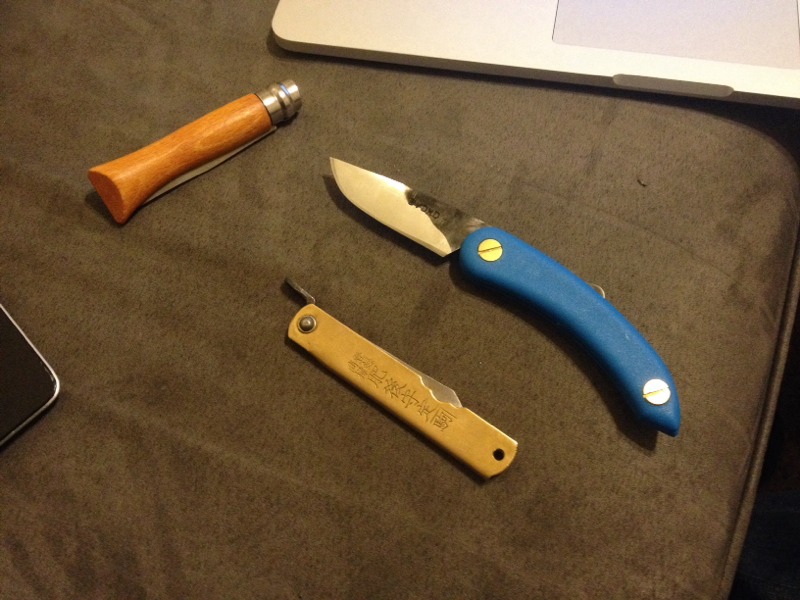
But we're talking about knives, so I mean the humble friction folder. The Opinel, Resolza, Taramundi, Nontron, and all the other so called peasant knives. I keep coming back to the resolza because it's so darn beguiling. It seems so simple, but the more you look at it and use it, it makes more sense, and you get the complex thinking that went into it's construction. There's nothing more there than has to be, to function at it's intended task. A cutting tool. The friction folder is a purist of a tool. And since I've gotten very used to not having a back spring, I wonder why and when it was put into use?
I know the pocket knives of the 1800's had them, so the back spring has ben used for at least that long. The 1700's? I'm not sure. Was the famous George Washington pen knife a slip joint?
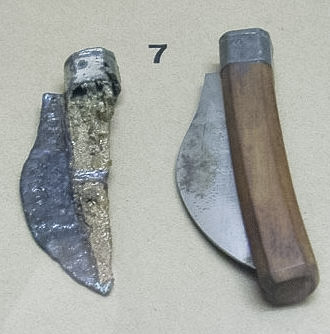
The folding knives of the 1600's were friction folders, I'm fairly sure of that. In some of the museums I've been to in England and Germany, I saw plenty of friction folders in the cases. And Nontron makes a big point of being made in the same factory since the 1600's. The old 'penny knife' has been around a very longtime, and for the last 150 years, has been sold alongside of the more modern back spring slip joint, with the slip joint taking the lead in the last half of the 1800's, except maybe in France and Sardinia. I guess in some places tradition is a powerful thing. While Victorinox is the worlds biggest knife company, it's interesting that Opinel is the worlds second biggest knife company. And of course, the bulk of their product is the friction folder that only had a makeshift locking ring put on in 1955. Of course, I have to wonder why? It worked for centuries without it just fine. Back in 1890, Joseph Opinel just took a design that was a local blacksmith product and made a mass production out of it. In essence, he was the first to mass produce the age old penny knife. Today, Opinel's of all sizes are shipped all over the world by the millions. Something to think about.
I may have to order a Svord and a Nontron to add to my accumulation of oldies but goodies. The little Sardinian knife has been such a good teacher, that I keep coming back to it. The friction folder is such a nice cutting tool to use, that it makes me wonder why would they bother with a back spring? I've got an Opinel in the kitchen drawer, and it's my fine slicing knife. Tomatoes, fruits, well cooked tender meat, and fish. The Opinel works well on raw fish, no matter if filleting or slicing something delicate like smoked salmon. Having bought my first Opinel in 1982, I've had a love/hate relationship with them ever since. They are like an Italian car or motor scooter. It has to sometimes be finagled, coxed, tinkered with. But when it runs, it runs great, and is sheer pleasure to use. Carving the Thanksgiving turkey, I find myself reaching for a large Opiel slim in the drawer. I hardly ever bother to lock the blade, and it slices so effortlessly. Kind of glides through the meat like magic.
If I were doing it all over again, I'd have taught my kids safe knife handling practice by giving them an Opinel as their first knife, with no lock. They'd have to learn to keep it dry as possible, lube the joint regularly, and pay careful attention to how they are cutting with it. Seeing as how Opinel is the worlds second biggest knife company, and ships all over the world, there must be a zillion kids in countries all over the world that had one as their first knife. And most of them still have all their fingers. The learned from a great teacher. A friction folder.
The friction folder mechanisim, if something that simple can be called a mechanism, is a study in maximum efficiency with minimum parts and bulk. I like simple. Simple is good. It's awfully hard to screw up simple. I've never had a malfunction from my revolvers, Remington rolling block or Ruger number 1 rifles. Gunsmith B. Tyler Henry engineered a simple action for a rifle that went on to be a long lasting favorite for the last half of the 19th century and the first half of the 20th. To this day, the Old Winchester's bring a premium on the gun market.
But we're talking about knives, so I mean the humble friction folder. The Opinel, Resolza, Taramundi, Nontron, and all the other so called peasant knives. I keep coming back to the resolza because it's so darn beguiling. It seems so simple, but the more you look at it and use it, it makes more sense, and you get the complex thinking that went into it's construction. There's nothing more there than has to be, to function at it's intended task. A cutting tool. The friction folder is a purist of a tool. And since I've gotten very used to not having a back spring, I wonder why and when it was put into use?
I know the pocket knives of the 1800's had them, so the back spring has ben used for at least that long. The 1700's? I'm not sure. Was the famous George Washington pen knife a slip joint?
The folding knives of the 1600's were friction folders, I'm fairly sure of that. In some of the museums I've been to in England and Germany, I saw plenty of friction folders in the cases. And Nontron makes a big point of being made in the same factory since the 1600's. The old 'penny knife' has been around a very longtime, and for the last 150 years, has been sold alongside of the more modern back spring slip joint, with the slip joint taking the lead in the last half of the 1800's, except maybe in France and Sardinia. I guess in some places tradition is a powerful thing. While Victorinox is the worlds biggest knife company, it's interesting that Opinel is the worlds second biggest knife company. And of course, the bulk of their product is the friction folder that only had a makeshift locking ring put on in 1955. Of course, I have to wonder why? It worked for centuries without it just fine. Back in 1890, Joseph Opinel just took a design that was a local blacksmith product and made a mass production out of it. In essence, he was the first to mass produce the age old penny knife. Today, Opinel's of all sizes are shipped all over the world by the millions. Something to think about.
I may have to order a Svord and a Nontron to add to my accumulation of oldies but goodies. The little Sardinian knife has been such a good teacher, that I keep coming back to it. The friction folder is such a nice cutting tool to use, that it makes me wonder why would they bother with a back spring? I've got an Opinel in the kitchen drawer, and it's my fine slicing knife. Tomatoes, fruits, well cooked tender meat, and fish. The Opinel works well on raw fish, no matter if filleting or slicing something delicate like smoked salmon. Having bought my first Opinel in 1982, I've had a love/hate relationship with them ever since. They are like an Italian car or motor scooter. It has to sometimes be finagled, coxed, tinkered with. But when it runs, it runs great, and is sheer pleasure to use. Carving the Thanksgiving turkey, I find myself reaching for a large Opiel slim in the drawer. I hardly ever bother to lock the blade, and it slices so effortlessly. Kind of glides through the meat like magic.
If I were doing it all over again, I'd have taught my kids safe knife handling practice by giving them an Opinel as their first knife, with no lock. They'd have to learn to keep it dry as possible, lube the joint regularly, and pay careful attention to how they are cutting with it. Seeing as how Opinel is the worlds second biggest knife company, and ships all over the world, there must be a zillion kids in countries all over the world that had one as their first knife. And most of them still have all their fingers. The learned from a great teacher. A friction folder.






 ...
... ...
...