The need-to-knows for a new knife enthusiast

Joined
Sep 5, 2009
Messages
194
not so recently, i bought my first good quality folder (CS Recon 1 clip point). Since then, I've gotten very few chances to use it since I've been away for a few weeks and didn't want to take i with me because i figured i wouldn't use it (and didn't want to deal with legality issues while i was traveling).

now I'm back i've been really using this knife for camping and hiking and everyday use (i want to get the most out of the outdoors before winter....god i hate winter:grumpy:) but i realized i really dont know anything about knife care and such.

things like knife storage, carry, cleaning and especially sharpening. it sounds silly but I'm paranoid that ill mess it up and ruin the knife. i know sharpening is an important skill to learn, but should i take it somewhere and get it sharpened by someone who knows what theyre doing for my first sharpening? should i get a cheap knife to practice with?

sorry for the dumb questions. help is much appreciated.
 
Sharpeing is a very personal thing, just like your choice in knives. There are many methods and they all get the job done. It dpends what is right for you. I personally like the sandpaper/mousepad method. I would definatly practice on some cheap kitchen knives.
 
thanks. but i guess my question was, how do i find out what's "right for me"? and what would i need for the different sharpening methods and what the ups and downs of different sharpening methods are. I've really never sharpened a knife before and when i try to research how to sharpen it i get hundreds of different ways to do it. since most of you have much more experience than me i guess i just wanted to be sure i wouldn't damage my knife.
 
Buy a Spyderco Sharpmaker and watch the DVD it comes with. Then find a cheap knife as you suggested and learn with it. The Sharpmaker is one of the easiest sharpening systems around and is virtually foolproof, not that your a fool:eek:;). Cost around $50.00 on the bay, and one of the best investments you will ever make if you are commited to the knife! Btw, best way to keep your knife sharp is to not let it get dull. When I get home in the evening I take whichever knife I have used that day and hit it about 10 strokes each side on my Sharpmaker. Keeps the edge sharp and requires very little effort or time.
 
You coukld check Crock sticks as cheaper alternative of sharpmaker, but unlike Sharpmaker you cannot use crock sticks in serations.
 
Welcome to BF and to the addiction! I also suggest the sharpmaker or some sort of crock stick system, pretty hard to screw up when your using a system like one of those.
 
General maintenance is similar to anything else made of steel. Keep it cleaned, and if it's not stainless, keep a little bit of oil on it.

Be EXTREMELY CAREFUL of so-called "Professional Sharpeners." :eek::eek:

Many of them don't know what the heck they're doing! (and don't care) :grumpy::grumpy:

Some even use power grinders that can totally ruin your knife.

Buy a few old 50 cent to one dollar kitchen knives at garage sales, and either a couple of sharpening stones or a set of Crock Sticks or a SharpMaker, or Lansky etc., and learn how to sharpen on the old junk knives. If you ruin a couple of them learning, you've only lost a couple of dollars. :p

If money isn't a problem, buy an Edge-Pro! :thumbup:
 
thanks. but i guess my question was, how do i find out what's "right for me"? and what would i need for the different sharpening methods and what the ups and downs of different sharpening methods are. I've really never sharpened a knife before and when i try to research how to sharpen it i get hundreds of different ways to do it. since most of you have much more experience than me i guess i just wanted to be sure i wouldn't damage my knife.

The problem is that there is hundreds of ways to sharpen and only you can decide what way works for you. Personally I like freehand because its the way I started and I can get the sharpest edges that way. For starting out I would suggest a DMT aligner or a simple benchstone if you want to learn freehand. Sometimes it can take years to find what sharpener works best and in the end you end up with almost everything. :)

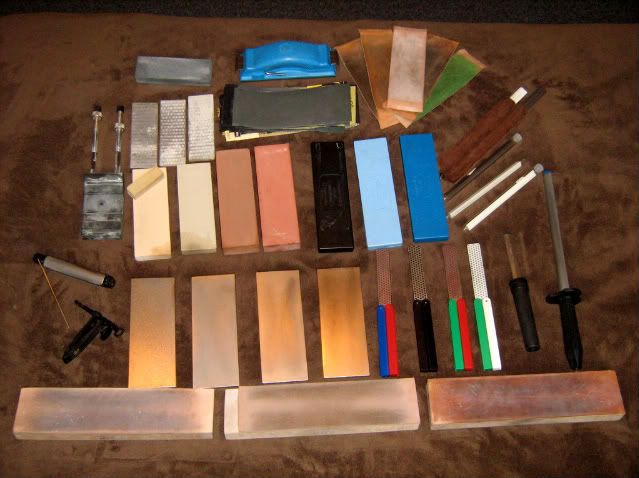
Picture513.jpg
 
Buy a few old 50 cent to one dollar kitchen knives at garage sales, and either a couple of sharpening stones or a set of Crock Sticks or a SharpMaker, or Lansky etc., and learn how to sharpen on the old junk knives. If you ruin a couple of them learning, you've only lost a couple of dollars. :p

If money isn't a problem, buy an Edge-Pro! :thumbup:

The problem is that there is hundreds of ways to sharpen and only you can decide what way works for you. Personally I like freehand because its the way I started and I can get the sharpest edges that way. For starting out I would suggest a DMT aligner or a simple benchstone if you want to learn freehand. Sometimes it can take years to find what sharpener works best and in the end you end up with almost everything. :)

I agree with Ben Dover and knifenut1013, particularly with respect to the points they made about using inexpensive knives to learn how to sharpen,
and that there are many ways to sharpen effectively.

For a beginner, I agree also that the use of a "guided" type of sharpener like the DMT Aligner or GATCO (diamond) is fine.
Using the Sharpmaker correctly IMO requires a little more practice and patience, but is a good transition to freehand sharpening.
 
Moving from General Knife to Maintenance, where we specialize in sharpening. :)

I strongly suggest a Sharpmaker, for two reasons:
First, it's not hard to learn and even comes with an instructional DVD.
Second, it leads you to understand how sharpening works, so you can pick up on other ways, like guided systems, freehand, and stropping.

Read a few threads on sharpenin in the Maintenance forum for more background, and whichever system you decide to go with, get back to us with any questions.

Do NOT take your knives to a "professional". Even if they are good at it, they won't put the different grinds you can learn to do on each different knife. For example, a full flat grind on a thin kitchen knife takes a different edge than a thick sabre grind on an outdoor knife.
 
the sharpmaker is looking pretty good right now...
I like the idea of it and it seems to be pretty beginner-friendly, plus it seems to be unanimous that it is my best option.

my only gripe is the price.

a few other members recommended crock sticks as a cheaper alternative to the sharpmaker. do they work just as well? thejamppa said they cant be used on serrations, but i dont own any serrated knives anyway, so that isn't really a problem. are crock sticks just as easy to use as the sharpmaker?
 
A flat stone is just as easy to use as a Sharpmaker -- once you learn how. The Sharpmaker comes with instructions that shorten the learning curve.

The Sharpmaker gives you more options than the crock sticks. Crock sticks are round, Sharpmaker rods are triangular. So you can sharpen on the flats or the corners, for different effects. You can also turn the Sharpmaker base over and lay the rods in the two grooves, and you have a benchstone to practice on.
 
I would recommend a Spyderco Sharpmaker as well, it is great for beginners, IMO professional sharpeners are more for reprofiling and taking out nicks or dings which will be a major PITA with a sharpmaker.
 
Once you get good with the Sharpmaker, do as I suggested and turn it over to use the rods as a benchstone. Since they are ceramic and work slowly, you won't do much damage while you learn.

Then go out and buy a fine diamond benchstone and you will be abe to sharpen almost anything, including fixing nicks and dings. :)
 
To start get the sharp maker w/ diamond sticks.
Knifenut,In your picture.Were the bottom three strops just loaded w/ different paste?
Thanks for posting your sharpening set up.DM
 
thanks. but i guess my question was, how do i find out what's "right for me"?

Experience. That's all. I've been doing it for about 2 years now, and I'm still changing my methods.

The problem is that there is hundreds of ways to sharpen and only you can decide what way works for you. Personally I like freehand because its the way I started and I can get the sharpest edges that way. For starting out I would suggest a DMT aligner or a simple benchstone if you want to learn freehand. Sometimes it can take years to find what sharpener works best and in the end you end up with almost everything. :)

Picture513.jpg

Nice sharpening paraphernalia.

I agree. The Aligner is a good system and will help you learn how sharpening works.

And I think you'll kinda have to learn as you go. If you just practice on your junk knives and wait to sharpen your good ones, then your good ones will sit to the side for a long time, because it does take a long time to get good at sharpening. If your bevels become not as good as you'd like them over time, then you can use the Aligner again, for example, and "reset" the bevels to the way you like them and then freehand for a few months with it. That's what I do, anyway.
 
To start get the sharp maker w/ diamond sticks.
Knifenut,In your picture.Were the bottom three strops just loaded w/ different paste?
Thanks for posting your sharpening set up.DM

Yes, and most are double sided. I have 6, 3, 1, 0.5, and 0.25 micron diamond compound spread separately on their own piece of leather.
 
The need-to-knows for a new knife enthusiast ....

sorry for the dumb questions. help is much appreciated.
You've already discovered the most important thing you need to know: ask others! :) And remember, there are no dumb questions -- the only thing that's dumb is not knowing, yet not being willing to ask.

Like many here, I grew up with knives and edged tools, and I'm still learning (and I ain't exactly young anymore, either.) That's part of the fascination of this hobby, seems the more you know, the more you realize there's a lot that you still need to learn.

Regarding sharpening, you've gotten lots of good advice already. I'll just add, be patient. Be *very* patient. Don't ever rush. Don't use heavy pressure when sharpening unless you it's an extremely blunt or damaged edge, and then ease up into lighter strokes as you get closer to a final edge. And don't *ever* use heavy pressure when using a Sharpmaker, CrockSticks, or similar rod type sharpener. Again, be patient, and take your time.

And keep reading and asking questions here on BFC, obviously we all enjoy talking about knives.
 
Back
Top