The origins and use of the Warncliffe?

Joined
Feb 6, 2009
Messages
406
For some reason I’m fond of the Warncliffe shape blade. It started with a Kershaw Leek years ago. I just purchased a Spyderco Centofante 4 with a beautiful Warncliffe blade. I’m interested in the true purpose of this shape. It’s benefits etc. I have some ideas just based on it’s geometry.
I have spent much time on the Internet looking. Internet searches come up with endless
“this shape blade is called Warncliffe”.

I know you folks know more about the use and origins of this beautiful blade.

Any input?
 
This is what KnifeOutlet has to say about the Wharncliffe pattern:
"Wharncliffe Blade- The Wharncliffe blade has a straight edge and a spine that tapers to the tip. If the taper is abrupt at the tip, the blade is called a sheepsfoot. This blade profile is excellent for scoring and other applications where the point is used in slicing cuts."

According to A.G. Russell's Knife Encylopedia, the Wharncliffe shape dates back to the 1900's.

Here is a thread from these forums about Wharncliffe blades:
http://www.bladeforums.com/forums/showthread.php?t=621419

Here is a thread from the Spyderco forums about Wharncliffe knives:
http://spyderco.com/forums/showthread.php?t=36529

Unfortunately, I don't have much more information than that. I hope what little information I've provided helps you out.:)

Regards,
3G
 
I like warncliffe blades, very handy when doing precision cutting with tip (that I often do). Same with small spearpoint knives, gives good maneuverability with the tip.
 
"Whittling and Woodcarving " Tangerman - a modification of the sheeps foot for carving.
 
Wharnies make great utility knives and whittlers. My two go two knives for shop work are a wharncliffe and a modified wharncliffe. :)
 
OK,

Boy, America has certainly morphed into a culture that lacks any societal memory of the family farm. This is probably a change for the worse, particularly for people that like knives.

OK, since nobody else will say it...or seems to know. Both the Wharncliffe and Sheepsfoot are both blade designs for the castration of farm animals.

On a farm you HAVE to castrate Hogs (unless you are keeping him for a stud) or you can't eat them due to a scent gland that develops as an adult. Horse are castrated to keep them under control, bulls are castrated for control and because they put on weight faster ie more valueable. There are a variety of economic, control, and eatability issues that caused farmers and ranchers to lop off the twins. It was quite common.

Every wonder why a sheepsfoot is one of the blades on a Stockman knife (the knife is named after Stockmen: The term "stockman" was previously used in the United States and Canada as a formal term for a person who raised livestock, principally cattle, "stockgrower" being term in more recent use.); now you know.
 
I thought that was what a spey blade was designed for? Although I can understand the usefulness of any tipless blade for that sort of thing.
 
Something in the back of my mind is also telling me that the wharncliffe style blade is also associated with sailors as well.
 
Something in the back of my mind is also telling me that the wharncliffe style blade is also associated with sailors as well.

Maybe because it resembles the shape of a marlin spike? I know sheepsfoot blades are often associated with sailors due to their rounded, non-pointy tips. Hopefully, someone like A.G. Russell will see this thread and provide some more historical content for us.:thumbup:

Regards,
3G
 
Something in the back of my mind is also telling me that the wharncliffe style blade is also associated with sailors as well.

I seem to recall reading that in the Royal Navy back in the tall ship days, there was a regulation prohibiting pointy knives. It was probably a safety rule so you don't stick yourself when the vessel moves, but also it was probably to make them less lethal if a fight broke out between crewmen. Theirs were more like sheepsfoot blades than the wharncliffe though.

The wharncliffe is such an elegant and useful shape. I just traded away a Case wharncliffe trapper, but I'll probably end up with some other wharnie again at some point.
 
Last edited:
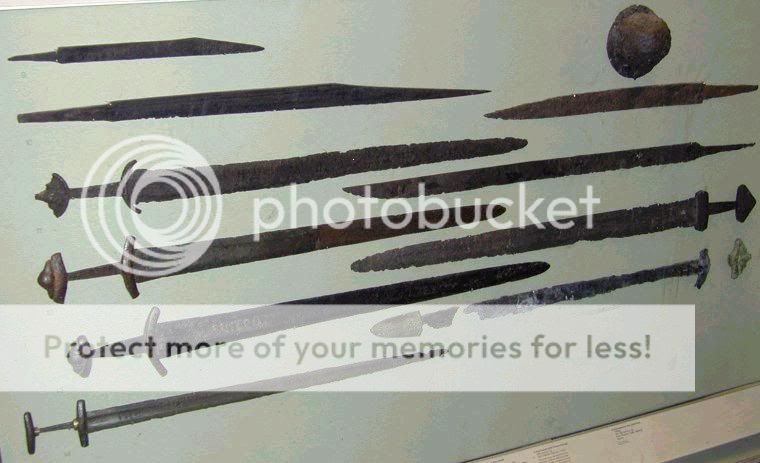
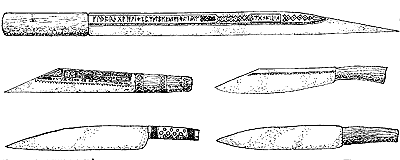
It can be argued that the Warncliffe design is much older. The early Scramasaxe for example share a very similar shape. Lengths of the scramasax ranged from a few inches to sword lengths.

smallviking.jpg


SmallSeax.jpg


Seaxes.gif
 
Last edited:
Bors beat me to it! :D

However the "modern era" wharncliffe seems to have developed as something of a woodworking/whittling blade shape excellent for very tight controlled and precise cuts. It is perfectly suited to detail carving.
 
Bors beat me to it! :D

However the "modern era" wharncliffe seems to have developed as something of a woodworking/whittling blade shape excellent for very tight controlled and precise cuts. It is perfectly suited to detail carving.


Yep....
 
as far as the pocketknife pattern goes...
the owners of Joseph Rodgers & Sons credited James Archibald Stuart-Wortley-Mackenzie (1st Baron Wharncliffe) with the design, and named it after him sometime after he became Lord Wharncliffe in 1826.
 
Common sense suggests to me that any shape in which flint/obsidian or the like had/has ever been broken naturally or knapped into (straight, curved, rounded, segmented, etc.) so have we replicated in steel blade shapes.

Gibby
 
The shape of the Wharncliffe is derived from the Scramasax, as noted above. they have been around for at least a thousand years, in one form or another. They are very good because anyone can sharpen them on a rock, the edge being straight makes that much easier.
 
The point also does not have clearance issues caused by the belly of a blade.
 
Back
Top