Then and Now..

Joined
Mar 13, 2002
Messages
2,125
Hello all,
I thought it would be an interesting topic, seeing photo examples from the community, picking a favorite maker's work and following signature elements or his styles through the years. Differences and similarity noted between the new and the old. Please post your own photos and descriptions..
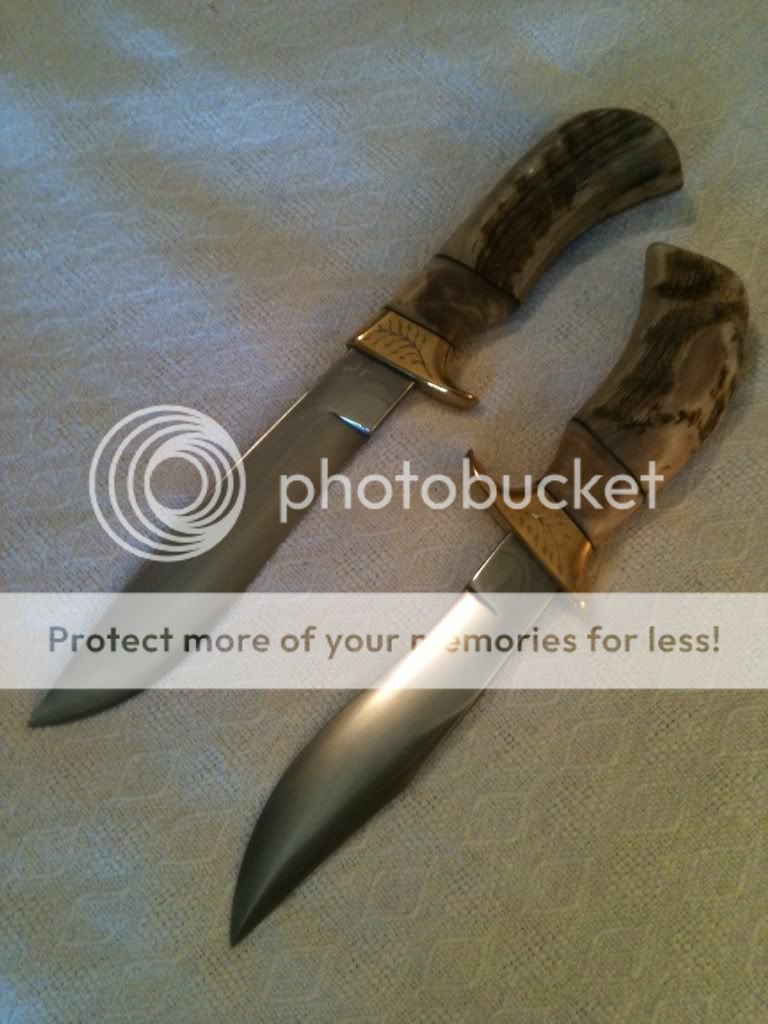
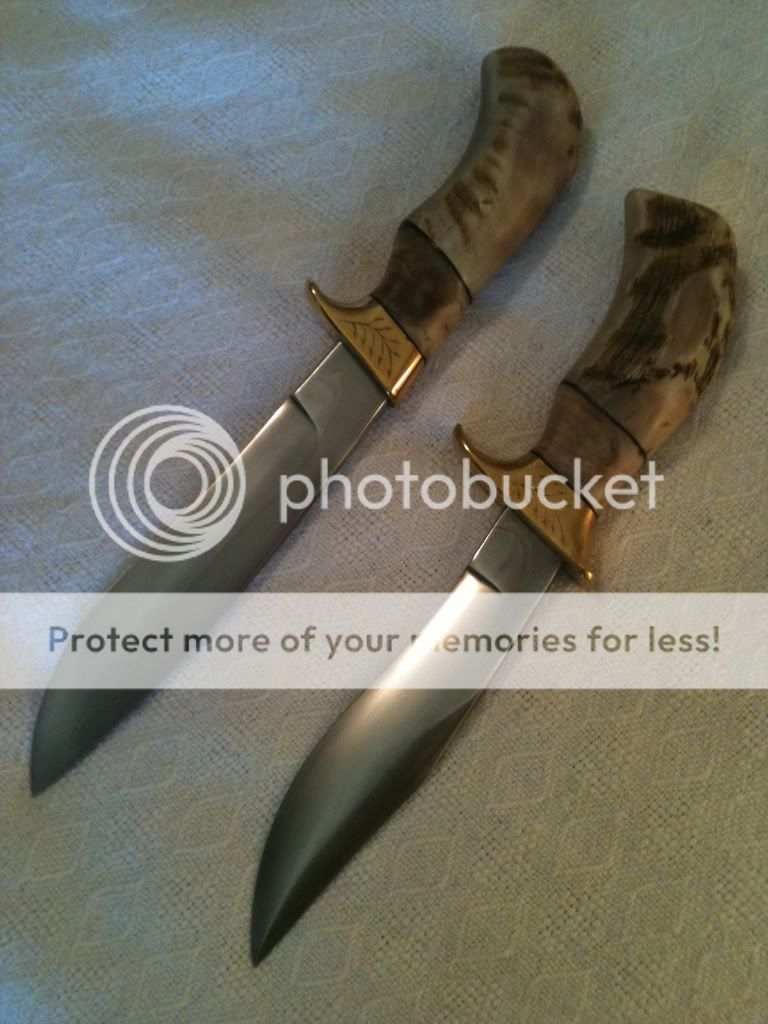
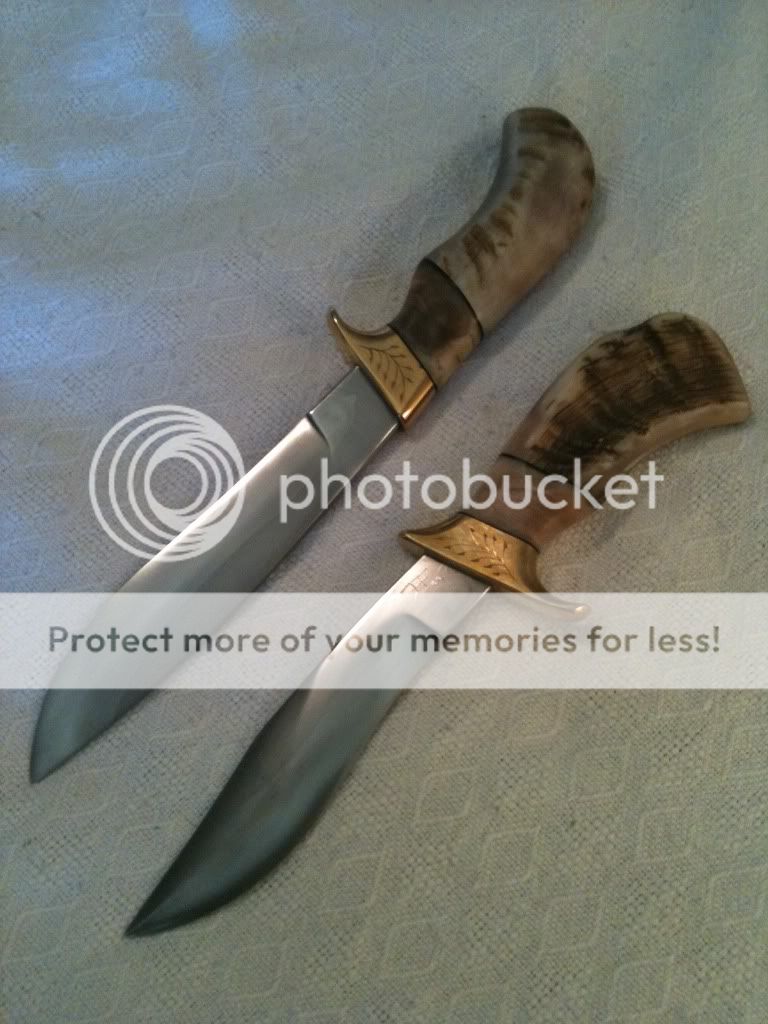
Here is one example: by Ed Fowler. These two knives compliment each other well, I feel. Camp knife and a Bowie. They were made 14 years apart. 1995 and 2009. Some development obvious in the grind, and slight edge recurve. Much of the overall form, very intact..
84e00b65.jpg

9aa4b50d.jpg

3271a52c.jpg


Thanks,
David
 
Last edited:
the one at the top is WAY nicer, to my eye. In particular the plunge line, the guard and the handle shaping.
I have a real affinity to Ed Fowler's knives.
 
doesn't it get a little boring making knives in the same style, and sometimes very similar for decades? or is does it never get old
 
doesn't it get a little boring making knives in the same style, and sometimes very similar for decades? or is does it never get old

I would say it's different for each maker, I personally get bored making the second one, I wouldn't attemp to speak for Ed but I am sure he could tell you about a lot of differences in the two knives, though probably not visual. More in knowledge and experience gained in the years of building "His" knife. I will never get to build the best knife I can of a particular style or modle of knife because I don't do that. To each his own. Nice thread David
 
doesn't it get a little boring making knives in the same style, and sometimes very similar for decades? or is does it never get old

That is a fair question, whether talking about stock removal makers or those who forge. The question is are the makers growing, learning, changing, and what is breathing life into the work?
In a Fowler style of knife, one might argue it is an old style, not offering anything "new".
A couple of points: sheephorn itself provides endless variations. Not just visually, but matching up the correct feel, contours of each individual horn. Each knife really has it's own unique feel, as a result. If the medium were a more uniform material, such as wood or micarta, there would be no "riddle" to it. And, I would agree- it would offer little interest. But, with these knives, they really have a distinct difference from knife to knife, and in various proportions.
With that said, I myself would consider Ed's knives a traditional style, nothing wild.. For some people that might equal "boring". For Ed, it is his craft and I think he has settled on what seems best, in terms of materials.
As a collector, I enjoy the consistency of materials, as a theme. It lends to some convenience.. and gives a certain presentation value I think. Also, it is a philosophical thing.. You recognize makers by their developed styles.

One might wonder if the makers tire of their work, if it is driven by someone else's ideas and wishes. Working off of commision, building to suit the customer.. I've heard that this is a frustration of makers, having to go against their own creative impulses to suit an imposed demand, or style of knife.
If Ed didn't want to make these knives, or got bored with using the same materials I'm sure there are those would have applauded and encouraged him more than we think! It was his choice..
 
Thanks Mark, I appreciate your response.

Severed, I don't know- you'd have to ask.. I assume you mean something about the etching/buffing to the desired finish?
 
good point about the sheep horn as opposed to perfectly uniform synthetics. Even if it does get boring doing it for a living, it still beats the hell out of most of our jobs.
 
Also, in Ed's case he raises the sheep too.. Not a small part of the equation.

Hope to see a few more posters! More "before / after" photos.
Thanks,
David
 
Hi David,
I'll play
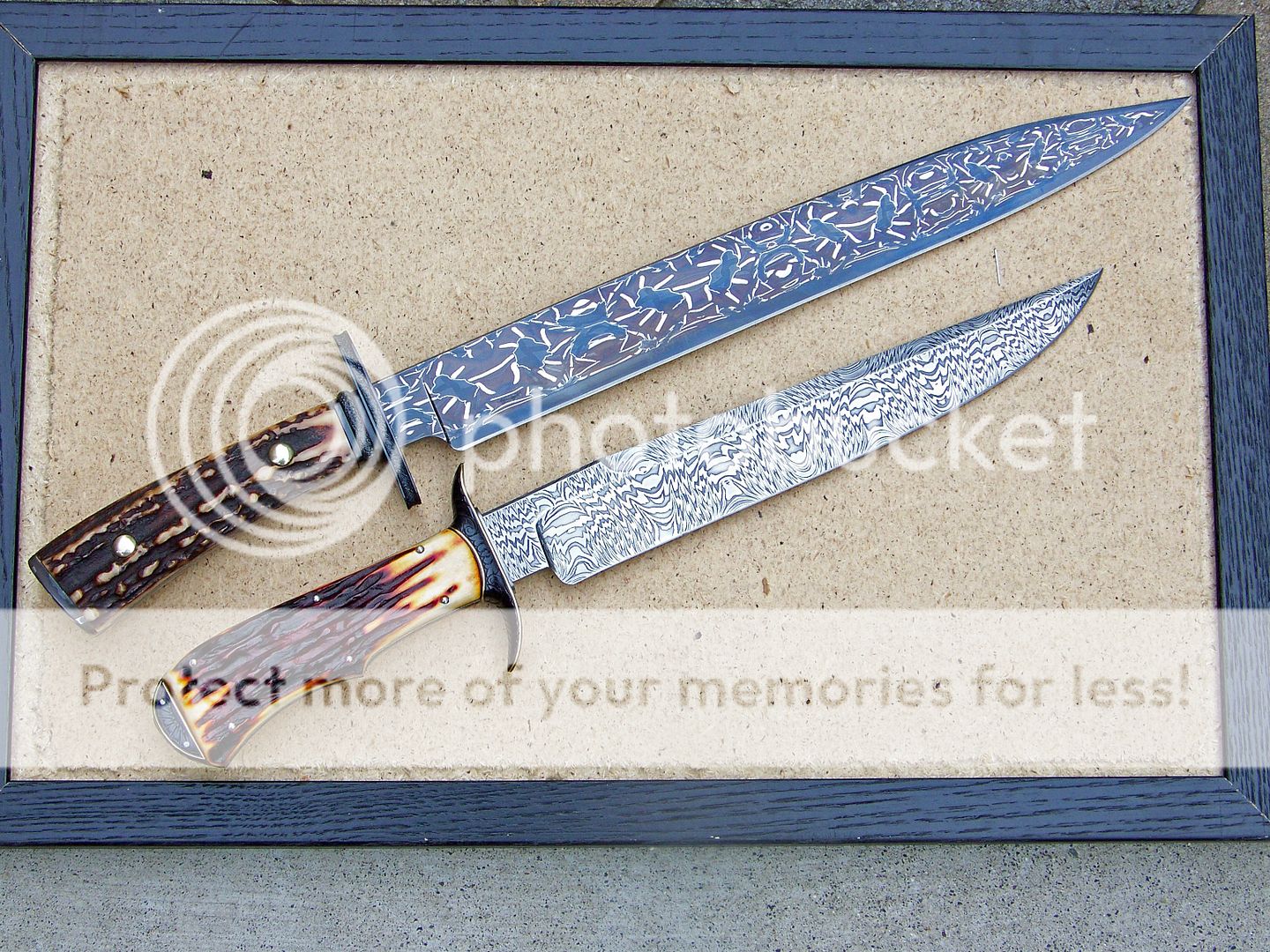
Here is 2003 one of my MS test knives on top and one I just finished.
The top knife is mosaic and has about 4 steels in the canister, accordian cut with a welded on edge of 1075. At the time it was a way to show off but now folks may be afraid to use a welded on edged knife and go for san-mai clad instead. I dont blame em as function should be first over looks.
The bottom knife has a "W" pattern blade and is also accordian cut. This steel is much simpler to make and should be a real nice user. I like the contoured guard and comfy style grip. The bottom one is a "take down" which is standard for me now.
I like both knives but I can see now comparing the two that my new stuff has improved over the former.

100_7418_edited.jpg
 
I will play also


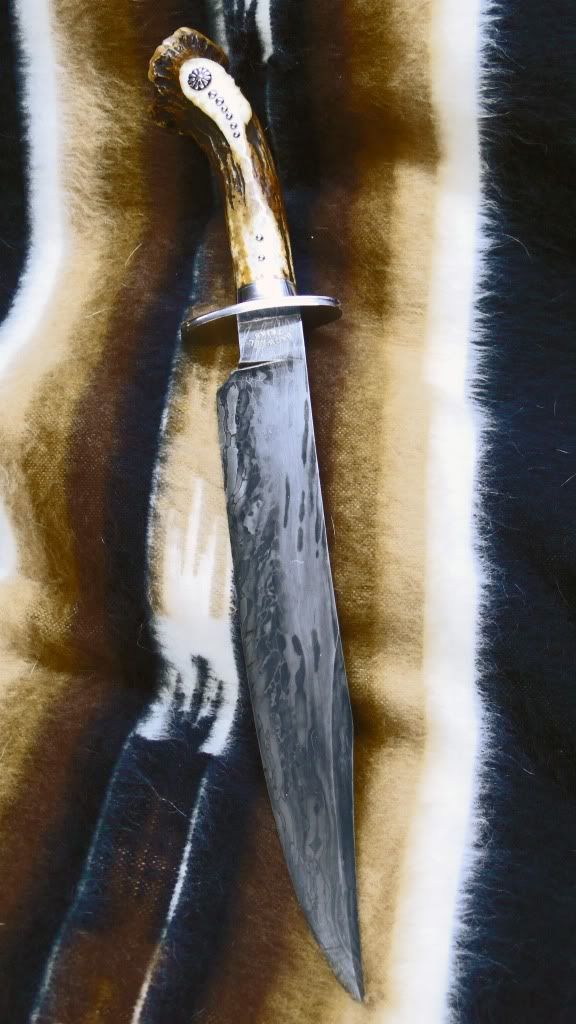
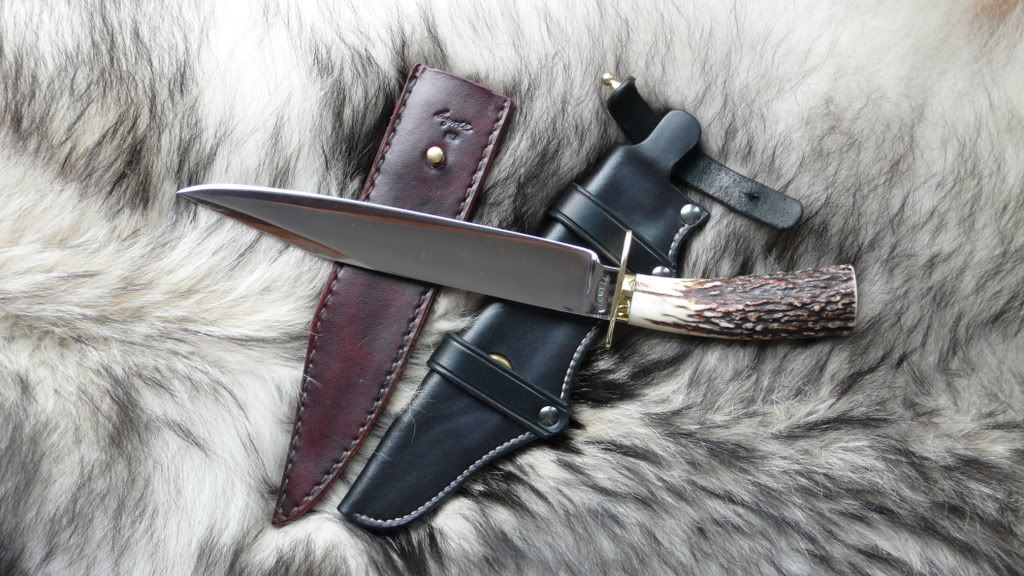
Here is a 20 + plus year old Bagwell it is probale my favorite carry user Bowie

I have 4 sheaths for this knife

It has what I like to call a dolphin style clip. The clip is classic of Bill of that time period.
It is shorter and the tip does not sweep up.

longsheath005.jpg


Bill still now and then does the old style clip but now they are mostly along the lines of this blade a bit longer with a sweeped up tip more Talon like

L1000482_edited-1.jpg


Both great with just slight differences

There where some comments about particular makes making similar designs over and over again

These are my thoughts on this subject

If you order a knife from Ed Fowler you are expecting to get a sheep hande and a blade that is typical of what Ed makes thats why you order a Fowler

When you order a blade from Bagwell most times you are ordering a Bowie thats what he does and what he is best known for

These makers do not get bored with there designs because they believe in these designs and have long waiting lists full of people that believe in them also
 
Thanks Bruce and Joe! We're almost having a party..
more stuff please! :)

Joe, can you also post pictures of the 3 other sheaths?
 
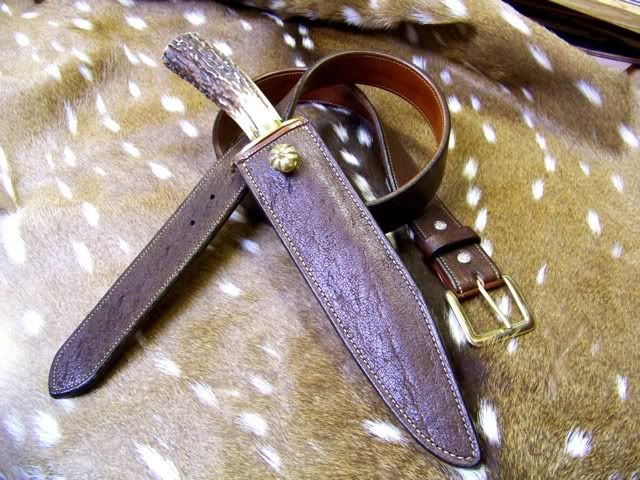
Sure the one in the original pic is of course by the great P Long

Here is the original from Bill and a really neat scout style with rare earth magnets from Richard Hollomen of Rawhide leather

bowie003.jpg


The latest is my favorite a full frontal Cape Buffalo sheath with matching belt that i shot and again this one is from Paul Long


100_1233.jpg
 
Seventhumbs: The second knife is what I call a blended bowie, actually it is a double grind, the top of the ricasso is thinner than the thickness at the top of the plunge grind and this follows through the entire length of the blade.

I learned this trick from Rudy Ruana and just saw one made my Bill Scagel at this years blade show. Dr Lucie had just purchased it from a collection in Canada. It was abolutely the most well developed Scagel I have ever held. I hated to return her to him.

The Ruana was made in 1938, double ground and no sharp grind lines anywhere on the blade. I was fascinated when I saw it and bought it at Blade Show about 6 years ago, not knowing that Rudy Ruana had made it. The knife had a complex, convex grind that flowed very gracefully from and to all directions. It took me some time to understand the knife and finally figured it out when reading about the hull design of racing sailing boats.

Like a sharks body, there are no sharp grind lines, when moving through the water sharp lines would create turbulence. Same with knife blades, while sharp grind lines are nice to look at for some, they reduce the efficiency of the blade doing its work.

Take a look at some of the grinds on the competition knives and you will see that many are now considering the influence of blended blades. They take longer to develop than if I were to simply leave a sharp grind line on the clip, but to me they are worth it. Ed Schemp describes it as a "think rotary" design.

When I have to put down an old buck sheep, I usually just cut their throat and let them bleed out. Some time after all neurological activity has ceased I try out one of the Bowie's or fighters on the carcass. I was amazed the first time I used one of my blended fighters, from heart to liver or where ever you want to go the blade flows with ease.

These aspects lead to the development of the what I call the "organic" knife that I still seek to perfect. There are no aspects of the blade that do not have a functional reason to be there.

The handles are another aspect that takes a lot of planning and development, as they are all different from the start, it takes a lot of learning to develop a fit to the hand. A young lad made a comment about another makers knife that had a very well designed handle, "It holds your hand!"

I appreciate your question.
 
Thanks Joe, I enjoyed seeing the sheaths. I'd be curious to know what purpose the earth magnets on the Hollowman sheath serve?

And thanks to Ed! it is always interesting to hear your descriptions on knife design, especially details of a historical context. You surely did a fantastic job on this Bowie! I love the blended grind.
David
 
Thanks Joe, I enjoyed seeing the sheaths. I'd be curious to know what purpose the earth magnets on the Hollowman sheath serve?

And thanks to Ed! it is always interesting to hear your descriptions on knife design, especially details of a historical context. You surely did a fantastic job on this Bowie! I love the blended grind.
David

David they are not really needed because the sheath has a retention strap but with the strap removed or left open the knife will stay put in the sheath this sheath is designed to be worn horizontaly along your lower back or hooked to a pack.
 
Back
Top