Thin Slicers, Peanuts, What about the flex?

Joined
Dec 23, 2008
Messages
566
After reading a post by Quy4n8 about thin blades, I decided to make a post to find your prefrences about small thin blades such as Peanuts, small toothpicks, or 2" blades in general.

I just made a peanut using a 1/16" stock, pretty thin, but the same thickness as a case peanut. However, it's a touch longer and it is 1/2" from spine to edge where as a typical peanut is 3/8". This wider blade allowed me a more narrow angle geometry and made a really mean slicer. The downside is that it has quite a bit of flex.

So if you are carrying a small slicer like a peanut would the flex bother you? Obviously a 2" blade has limitations and isn't meant to perform every task.

So I would like your opinion and also, if you carry a peanut, how many of you also cary a second larger knife on you? What do you use your peanut for?
 
I have a roughly 3.5" trapper with a clip blade,made by Menefee,who is a maker known for grinding thin slicer type grinds
It has a little flex action,towards the tip. I doubt I'd be able to snap it,considering I know how the blade is thin & I will use it,accordingly.I won't abuse a custom slipjoint.
I think any custom handmade slipjoint that has a blade like this,or what you speak of,is somewhat rare & to me it's unique.
I think most custom slipjoint makers have a point where they would not want to continuosly build folders with blades this thin,because,later on,they may get a lot returned for repair
They are somewhat hard enough to build once,let alone rebuilding them.

I hope that ramble makes sense & helps. We'd love to see such a knife ,I'm sure
-Vince
 
Otto,another thing to consider...on the secondary blade,if you start out with the thin stock & grind it to where it flexes,the blade may rub the liner or other blades (depending on the pattern),as the nail pull is engaged & opened.
The firmer the spring,the harder one tends to push & pull ,w/ opening.

So you get the whole knife pinned together,working & finished,but you customer does not like that flexing blade that rubs a little.

Something to consider
-Vince
 
After reading a post by Quy4n8 about thin blades, I decided to make a post to find your prefrences about small thin blades such as Peanuts, small toothpicks, or 2" blades in general.

I just made a peanut using a 1/16" stock, pretty thin, but the same thickness as a case peanut. However, it's a touch longer and it is 1/2" from spine to edge where as a typical peanut is 3/8". This wider blade allowed me a more narrow angle geometry and made a really mean slicer. The downside is that it has quite a bit of flex.

So if you are carrying a small slicer like a peanut would the flex bother you? Obviously a 2" blade has limitations and isn't meant to perform every task.

So I would like your opinion and also, if you carry a peanut, how many of you also cary a second larger knife on you? What do you use your peanut for?

Never quite understood this.
I have yet to find an everyday task that my Peanut, or even my Classic can
t handle that ANY other pocket knife can.
Food stuff?
Handled it.
Whittling?
Been there, done that.
Cut tough material such as thick rope, cardboard boxes, etc?
Yup. Both have handled that too.
Anything that these knives can't handle would require a large fixed blade or a hatchet/ax.
 
A bit of flex in a blade does not bother me at all. I'd really rather have a blade that is thinner than thicker. Much better cutter that way, and after all, that's what I do with a knife; cut stuff.

I think Voltron put it pretty well. If my pocket knife can't deal with it, then a hatchet or saw is needed. I'm not into the 'hard use' thing, whatever that may be. I've got a heck of a lot of milage out of a Rapala fillet knife, and that blade flexes all over the place, but it cuts like a razor.

My uses for a peanut are all the normal pocket knife jobs. Cutting twine/rope/string, opening packages, cutting open plastic bags of mulch/top soil/bird seed/dog kibble, a little whittling of hot dog sticks, opening mail, and any other things that need a sharp edge. I find a 2 inch blade enough for all my normal suburban use, with a little fishing tossed in.

How thin is the blade on a Stanley utility knife that's found on 99.9 % of job sites? If there's such a thing as a hard use knife, the Stanley must be it.

No, thin blades don't bother me at all. I can flex the heck out of my number 6 Opinel or Victorinox classic, and they work just fine for most pocket knife type cutting.

Carl.
 
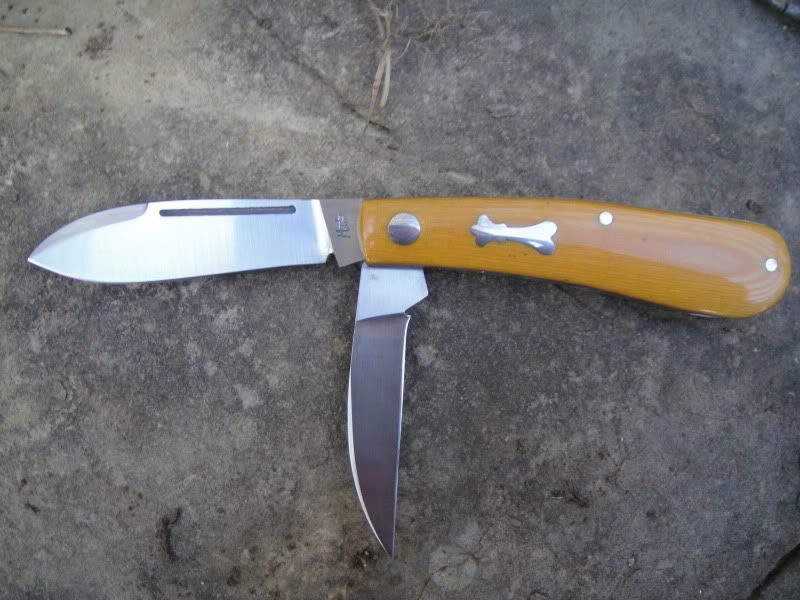
Rick made me this one. The master is 1/8 stock and the secondary wharncliffe is 1/16 stock. I love the combination. Th wharnie has a lot of flex, but it is a crazy slicer...one of the sharpest blades I own. I wouldn't use it for tough tasks, but as a pure cutter and blade for detail work, it is superb.

DSC00690.jpg
 
Rick made me this one. The master is 1/8 stock and the secondary wharncliffe is 1/16 stock. I love the combination. Th wharnie has a lot of flex, but it is a crazy slicer...one of the sharpest blades I own. I wouldn't use it for tough tasks, but as a pure cutter and blade for detail work, it is superb.


Again, not to sound like a broken record, but..... what does this mean?
Tough tasks? What is a tough task for a knife?
Pure cutter?
Isn't that the only thing knives are made for. Cutting? What "cutting" job is too tough for a knife?
 
Again, not to sound like a broken record, but..... what does this mean?
Tough tasks? What is a tough task for a knife?
Pure cutter?
Isn't that the only thing knives are made for. Cutting? What "cutting" job is too tough for a knife?

Voltron,one thing that could mess up a thin ground blade,on a slipjoint that has a harder Rc (like a custom made),would be cutting into a hard material,getting the blade wedged a little.A natural reaction is to wiggle the blade to get it un stuck,Something like this,could chip a chunk out of the blade.

I think a tough task for a knife would be scoring alum. flashing material,I would not use a peanut for this,I'd use a sheetrock knife (If I used a knife & not tin snips). The blade is probably the thickness the OP mentioned,but because of the way it is ground,it'd take it. The disposable blade would then be trashed.

There are cutting tasks that one type of knife can tackle & is moreso suited than others
-Vince
 
Voltron, I would not field dress a deer with the small wharncliffe blade, but I would do it with the master blade. If I am carving/whittling wood, for detail work that requires a smaller blade, I would opt for the wharncliffe instead of the master blade.

When in the woods and I opt to do it buschcraft style, I would not do a bow drill setup with a small flimsy blade to start a fire. You have to carve out a notch in the base for the spindle to get a coal, and on the upper end you have to carve a handhold to accommodate the top of the spindle. Depending on the type of wood, this would not be an easy task with a small and flimsy blade. It would take too long, and you would also risk damaging the blade.

Think of kitchen knives for example. Different types of knives are used for different tasks. I would think that people discovered long ago that a fillet knife shouldn't be made with 1/4 inch stock, and that a butcher's knife of cleaver shouldn't be made with 1/16 stock.

IMO, knives are not just for "cutting". Knives are made for specific tasks. An analogy would be to say why do we need different types of vehicles. In the big picture, yes a vehicle is made to get you from point a to point b (just as you say a knife is made for cutting). But if a vehicle was only made to get you from here to there, what is the point of having sports cars, trucks, vans, semi trucks. Different needs demand different vehicles. If a person wants to go to a race track, they aren't going to take a '75 Chevy Pickup. Just as a person who needs to haul 2000 lbs of cement isn't going to do it in a corvette.
 
Voltron, I would not field dress a deer with the small wharncliffe blade, but I would do it with the master blade. If I am carving/whittling wood, for detail work that requires a smaller blade, I would opt for the wharncliffe instead of the master blade.

When in the woods and I opt to do it buschcraft style, I would not do a bow drill setup with a small flimsy blade to start a fire. You have to carve out a notch in the base for the spindle to get a coal, and on the upper end you have to carve a handhold to accommodate the top of the spindle. Depending on the type of wood, this would not be an easy task with a small and flimsy blade. It would take too long, and you would also risk damaging the blade.

Think of kitchen knives for example. Different types of knives are used for different tasks. I would think that people discovered long ago that a fillet knife shouldn't be made with 1/4 inch stock, and that a butcher's knife of cleaver shouldn't be made with 1/16 stock.

IMO, knives are not just for "cutting". Knives are made for specific tasks. An analogy would be to say why do we need different types of vehicles. In the big picture, yes a vehicle is made to get you from point a to point b (just as you say a knife is made for cutting). But if a vehicle was only made to get you from here to there, what is the point of having sports cars, trucks, vans, semi trucks. Different needs demand different vehicles. If a person wants to go to a race track, they aren't going to take a '75 Chevy Pickup. Just as a person who needs to haul 2000 lbs of cement isn't going to do it in a corvette.

All true Campbell,nicely put.

But Voltron says this :
I have yet to find an everyday task that my Peanut, or even my Classic can
t handle that ANY other pocket knife can

And I'd say your field dressing a deer would be a good example.

It could be done with the peanut,but a larger ,longer bladed pocket knife would definitely be more effective & cut down time.
I love the afternoon hunt,most times the shot is at last light & I dunno about you Voltron,but I would not want to be up in the woods somewhere cold,dressing a whitetail,headlamp on head,relying on a peanut,especially knowing it still has to be dragged out,in the dark,downhill.

And I realize,this scenario is not an every day task,but on a good day it could be.
-Vince
 
Voltron, I would not field dress a deer with the small wharncliffe blade, but I would do it with the master blade. If I am carving/whittling wood, for detail work that requires a smaller blade, I would opt for the wharncliffe instead of the master blade.

When in the woods and I opt to do it buschcraft style, I would not do a bow drill setup with a small flimsy blade to start a fire. You have to carve out a notch in the base for the spindle to get a coal, and on the upper end you have to carve a handhold to accommodate the top of the spindle. Depending on the type of wood, this would not be an easy task with a small and flimsy blade. It would take too long, and you would also risk damaging the blade.

Think of kitchen knives for example. Different types of knives are used for different tasks. I would think that people discovered long ago that a fillet knife shouldn't be made with 1/4 inch stock, and that a butcher's knife of cleaver shouldn't be made with 1/16 stock.

IMO, knives are not just for "cutting". Knives are made for specific tasks. An analogy would be to say why do we need different types of vehicles. In the big picture, yes a vehicle is made to get you from point a to point b (just as you say a knife is made for cutting). But if a vehicle was only made to get you from here to there, what is the point of having sports cars, trucks, vans, semi trucks. Different needs demand different vehicles. If a person wants to go to a race track, they aren't going to take a '75 Chevy Pickup. Just as a person who needs to haul 2000 lbs of cement isn't going to do it in a corvette.

See, now this makes sense as far as different blades, but there is no "tough task" mentioned.
Field dressing a deer with a master blade rather then the smaller one is not an issue of "tough" or "hard" use, it's more an issue of convenience. OF COURSE you could skin the deer with the smaller wharncliff. I have read stories of guys who were stuck out there with nothing but a Classic (left skinning blade in truck), and still did it.
Was it more time consuming? Absolutely.
Did the Classic break or sustain any more damage then the larger blade would have?
No.
VCM3 mentioned how scoring alum. is a tough task, and how you would use a sheetrock knife, not a Peanut. However, he then goes on to say that you would then trash the disposable blade.
That's my point. These are not tough tasks for a knife, these are inappropriate tasks for a knife. That's what the snips are for.
I think we tend to misunderstand what a knife is for. Knives are for cutting. Whether it is Rambo's knife, or a Peanut. They are not meant to pry, scrape, or drive a screw. They are meant to cut.
CAN they scrape and pry?
Sometimes. However, chances are you damage the blade.
As cnas122 said, there are appropriate knives for certain tasks.
Which means that they can handle these tasks.
Which means they aren't tough tasks, just appropriate tasks.
If we remember that it is a knife, and it is meant for cutting, I don't see what "hard use" could be.
 
All true Campbell,nicely put.

But Voltron says this :
I have yet to find an everyday task that my Peanut, or even my Classic can
t handle that ANY other pocket knife can

And I'd say your field dressing a deer would be a good example.

It could be done with the peanut,but a larger ,longer bladed pocket knife would definitely be more effective & cut down time.
I love the afternoon hunt,most times the shot is at last light & I dunno about you Voltron,but I would not want to be up in the woods somewhere cold,dressing a whitetail,headlamp on head,relying on a peanut,especially knowing it still has to be dragged out,in the dark,downhill.

And I realize,this scenario is not an every day task,but on a good day it could be.
-Vince

LOL. Uhm, no. I would not want to be caught out there in the cold dressing a deer with a tiny knife.
However, that is not the issue. If you were to be out there int he cold dressing a deer with a peanut, it would not be a tough task for the knife. Perhaps for US, but the peanut could handle it. Sure it would take longer, but is this a tough task for the knife? Not really. Jackknife has mentioned how he saw a demonstration put on by a park ranger where he skinned a deer with a two inch piece of obsidian. About the size of a Peanut.
Again, there is no "tough" job for a knife. Just tough jobs for our own convenience, and inappropriate jobs for a knife (Like prying, bending, or trying to cut something a knife is not meant to cut).
 
The whole 2" blade thing...I've very much steered slowly away from it,for an EDC blade. On a 3.5 to 4",single blade,if I need to,I can choke up on the blade & use the tip,in a way like a small blade like on a peanut.

Its probably the same with you Campbell,that two blade Dog Leg is so much more useful as a double. The big belly tip to the main blade is not as suited for what that warncliffe secondary blade is.

These days most times I carry a smaller knife is because of the dress attire & at that point,I may never even use that knife that day

I do know of a guy who is a maker & carries a smaller trapper & I was told he uses it so much he replaced the blade.

I also have seen many a guy,loving small knives,only at a later time getting into larger folders.

I think a little tiny blade with alot of flex,can handle alot more than one would think & be strong enough & handle it
But most who walk here are beyond doing it all,with that same ,single small blade.
-Vince
 
Rick made me this one. The master is 1/8 stock and the secondary wharncliffe is 1/16 stock. I love the combination. Th wharnie has a lot of flex, but it is a crazy slicer...one of the sharpest blades I own. I wouldn't use it for tough tasks, but as a pure cutter and blade for detail work, it is superb.

DSC00690.jpg

Thats a beauty Campbell :thumbup:
 
I have heard a story of a biologist,that trapped himself inside a bear trap by accident,with the drugged black bear in there.He cut the bear's throat,for safety reasons,with a small SAK on his keychain.I bet he was glad it handled the task.
-Vince
 
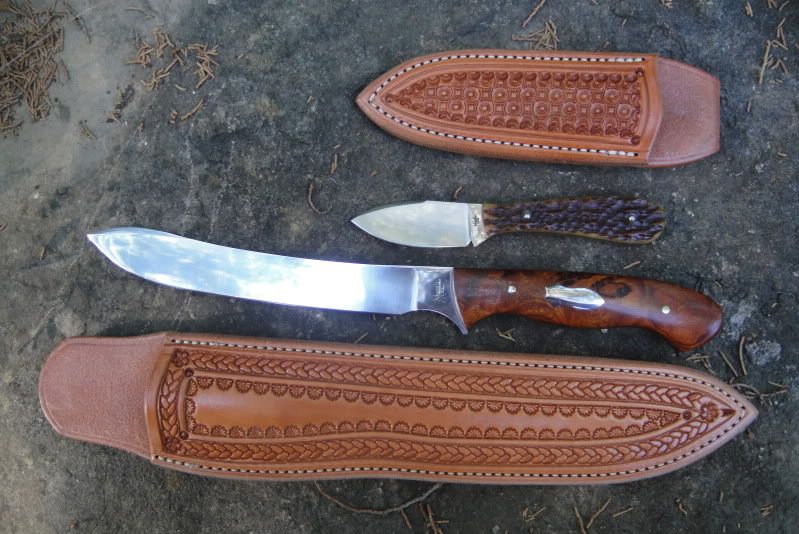
I think you are getting into semantics now. I am a pretty avid outdoorsman and, for example, I have several knives that I expect to be capable of prying without damage to the blade. Many tasks I use the knife for require a prying action. I consider this tough and hard use, and also consider these knives as tools used for more than just cutting. The Gossman knife below is an example. It is made of 1/8 stock. I've also used this knife to drive a screw and to bore holes in wood...a task not thought of as a typical use of a knife. I would not do the same with the Menefee fillet knife.

cstusk5.jpg

DSC00899.jpg
 
Yo Campbell,you have been holding back,pics of some good stuff my man :thumbup:

DSC01867.jpg


Thats my smallest folder at 3",a blade of 2-3/8" measured tip to scale,a 2-1/16" cutting edge.Not really much flex,to its very thin stock,thin ground blade
If it were my only knife.I probably could do most everything I need to do with a pocket knife,with it,if I had to
-Vince
 
Back
Top