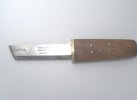
Thoughts on this new violin maker's knife?

Status
Not open for further replies.
Joined
Dec 19, 2007
Messages
458
There are a few of us forger's/knifemakers that also make stringed instruments. I have in the past sought to make a knives for special tasks during the violin making process. What I found was that simple luthier blanks work just fine and each individual luthier has a different approach.
A friend of mine bought one of these and is "hooked". I looked at the web page and had my own thoughts but I am biased and competition may be blinding me. The only thing I will mention is the "special" HT of O1. This can be seen on the web page if you back up to the main page. In no way am I trying to trash this person. I know him and he's a nice guy...just checking on the objective statements.
Your thoughts would be appreciated:
http://jpschmidtviolins.com/mknife.html

Thanks
Dean
 
Last edited:
what sort of work is a knife liked that used for when making a violin?

-Daizee
 
what sort of work is a knife liked that used for when making a violin?

-Daizee

This one would work well doing the final cuts on the f-hole. The knife is used a lot in various stages but I use different types. for instance I use two matching single bevel blades to chalk fit the neck. I use a short stout blade to carve the neck root and the fluting on the scroll. I also use the #15 and #11 scalpels for fine work.
 
"deviation from literature" could mean anything IMO. Maybe he normalizes for an extra cycle, or maybe he does the hokey pokey before he quenches.... who knows.
Keep in mind that "heat treat literature" could mean anything as well, but standard heat treating methods are usually developed using steel samples with larger cross sections than your typical knife blades. Therefore, most knife makers are ALREADY "deviating" from the "literature" in some slight detail, whether it's quench medium, soak times, temperatures, etc...

O1 is a fairly tough steel that is already widely known for holding a fine edge and being relatively easy to sharpen. One review stating that they replaced a no name japanese damascus blade (what type of damascus?) does little to sway me one way or the other as well.

Sounds more like a cheap sales pitch to me. Too many broad statements with no real detail to back them up.
 
What "Knife to a gunfight" said.

O-1 is a great steel, much better than scalpels, which are designed for one use on soft tissue then throw em away.
Standard heat treat on it would make a really good lil' violin knife.
I wish the maker great success- we're all looking for that niche market where we can make a thousand @ $50 and pay some bills.
Andy
 
I'm a retail sales guy, I know a sales pitch when I hear it. I've seen much nicer kiridashi for that price, wood workers marking knives, field scalpels, bench knife, all the same basic thing. I made one a year ago that I will now call a "violin knife" because its a bit small for a kiridashi, I use it for marking joints in wood working, detail carving, paring work in wood carving.

Good for him if he found a niche he can sell in!


-Xander
 
Well, the detail is not provided because then you would have know exactly what I do. Tell you what, you tell me the test you would perform on my knife, vs a Hock knife, or Japanese blade, and I will send you a knife. Promise to report the results?

Violin makers (generally) do not like HSS steel because it takes too long to sharpen by the methods they have been taught.

Basically a knife test should involve testing initial sharpness, like my thread test, and then doing well defined cuts. Then testing sharpness again.
 
So you want me to cut down trees all day with my 3V then in the evening carve a violin with it ? Well if someone will play the lute for me I'd probably do it !!! LOL
 
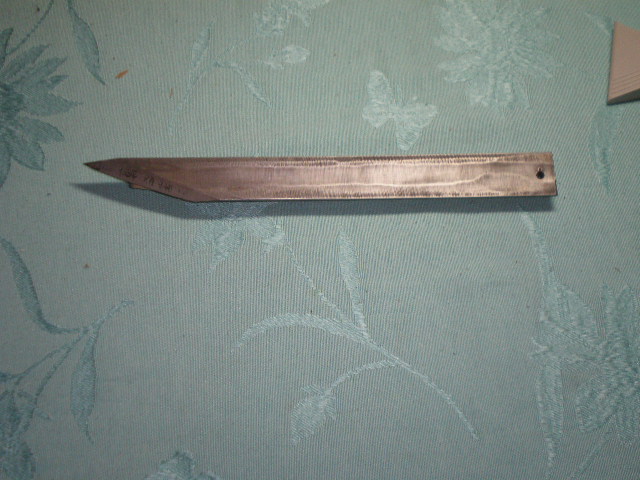
From this photo

m19.JPG


I assume that he is using a hard wheel bench grinder to shape it.

I find the finish lacking consistancy and fine finish lacking


His sharpness test video?
That 65gram push cut only works when he gives it a jiggle

I think if you took that to the maintenance and sharpening forum, they could criticize that properly.

I've seen some whittle hair there.


I think it wouldn't take too much work to do better than that.

At $50 you have to do it quickly though.
 
I'm missing what media is cut in the test.

I'd take a stab at something lighter, but I wouldn't want to cheat.

I don't mind the finish personally. I have hand forged tools that I consider fine, but wouldn't be deemed acceptable as art around here.

Nothing wrong with a high level of f&f, but as the Count infers, it raises the time ($) to make and sell.
 
Last edited:
That's about as "stripped down" basic a knife as I've ever seen here. As Fast14riot said there are lots of names for that style of cutting tool, also, alas for him, few of us make violins, so we are not his target demographic.

I think that if you had a stack of 50 of these on a table at a knife, or woodworking, show priced at $50@ you'd leave with most, if not all, of them on Sunday. He gets some credit for his marketing but not for his fine "craftsmanship" I think.

How long do those take to make anyway?

EDIT........................

I googled "Violin knife" and saw these same style of knives on a variety of websites. I guess violin makers like this style, and they must buy them. Go figure.

Corey "synthesist" Gimbel
 
Last edited:
I think that if you had a stack of 50 of these on a table at a knife, or woodworking, show priced at $50@ you'd leave with most, if not all, of them on Sunday

I was at a wood working show and knives like these sold pretty well, wood workers are looking for good tool and many don't have the money for the fancy stuff. I bought a wood scribe for $80, because I really liked the handle. Could have made it for less myself but not currently doing any wood turning.

I have use a bit of O1 and I think he is right, it is a really good steel, holds a edge and easy to sharpen. All of my shop knives are O1.

I like the thread test, I will have to try it myself, nice to see something new
 
I think if I was a woodworker, Id probably have some scrap used planer blades

I'd just grind one of those out myself on a proper planer blade sharpener, or disc sander.
 
I think if I was a woodworker, Id probably have some scrap used planer blades

I'd just grind one of those out myself on a proper planer blade sharpener, or disc sander.

Like this, I was wondering when my shop life went to pieces, at one time I was a happy woodworker and then I made this from a planer blade, and now look at me!

First Knives Jan 07 003.jpg
 
I think if I was a woodworker, Id probably have some scrap used planer blades

I'd just grind one of those out myself on a proper planer blade sharpener, or disc sander.

I'm certain you would.

Some wood guys that I've met have a sort of "them vrs us" take on the topic of wood and steel working. I know guys that would be happy to pay for an item in steel if it works well.

Maybe it comes down to equipment (and time), but some guys don't see manipulating steel as something they can do. I know that my (woefully basic) tools for grinding, and otherwise bending steel to my will, can easily be utilized for similar things on the softer medium, but some woodworkers have no interest in shaping steel for their uses. In that case a "specialized" knife that possesses qualities that are unfamiliar to them are worth a high price of admission.
 
Status
Not open for further replies.
Back
Top