
Tightening pivots on folders without pivot screws...

Joined
Mar 19, 2012
Messages
1,489
I don't like buying folders without pivot screws unless they are slipjoints because I can't easily tighten the pivots.

(I need to tighten the pivots on most knives for legal reasons).

For example:
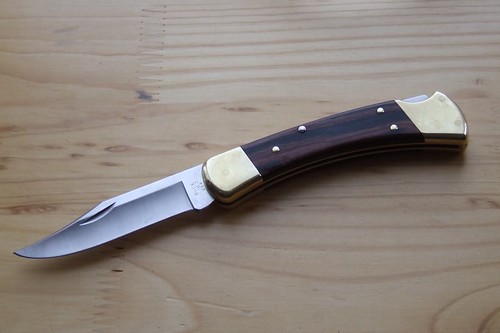
232999458_8df52ca125.jpg


3370659255_9eb9fa0359.jpg


Sometimes if the knives have a larger blade I need them to be quite tight indeed, especially when they get over 4 inches.

So... how can I do this without damaging the knife? I'm afraid that if I start peening the rivet I'll make a mess of the bolsters or make it too tight.

Also, I find it hard to see the rivets on many knives.
 
I had the old model of the Spyderco Pacific Salt which has rivets instead of screws, a few light taps with a rubber mallet or similar tool always worked. Not sure if that method would be advisable on the knives you pictured.
 
Does that apply to non locking folders as well? Traditional knives for the most part have a tougher pull and might not be considered "gravity" or one hand openers. Especially wth a nail nick. Peening the pins is the only way.
 
Does that apply to non locking folders as well? Traditional knives for the most part have a tougher pull and might not be considered "gravity" or one hand openers. Especially wth a nail nick. Peening the pins is the only way.

It applies to everything, but I've never had a non-locking folder that was easy to open with intertia. I'm mostly thinking of traditional-styled locking folders here. Specifically, I really like a lot of A. G. Russell's designs, but in large knives like the Texas Rangers Hunter or Folding Hunter I assume the large blades would be super easy to flick out without tightening (especially since I've seen people using the nails nicks to open them with one hand). I don't mind a tough pull that takes two hands...

How does one peen the pin on a knife that has the pin and bolster polished so they blend in?
 
If I was going to attempt it, I would test it on a cheaper folder. You would need a punch of some sort, and to locate the pin. Some finishes make it tough because the pins are blended very well with the bolsters. Center the punch on the pin and give it a couple of very light taps with a mallot. That should do it. I would also advise possibly putting a layer of black electrical tape on the punch to avoid scratching. It will cut through the tape with a harder strike, but light taps should cushion it to some extent.

You could also try to place the knife in a vice, wrapping it with something to avoid damage. A suede rag might work.
 
I think you might get more responses about this in the "maintenance, tinkering, and embellishment" section.
 
I don't like buying folders without pivot screws unless they are slipjoints because I can't easily tighten the pivots.

(I need to tighten the pivots on most knives for legal reasons).

For example:

232999458_8df52ca125.jpg


3370659255_9eb9fa0359.jpg


Sometimes if the knives have a larger blade I need them to be quite tight indeed, especially when they get over 4 inches.

So... how can I do this without damaging the knife? I'm afraid that if I start peening the rivet I'll make a mess of the bolsters or make it too tight.

Also, I find it hard to see the rivets on many knives.

Where do you live that requires you to distroy the value of ordenary knives before you can carry them. The only police state I know of is the XX.
 
Where do you live that requires you to distroy the value of ordenary knives before you can carry them. The only police state I know of is the XX.


Canada.

It's more of a technicality, but I have had more than one knife seized by Customs because the pivots were two loose. I've also read many cases where the police charged someone with possession of a prohibited weapon for having a knife that could flick open, so now it's become something I am very aware of. :o

For example:

A "prohibited weapon" is defined in s. 84 of the Criminal Code to include "a knife that has a blade that opens automatically by gravity or centrifugal force". […] Nor does the blade simply fall out of the knife's handle; it opening by way of centrifugal force requires the conscious application of this type of force. […] Clarke, while testifying, demonstrated the manner in which he centrifugally opened the knife-blade using a strong flick of his wrist while holding the knife's handle.

The knife was not designed to open by centrifugal force but has tabs on the blade that assist in opening it in the usual fashion. He was not aware that the knife could open by centrifugal force. Indeed at the time of the arrest, the officer could not make the knife open in that fashion every time he tried and when he tried before the Court he had even less luck flipping it open. The accused said that he had purchased the knife at a retail outlet.

urther investigation by the officers revealed that the knife that had been in possession of the appellant could have the blade portion opened by centrifugal force.
 
Back
Top