
Tippmann Sewing?

G L Drew

Knifemaker / Craftsman / Service Provider
Joined
Feb 3, 2005
Messages
4,757
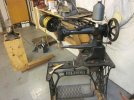
I recently bought an antique Singer sewing machine that was made to sew leather. I have had a lot of fun getting it tuned up and learning to sew but it just won't do what I need to sew sheaths. It works great for a 100 year old machine but I want to use a heavier thread and sew through three layers of heavy leather.

Has anyone here had experience with the Tippmann Boss machine? It looks like the answer for a quick way to make sheaths but I would sure like some input before I spend $1500.
10-16.jpg
 
Last edited:
I have a commercial Consew and a Tippmann Boss. I never use the Consew. The Tippmann is made for sewing sheaths. Most powered machines are for sewing leather garments and upholstery, not sheaths. The guide foot on the Tippmann makes straight seams easy,too. It is a luxury, but you won't regret having one if you make sheaths.

I'll give you a tip about using one for stitching.This tip applies to hand stitching sheaths ,too. There will be a 6-10" long pair of threads on each end of the seam (On one end only with hand stitching). Most folks place a dot of super glue on the thread to lock it in the hole, and cut it off. Don't do that right away. Instead, tie the ends of those Irish Pennants together to make a pair of loops. Do all the dying and finish coats, and use the loops to suspend the sheath on a rod or pipe. Once all work is done, and the finish is dry, put the super glue dots on the stitch and trim the thread flush. If you do it with the sheath unfinished, the leather at the glue spot won't take the dye or finish. Most commercial sheaths blanks have this problem.
 
Have rivots gone off the market?? The machine you have just will not work for the heavy leather used in sheaths. I have a very similar one that I had hoped would work, but now is just a dust collector. The Tippmann Boss is the very best answer. Short learning curve and very dependable once you have it set. It's possible to find a good used one for around $750-$800, just have to search. Top of the line would be an Artesian 3000 sewing machine. Cost about $3200 new. Sandy Morrissay used a Tippmann for years and went to the Artesian a couple of years ago and loves it.

No need to use super glue with either hand or machine sewing to finish the stitch. Just back stitch two and a half holes, leaving both threads on the back side. Cut the ends off close and use a small soldering iron to melt the ends back into themselves. Of course, that works best with waxed nylon thread ( which you'll use with a machine). If you like the super glue, dye everything before gluing up and sewing.
 
Have rivots gone off the market??

I am thinking about sewing again so that I don't have to take any more guff from you about rivets in my sheaths :)

Seriously Rick, I have always admired your leather work but I have been trying to keep the pricing of my knives low and I just can't spend 4-5 hours making a sheath for a $100 knife. Can I justify $1500 for a sewing machine? I wonder if I will live long enough to depreciate that kind of investment or like Bladsmith says will it just be a luxury?
 
Take a look at some if the motorized machines as well. For just a moderate price difference you could pick up an artisan and expand your offerings.
 
Gerry,
Your thinking on this is exactly the same as mine. The only way to continue selling knives is to keep the price point within the market at this time. Today, that point is on the low side, so every extra minute spent means less profit. That would seem to make a sewing machine purchase a good idea due to the time savings. On the other hand, as you point out, how do you justify the expense and the length of depreciation to come out even. With the number of sheaths and holsters I make, I'd dearly love a Tippmann, but still can't come up with or justify the cost. If business was just a little better........
 
I want one of these:


[video=youtube;tO5bX60nbFQ]http://www.youtube.com/watch?v=tO5bX60nbFQ[/video]

Thanks Phil, I haven't seen that before.

$1,800 in my area for a reconditioned model -
Reverse is a new feature, If I can find a used one, I have to watch that it has reverse.


And I like the fact you have 2 full spools of thread instead of a little bobbin.
Although on small items such as sheath, that wouldn't be too much of a risk.

No running out of thread in the middle of a stitch.


On one youtube video some fellow has trouble setting up timing on a Boss
Is this a common problem ?
 
Last edited:
I bought a Boss on Stacy's advice. I've not regretted it for a second. It is a perfect machine for making sheaths. 5 layers of the heavy 9/10 oz leather is absolutely no problem for the Boss. Since a sheath is a relatively small sewing job a powered machine is not all that helpful...in my opinion anyway. The manual action is actually a plus as you can see exactly where the next hole is going to go.

It is a good chunk of change but it is a very solid machine, it has greatly improved my work, and now the only part of making knives I didn't like(making holes and hand stitching) is a pleasure.
 
Timing is mainly a factor of setting the thread tension right. You want it set so the loop of each stitch is in the center of the leather.
With one hand on the lever and one on the sheath, I can stitch as fast as I would ever want to. On a 6" sheath with 8SPI, that is only about 50 stitches, so it takes about one minute.....max.
 
Thanks a lot for the info guys. I had a great knife selling show in Asheville this week end so maybe .......
 
One thing I have noticed about sheaths sewn on BOSS machines is the "footprint" it leaves in the leather. Maybe there is a setting on the machine itself or a process to get them out but they stick out like a soar thumb, to me. I can pick out folks who use one as I walk from table to table at Shows. Of course, that excludes the makers who have found a way around it.

Please share, if you have.

Rick
 
Gerry you might think about inquiring around the saddle shops in the area. They use industrial machines that are made for sewing our weight and higher leather.

The one over there by Westgate has a number of old behemoths in the lower section. Which, if you're not already aware, resells for Tandy and will order anything materials wise you might need. They also stock a bunch of stamps and other hand-tools. Regardless, they might be able to put you in touch with someone that has an appropriate machine, they're super nice, and there seems to be just about any machine for any craft if you start digging in our area.
 
I like my Tipp Boss just fine. What it did for me was free up my "mental" so I could be more creative with my sheaths. Dreading sitting and hand stitching 10 to 15 sheaths used to bum me out (and really played heck on my pinkies). Now, like Stacy said stroke, stroke, stroke and you're done. RLo's right on the back-stitching, better lock on threads and no glue showing to mess things up.
Foot marks on the leather can be minimized with the right adjustments plus using the right followup tools to smooth things back out. Number one mistake is sewing while the leather is still wet and not getting your thread grooves matched front to back. Like anything in this game, you have to watch what you are doing and not do it wrong.

Gerry - glad you had a good show. Sorry you couldn't make TR. I like to think my Tipp paid for itself in less than a year. Plus you can take on a few extra sheath/holster jobs to make up the diff. pretty quick. Once you get it set and get the rythem of the machine it is very fast and easy. You can get a used one a good bit cheaper, just kick the bushes. I got mine 1/3 retail and have seen others go for near the same. Sort of like anvils.....keep the cash in your pocket and your eyes open. Tippman has a great customer support rep. and they can walk you through most set up problems. Biggest problem most guys have with them is they don't do proper maintenance and keep it cleaned and oiled properly.
 
I once walked into the Red Wing boot factory in Minnesota and showed the guy (maintenance guy)
a glued up 8oz three layer sheath. He looked me right in the eye and said "you need a Tippman".
I'm sure there are a number of old american lockstitch and other machines that would work fine,
including the newer powered models. As Stacy said -these machines were built to do this. Even
though I don't do too many straight blades anymore I'm not getting rid of my Tippman.
Ken.
 
Back
Top