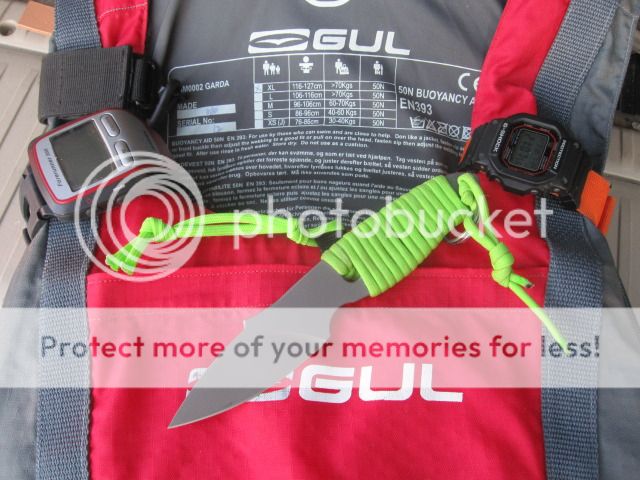
Titanium as a Steel

Joined
Sep 24, 2012
Messages
366
So I've been meaning to purchase one of Amsler's knives... However he offers them both in Titanium and S35vn and I have little to no experience with either of those as blade steels. Hoping someone here could shed some light on the advantages of either one.
Thanks in advance.
 
In my experience owning a ZT 0550 S35VN is a very fine steel. It holds an edge for a long time and is easy to touch up on a strop or a sharpmaker. As far as titanium, if it's not carbodized titanium than it won't hold an edge for very long. I would imagine that the titanium is more than likely carbodized which in that case will hold an edge pretty well, but it may not get quite as sharp as steel.
 
Titanium isn't a steel. Also, if you're talking about the advantages of using titanium to create a blade, it'll probably be more durable? No idea, but I do know that it won't be very sharp. Titanium doesn't seem to take an edge very well. Go for the S35vn, although I'm pretty sure that they meant that blade is in S35vn and the handle is made out of titanium and you just misread.
 
As pointed out by XiaolongJ, Ti is not a steel. It is Ti.

For most uses, steel is better than Ti. The benefit of having a Ti blade is for corrosion-resistance and its nonmagnetic properties (the strength of Ti in weight savings and anti-fatigue nature are more beneficial for aircraft, not knives). So unless you are working in a harsh environment like underneath the sea, or you are a EOD/mone clearance professional, Ti is more of a novelty than practicality.

If you want to keep something in your pocket to cut stuff with, steel is the better choice. Ti will not hold as good of an edge, nor will it cut nearly as well as steels.
 
He didn't misread, Amsler does a lot of small Ti fixed blades. For the most part their main purpose is self defense, titanium (unless it has a carbide edge) isn't really the best for an EDC. As for the advantages of Ti, lighter maybe? I'm not sure, someone else will have to chime in
 
If you plan on using it or using it often I'd definitely go with steel, if you plan on keeping on you only for a self defense knife, you could go with either since it won't need to hold an edge, and the titanium will be slightly lighter so you'll be able to move it slightly faster?
 
If you plan on using it or using it often I'd definitely go with steel, if you plan on keeping on you only for a self defense knife, you could go with either since it won't need to hold an edge, and the titanium will be slightly lighter so you'll be able to move it slightly faster?

LOL! Or you could do 3 pushups a day, and negate that difference
 
AMsler knives are offered iin a Ti blade that is carbodized. Ti is and has been used by makers for blades with and with out good success for a while now when it carbiodized it is around 60 RHC or better but will wear on you faster than steel will. I know warren Thomas works almost exclusively in Ti . The cool thing about Ti as a blade is that it can be anodized to a rainbow of colors. Its used in Dive knives allot because it will not rush in any way or is affected by salt water and in EOD tools where a non magnetic tool is a safety issue. Ti is also very light weight compared to steel but not the greatest choice for EDC rolls. If you looking for a Cool knife for your collection I would give one in Ti a try have it anodized to some wicked color if your after a user go for the steel.
 
Titanium isn't an ideal metal to make a typical knife blade with. Don't believe what you see in the movies or razor blade commercials. In the movies, they'll say a blade is titanium because it sounds cool. In a razor commercial, they're talking about titanium nitride coated steel blades. Titanium can't get as hard as even the crappiest Chinese junk flea market knives. Titanium makes for a very poor sword.

However, titanium isn't useless for making blades with. As mentioned before, it can be a person's choice for a self defense blade or diving knife, if that's what they're looking for. It doesn't rust or corrosively oxidize. And while edge-holding is poor, that's not really an issue if you're never going to use it (or hope that's the case) only to defend yourself. And of course, it's lighter than steel.

As for S35VN, I don't have any experience with it myself, but it's an evolution of S30V, a much used and highly respected steel. It doesn't have the wear resistance of M390 or S110V, but is instead a good compromise between edge holding and ease of sharpening. If you're looking for a knife to use every day, go with this rather than titanium.
 
I apologize Xialong, I should have been more accurate and used "metals."
I can assure you, I did not misread the product label on $200 item; Amsler does offer his knife blade and handle made from Titanium.
Thanks for the info on Titanium's properties though. Much appreciated.

Any ideas on how S35vn stacks up compared to S30V?
I hear that while it is the next step in blade steel, it isn't actually that much better.
 
It's worth mentioning that there is one place where the carbidized Ti blade is outstanding, and that is when used extensively in cutting paper and cardboard. The non carb'd side of the edge wears faster than the carb'd side essentially self sharpening the edge through use. I work for a moving company occasionally and a carb'd Ti knife will slice the toughest cardboard all day every day with not even a touchup. :thumbup:
 
I have a few Mission knives in Ti. They get as sharp as steel best I can tell. Mine will shave arm hairs like my steel knives. The Beta ti is th the lower 50's hardness wise just like knives made out of 420j2, some slipjoints like case CV, and a few more ( Ontario Spec plus folder rc 51 to 55), mercator, black cat, etc. Knives a lot of us grew up with including the flea market / gas station 420j2 knives.

Ti does have more wear resistance than 420J2 though. :)

I'm not sure what the composition of beta ti is but I know it's not the 6Aluminum4Vanidum ( 6AL4V) we see most often as the frames and locks in our common Ti knives.

The Mission Ti fixed blades are pretty much apocalypse proof and will outlast our civilization even if they are dull. :) Unless you have a volcano, or maybe a blast furnace handy the best you can do is grind it down and make rocket fuel from the dust left over. ( aluminum too )

Joe
 
Last edited:
Not to derail the thread, but I think this is still on topic. How do you sharpen the carbidized blade? Can you use a conventional sharpening method? As you sharpen, does the blade wear back toward the spine like a normal knife, or do you just knock the carbidizing off the edge until it has to be redone? Always been curious, thanks.

jstrange
 
Mission knives has made the the only quality Ti knives as far as I'm concerned.
 
I have a few Mission knives in Ti. They get as sharp as steel best I can tell. Mine will shave arm hairs like my steel knives. The Beta ti is th the lower 50's hardness wise just like knives made out of 420j2, some slipjoints like case CV, and a few more ( Ontario Spec plus folder rc 51 to 55), mercator, black cat, etc. Knives a lot of us grew up with including the flea market / gas station 420j2 knives.

Ti does have more wear resistance than 420J2 though. :)

I'm not sure what the composition of beta ti is but I know it's not the 6Aluminum4Vanidum ( 6AL4V) we see most often as the frames and locks in our common Ti knives.

The Mission Ti fixed blades are pretty much apocalypse proof and will outlast our civilization even if they are dull. :) Unless you have a volcano, or maybe a blast furnace handy the best you can do is grind it down and make rocket fuel from the dust left over. ( aluminum too )

Joe

Good post.

Sadly a lot people seems to have handled the multitude of non-Beta titanium knives out there.
Mission is one of the rare manufacturers, who make knives of Beta ti.

I have a couple of Mission titanium knives. I very often use my ti MPU and its hair popping sharp and the edge stays sharp just fine.
It will do several cutting tasks, zip through a few Bambis and still suffer no noticable loss of sharpness.

MissionMPU1.jpg


IMG_0176-1.jpg


IMG_0145.jpg


MissionMPU8.jpg


Its my kayaking knife as well. So nice to be able to just leave it in the flotation ves pocket after rinsing the rig with fresh water and not worry about the knife rusting or have to take care of it, like I had to with my previous 'SS' kayaking knife.

IMG_0044.jpg
 
Recently I was wondering the same thing regarding ti knives (after impulsively buying a Warren Thomas :o) and after searching bladeforums this is the best info I found.

It came from the FAQ in Ben Tang's subforum (link) and is not mine, I am just quoting HikingMano who posted it originally.


• Titanium knives with carbidized edge: What are they, why are you making them, and how are they made?

(Quote Originally Posted by Ban)
Most people think of Titanium knives as novelty items that hold very little practical value unless you are a diver (recreational, professional/commercial, EOD, etc). For the most part it is true. Titanium is soft, relative to steel, and it won’t hold an edge like a good heat-treated steel blade will. However, to the average civilian user, titanium offers a high strength-to-weight ratio, superior corrosion resistance, and a tough and ductile edge (so chipping shouldn’t be an issue).

Now, add some tungsten carbide to the mix and things start to look even more favorable for the titanium blade. Tungsten carbide is extremely hard; it’s a 9 in the Moh scale. A measurement of hardness on the Moh scale does not readily convert to the Rockwell C measurement most of us are familiar with, but I think it would be roughly in the mid 80's. If we apply a tungsten carbide edge to a titanium blade, we end up with a very low maintenance (effectively rustproof) piece of cutlery that can hold an edge just as well if not better than most quality steel edges. When a titanium blade is given a decent edge geometry, the carbide allows the titanium to hold a good edge and cut well.

I’ve been able to slice slivers of paper easily with a polished carbidized titanium blade. While it could no longer easily and cleanly slice paper after about 25-30 cuts through cardboard, I know it could have kept cutting cardboard for much longer without a problem. I have had a few guys put their carbidized Ti knives through the ringer, and all of them are amazed at how well the edges hold up and how easy they are to maintain. One guy used his knife to cut and lay up a yard full of sod. Needless to say the knife was dull afterwards from all the sand and various other grits in the soil, but it required minimal work to bring the edge back to working order. People have reported their Ti knives functioning well in a variety of tasks, including food prep, working with wood, and taking apart abrasive packaging materials (e.g. cardboard).

I, and others, have noticed that the carbidized edge will still cut very well even when it feels dull. In fact, the carbide edge can almost be considered self-sharpening: since the carbides are only applied to one side of the titanium blade edge, more carbide is exposed as the titanium wears away on the other side. This is similar to the self-sharpening phenomenon observed with the teeth of beavers. Actual sharpening of a carbidized titanium edge is very simple. See the sharpening and maintenance questions further along in this FAQ for more detail.

So why carbidized Ti knives? I think these knives should work well in the kitchen, where they would be cutting relatively soft, non-abrasive, material (veggies, fruit, meat) in a wet and corrosive environment. Titanium’s superior corrosion resistance, coupled with the easily maintained carbide edge, makes these knives perfect for every day kitchen duty. I also suspect that carbidized Ti knives will catch on with the ultralight hiking/backpacking crowd. A strong, lightweight, and very low maintenance knife sounds ideal for the ultralight backpacker - someone who typically isn’t out there building log cabins or doing things that require a fine edge.

How do I get the tungsten carbide onto the titanium? I currently use “The Carbidizer” from Travers Tool Co., Inc. Basically, this tungsten carbide applicator electronically embeds the carbides into the titanium. You can sort of think of it as a micro-weld, although no heat is generated. While I’m sure it’s not as fast or as powerful as the Rocklinizer, it does the job for me for now. I am currently looking into more powerful unit, which is supposed to be very close to the Rocklinizer for increased speed.

• How do you sharpen carbidized Ti BT knives?


(Quote Originally Posted by Ban)
As I touched upon in the Carbidized Ti knives FAQ question, the tungsten carbide is only applied to one side of the edge on the Ti knives. To sharpen the carbidized knife, you have merely to sharpen or strop the titanium side of the blade/edge to expose more carbides and thereby refresh the cutting edge. Do not sharpen the carbide side of the edge; you will only remove carbides from the titanium substrate.

You should very rarely need to do more than strop the non-carbide side of the blade on a compound-loaded strop. In fact, before you even hit a strop, you should first steel the edge to straighten any rolls and align the edge. Often, a good steeling is all that’s really needed to return a carbidized Ti knife to a utility edge. The guy discussed above who sodded an entire yard with the help of a carbidized Ti necker, brought a working edge back to his knife with only a bit of steeling and a couple of passes on a compound-loaded strop. If you have and are adept with a belt grinder, the process is even easier… three seconds on a leather belt and the edge is brand new again.

 
Back
Top