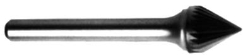
Tool or bit for beveling edges???

Joined
Aug 5, 2005
Messages
5,527
Hello!

Here is what I am trying to do: I have a folder with skeletonized Titanium scales, similar to the Buck 186 or 560 knife seen here -

c8_1.JPG


http://cgi.ebay.com/Buck-XLTi-Model-560-Titanium-NIB-1980s-Beautiful_W0QQitemZ7218733055

I want to bevel (or chamfer) the outer edges of the scales, like the photo above. Because of the irregular outline, this is quite difficult. I have no skill whatsoever with a file, so that method is out.

What I'm thinking is some kind of conical diamond or hard-cutting bit for a router, with a ball-bearing shaft to keep a fixed cutting depth. Something like this carbide bit from Grainger -

4AFF2.JPG


ROUTER BIT,1/4 IN
Carbide Tipped Chamfer Router Bit, Angle 45 Degrees, Shank Diameter 1/4 Inch, Carbide Length 3/4 Inches, Overall Length 2 1/8 Inches


Unfortunately, I don't have the vocabulary of the trade, or know quite where to look...

I'm only going to be beveling ~.030" off the edges, and I may actually try this router bit. I'm not enthusiastic about it, but for only .030" it should be OK.

Hopefully, someone else here knows a better way, or has seen a tool bit or tool for beveling, or knows someone whose brother-in-law's nephew's best friend did this before, and can describe the process...

Thankyouverymuch!!!... :D
 
Its a pain. The big boys have CNC and special end mills for that. I use a disc sander with a table that tilts for the outside radous but inside is the hard part. Usually I can do those areas with a dremel and a shot of whiskey.
 
I think that if you try that cutter in a router on most metals, you will find yourself in a lot of trouble. (Dangerous IMHO) I personally don't recomment it. Routers are far too fast for those types of bits.

btw, what you are looking for is a chamfer tool or a corner round depending on the desire for a radius around the edge or a chamfer.
Use these daily on a CNC mill.


hth

Bill
 
Thanks for the replies! :thumbup:

I think that instead of using a ball-bearing cutter, I can mount a 3/8" ball-bearing on a custom-made jig (just a flat plate tapped for the bearing) and center a 1/2" or 5/8" x 60* rotary file or carbide burr above it, say in a drill press or mill quill. Adjust the file/burr height to get a ~.030" bevel, and spin it at high speed. Then [hopefully] just feed the scale in and let it cut...

How's that sound??? :rolleyes:

51.jpg


http://www.discount-tools.com/51single.cfm

I'd have to grind the tip off the burr...hmmm...what do you grind carbide with???
 
chickentrax said:
I'd have to grind the tip off the burr...hmmm...what do you grind carbide with???


Diamond laps or wheels work nicely. However, you may or may not have access to these tools. The lap would take forever, so the wheel would be alot more efficient. Putting too much pressure on the diamond wheels tends to roll the industrial diamonds out of the substrate.

hth

Bill
 
I was down at the local Ace Hardware looking at their Dremel bits...they do have cutting disks, but they just say "Hard Metals", not which hard metals...

I don't have access to a diamond slitter...if there is such a thing...

Looks like Google will get a workout today... :p
 
I was down at the local Ace Hardware looking at their Dremel bits...they do have cutting disks, but they just say "Hard Metals", not which hard metals...

I don't have access to a diamond slitter...if there is such a thing...

Looks like Google will get a workout today... :p

Ok, I am going to be the guy that helps everyone with a dremel tool out...

If you already have this link shame on you for not sharing it with your knife making brothers. :p

http://www.widgetsupply.com/

If you cant find it here you just ain't going to find it. :D
 
If you are chamfering the edges of wood scales or handles. will a standard router bit do the trick or should i exepct ragged, torn up and split edges?:p ( is suspect that the answer to the question is the latter when talking about ebony or snakewood....sheesh!!!!)
 
Actually, I hope that if Chickentrax sees this thread from early last year he'll report back on what worked for him. He may well have come up with a novel method we'd all like to hear.

The bad thing about files and scrapers is that things happen real slow. It's also the good thing. :)
 
I didn't expect this thread to float to the top of the pool again... :D

OK, here's what I did - I got one of those 45* Carbide cutters; made a special fixture for my mill to spin it as fast as possible, with the bit centered above a piece of tubing pressed in a block of steel...and chamfered all edges of the knife...In fact, I did two of them...one Titanium and one stainless steel...it worked great! Freehand feeding the liner/bolster (they're combined on these skeletonized knives) against the rotation...

Now...As to the brass & wood scaled/linered Buck folder I made...I used a quarter round ball bearing router bit and a router table...took off a little bit at a time...freehand feeding again, against rotation...glasses, gloves, smock, etc...this also worked great!

I practiced on aluminum mockups in both cases, and I certainly don't recommend it to anyone who is not experienced in machine tools...and it's not for the faint of heart... :)
 
Actually, I hope that if Chickentrax sees this thread from early last year he'll report back on what worked for him. He may well have come up with a novel method we'd all like to hear.

...Or maybe not hear... :D

The bad thing about files and scrapers is that things happen real slow. It's also the good thing. :)

I used to have a sign in my shop - "Danger! Low Flying Tools!"... :eek: :D

I have pics of all three knives, completed...will post on request... :rolleyes:
 
........and it's not for the faint of heart... :)

I can just imagine that technique would keep the old ringmeat squinched up tight. :eek:

Thanks for sharing. :thumbup: Very interesting. I hope I manage to remember that. I have the cutters.
 
I can just imagine that technique would keep the old ringmeat squinched up tight. :eek:

The pucker factor is high...but the rewards are great... :D

Both of these used OEM blades, rockerbars, and springs...the rest is handmade...Titanium and brass on the 110; brass and oak on the 446... :)
 
That chamfering on the metal frame turned out very, very nice. I am impressed with the lack of chatter. Nice touch!
 
I am impressed with the lack of chatter.

There is some...it sort of adds to the "machined" look...high speed and a slow steady draw seem to work best... ;)

BTW: That Titanium is "as machined"; no polishing...although the flat could sure use some... :D

...and that is the last time I will work with Titanium... :grumpy:
 
Back
Top