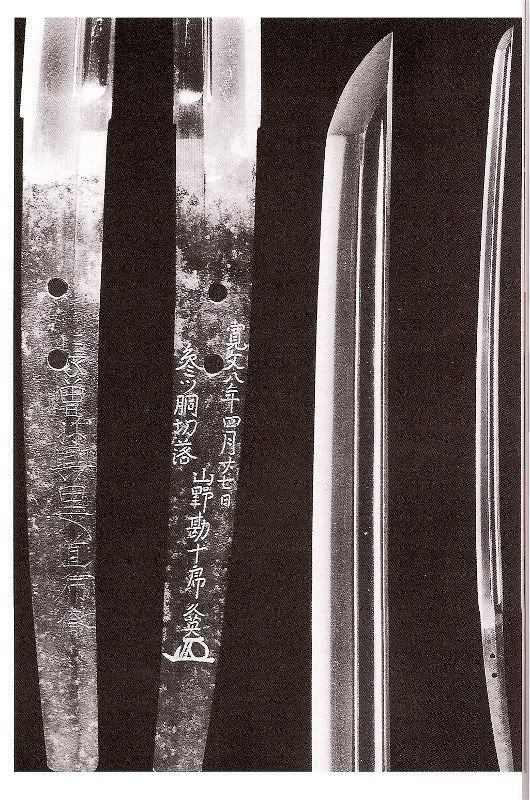
The few nihonto I've been able to handle were around 1/3" thick at the base. Search for Kasane- this is the term for thickness measurement. The Kashima sisters routinely list thickness and other useful dimensions of real antiques on their site; check their catalogue and gallery for lots of info:
http://www.ksky.ne.jp./~sumie99/ I took measurements of my great uncle's swords that may give you an idea of the distal taper if you're interested. The older one had been polished extensively, so it got thinner towards the tip, and had its dynamic balance point right around the yokote. His newer (1939 IIRC) sword had less taper and the dynamic balance point was about a third of the way back from the tip. They don't generally exibit much harmonic stuff compared to European swords since they're rather thick and stiff.
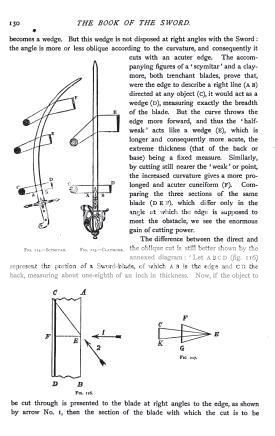
I pulled this from "The Book of the Sword" by Sir Richard Burton which illustrates some of the geometry differences between the straight blade and the curved one.
Just note the diagram is greatly exaggerated. The spine does not get any thinner when draw-cutting, and at least on blades with only a modest amount of curvature (or straight) you won't be cutting at a 45 degree angle (if the blade meets the target relatively straight).
...one of the things demonstrated in the picture that Bors posted is a demonstration of effective sectional density--i.e. how much mass is behind a surface area. If you were to draw a vertical line through the blade at the point of impact you would find a larger mass behind the curved blade as opposed to a straight blade of equal width thanks to the curvature aiding in mass placement.
Not sure I'd worry about this in the grand scheme of things. If you really want more sectional density, just make the blade wider from the start, etc.
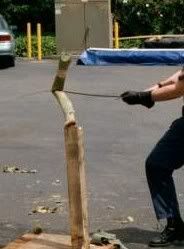
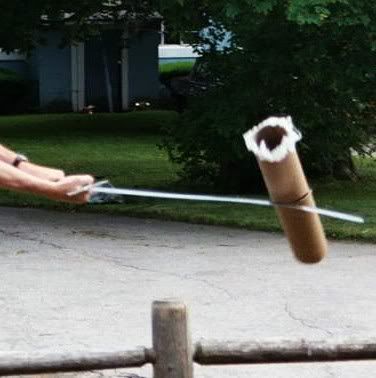
Certain mediums, such as skin, just react better to a slicing/drawing type cut by nature. I can take a sharp pocketknife and press it firmly against my skin, but I don't dare draw it across my skin under that same pressure!
On cutting swords it's common to find the balance to be about 6" in front of the guard.
Keep in mind how little the balance point alone can tell us about a sword's dynamic handling and impact properties. I can take a bar and attach two 1 pound weights at either end, and another bar with just a 2 pound weight in the center. Both will have the same length, mass, and balance point, but will handle totally differently. The moments of inertia are what determine circular motions/behavior.






 .
.