Triplets, custom Anza knives

Joined
Dec 31, 2000
Messages
17,079
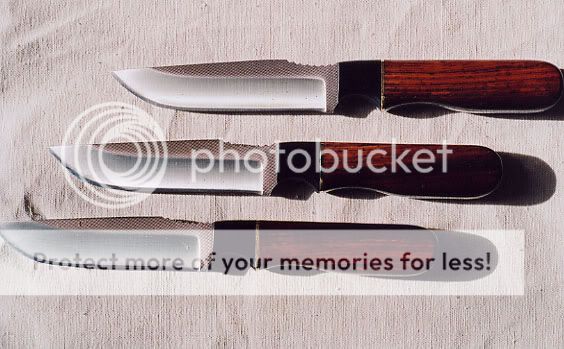
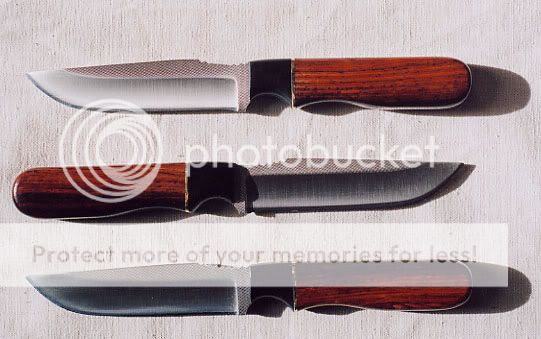
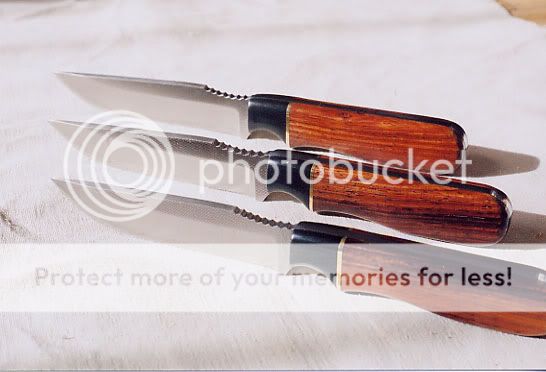
Here are three identical Anza knives, one for myself and each of my brothers. Based on my own design ideas and material choices, built by Anza, and later engraved "1/3" on the spines.

Any comments on the photos or knives are welcome. The photos were taken on the dining table as the winter sun streamed in, filtered by a sheer curtain. I'm especially interested in your opinions on the knives' arrangement.

3Anza1-3.jpg


2Anza1-3.jpg


1Anza1-3.jpg


Best Wishes,
Bob
 
I find lots to like in the design. Nice job!! Your brothers are lucky to have you in their camp for knife design. :) I especially like the materials choice. You picked out a gorgeous combo of wood, spacer, and bolster. Is the bolster micarta?

I don't usually care for material edges/boundaries running perpendicular to the major axis of handles because they serve as a disruptive jarring to the viewer's eye flowing along the handle. However, this knife doesn't seem to suffer from that phenomenon due to the proportion and balance of wood-to-bolster, coupled with the line of the wood grain. I also think it helps that the wood is dark enough that there isn't a huge light-dark shift going from the handle to the bolster.

============================================

As for the photos themselves, I'll break my analysis into "goods" and "bads" and "tips".

Good:
  • I like the dynamic, repeating-pattern diagonal line used to arrange the knives in the first and third photos, as well as the Z-line achieved by the flip-flop of the knives in the second shot.

  • The slightly textured monochromatic background works well to show off the knives. It especially shows the contrast between the coolness of its slightly bluish tint and the warmth of the reddish handle material.

Bad:
  • You've no doubt already recognized that the overly-stark contrast created by the direct sunlight (only minimally influenced by the sheer curtain) falling on the knives didn't do them justice. The shadows blurring the edge of the knife is especially noted in the first photo.

  • With strong side-light as in your pics, wrinkles in fabric are very unforgiving. Even the smallest ripple will show up glaringly. Ironing the fabric is about the only way to avoid them.

Tips:
  • Build or buy a diffusing lightbox (also called a "softbox") to greatly reduce the starkness of the shadows around the knives.

  • Use multiple lights or reflectors to fill in some of the dark areas with light. Reflectors can be very simple (sheet of white paper, piece of white tagboard, small mirror, aluminum foil wrapped around cardboard, etc propped up on the perimeter of lightbox or near subject in desktop shooting) or more complicated (same sorts of materials mounted on articulated arms).

  • While this isn't especially bad in your shots, reduce the background area around the knives to reduce the visual "floating knife" syndrome. This phenomenon is seen as a knife floating on the background, disconnected from the edges of the frame or anything around it, if there are props used in the picture. The larger the distance between the knife and the edges of the frame, the more it makes the knife get visually "lost" in the expanse of the background. You can reduce this knife-to-frame-edge distance either by (a) zooming in tight on the knife, (b) simply getting closer to the knife with your camera, or (c) editing out the excess background space in post-production software like Photoshop.

============================================

Let me recommend that you follow the knife photography link in my sig below. That leads to lots of tutorials and threads on how to effectively photograph knives.

Also, pay close attention to the work of professional knife photographers like Jim Cooper, Murray White, Terrill Hoffman, and Mitch Lum (or any others whose work you like). Study their shots to see if you can reverse-engineer the photos to figure out the mechanics of how the picture was set up, lit, and shot.
 
Those are beautiful knives!! I ahve been dying to see them since I heard you had triplets made. WOW!! You have lucky brothers!
 
Thank you very much for the comments. The material is simply some leftover canvas drop-cloth.

I didn't realize when I took the photos how much shadow was actually present. It wasn't really that bad, but it sure showed up in the photos. See how the shadow in the third photo isn't black? That's how it looked in real life.

This was also the first time I played with light at a steep angle. It worked well, I think, in the third photo, but not the first or second.

I've been happy with some previous knife photos taken in direct sunlight, but they were taken in the summer with the light directly overhead.

While I was happy with the lighting in the third picture, I obviously needed to fill the gap in the top right corner where the kitchen table shows. One knife got cut out of the frame. And see how the handle ends are staggered but the blades are aligned? If taking the picture over, I've offset the blade edges too.

I may play with a light box at some future time. Thanks for the great links and info!

Regarding the knives themselves: I didn't actually design the knife from scratch. I mixed and matched various design elements from knives shown at the Anza website, selected the materials, and specified the handle and blade lengths.

One thing I hadn't realized when I ordered: I selected a particular blade style because I liked the tip, but didn't notice that blade also had a half-moon removed from the top of the blade for thumb placement. I think it distracts from the knives' lines and looks like someone took a bite from the spine, but after fondling the knives for a time it grew on me, and might be quite useful for controlling the blade during fine cutting.

The cocobolo that Anza used is incredibly beautiful. The fore-handles are black plastic I believe. I need to check with a microscope - they could be ebony wood, maybe. They don't look like micarta regardless.

I don't usually care for material edges/boundaries running perpendicular to the major axis of handles because they serve as a disruptive jarring to the viewer's eye flowing along the handle. However, this knife doesn't seem to suffer from that phenomenon due to the proportion and balance of wood-to-bolster, coupled with the line of the wood grain. I also think it helps that the wood is dark enough that there isn't a huge light-dark shift going from the handle to the bolster.
I get what you're saying. So maybe have the brass spacer run at an angle? I've never seen an Anza like that, but maybe I'll ask about it next time.

Best Wishes,
Bob

 
Back
Top