I have just finished quenching my D2 stock in water. I hated doing that but had no oil of any sort. Is water quenching D2 safe for the knife or did I get lucky without hearing the big "pop"? I hope I didn't jack this blade up after all the work I put into it but live and learn.

-
The BladeForums.com 2024 Traditional Knife is available! Price is $250 ea (shipped within CONUS).
Order here: https://www.bladeforums.com/help/2024-traditional/
You are using an out of date browser. It may not display this or other websites correctly.
You should upgrade or use an alternative browser.
You should upgrade or use an alternative browser.
TROLL ALERT - Thread Locked
- Thread starter Sirmasta
- Start date
- Status
- Not open for further replies.

- Joined
- Oct 3, 2002
- Messages
- 12,297
You're either very lucky, or you didn't get the blade hot enough. D2 and water don't mix, at all.
D2 can be oil quenched, but it is an air hardening steel.
D2 can be oil quenched, but it is an air hardening steel.
- Joined
- Jan 1, 2009
- Messages
- 676
Thanks or sharing. I get the impression you knew this was not a good thing. Thousands of makers woke up this morning - read the title of your thread and looked like this - 
I don't think any of us expected it would survive - but it sounds like it may have. I don't think I'd want this blade as a user, but it would sure be interesting to see some testing done on it.
Some of science's greatest discoveries have come from an 'oops' moment. Keep us posted.
Rob!
I don't think any of us expected it would survive - but it sounds like it may have. I don't think I'd want this blade as a user, but it would sure be interesting to see some testing done on it.
Some of science's greatest discoveries have come from an 'oops' moment. Keep us posted.
Rob!

Stacy E. Apelt - Bladesmith
ilmarinen - MODERATOR
Moderator
Knifemaker / Craftsman / Service Provider
- Joined
- Aug 20, 2004
- Messages
- 38,474
Please give the details of how you heated the blade, temperatures, and the quench. It sounds like you may have treated it like it was a carbon steel. If it was fully austinitized at 1850F I can not believe it would survive a water quench. D2 is an air cooling steel.

- Joined
- Jan 6, 2005
- Messages
- 9,680
Have I ever showed you my fully sharpened, clay coated, cold water quenched, O1 knife?
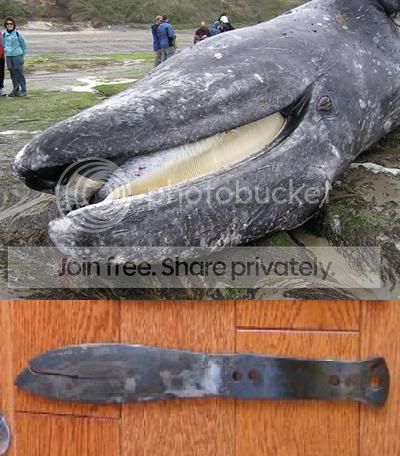
You probably didn't get the blade up to soak temperature or it would be gone if it had been quenchened in water. I would try normalizing the steel and do another heat treat and quench in oil or an air quench to be on the safe side. Olive oil works nicely and will make your shop smell like a kitchen.
- Joined
- Jun 23, 2006
- Messages
- 2,418
I know a fellow who quenched a D2 platen face in water and left it as hardened for his platen. Still running it, afik. So, this is not the first I've heard of someone doing a water quench with "success".
It may look OK, but if it got to temp, you may have microfracturing.
It may look OK, but if it got to temp, you may have microfracturing.

It survived and I tempered it. I do not plan on selling this one as it would not be right at all! But it seems very solid after several brass rod tests. I tempered it at 375 for 2 hours and the descaling was very rough work on this particular blade. The soak went well, the blade had to have been up to temp believe it or not due to the even color and time. I believe I got very very lucky with this blade after reading the many posts. I will keep this one in my trial and errors collection. I placed a Sambar Stag handle on it with mosiac pins. It looks beautiful but maybe that is all it will ever be good for!
- Joined
- Jun 23, 2006
- Messages
- 2,418
Just to be sure, you had the blade evenly colored yellow when you quenched? Also, how long was it at color? D2 requires quite a long soak for everything to go into solution. Not saying it would be any more ideal, honestly you need to be using simple steels for this type of setup, this is just academic for me.
Stacy E. Apelt - Bladesmith
ilmarinen - MODERATOR
Moderator
Knifemaker / Craftsman / Service Provider
- Joined
- Aug 20, 2004
- Messages
- 38,474
The reason for the doubt is:
D2 needs to be placed in a foil packet, slowly heated to 1500F, then raised to 1850F and held in the kiln/oven for 15-20 minutes at 1850F. Then the blade is removed and either plate cooled, air cooled. After the cooling, it is tempered at 400-1000F, depending on the use .
Did you read something online that made you think you could open heat it in a forge? A lot of bad info is on the web. Getting a HT book will solve many issues, and answer very many questions.
The directions posted on charts or spec sheets for stainless steels assume that the reader has the knowledge to do a stainless HT. They seldom say to wrap the steel in a foil packet, or to use a HT oven for instance. The instructions usually just give heating rates, rest points, austinitization ranges, soak times, and tempering range. It is up to the individual smith to do his learning first by reading up on the subject. The introductory chapters of most HT books are filled with boring metallurgy...but that is where they tell you these things.
A thought just occurred to me.....
Are you sure it is D-2?
D2 needs to be placed in a foil packet, slowly heated to 1500F, then raised to 1850F and held in the kiln/oven for 15-20 minutes at 1850F. Then the blade is removed and either plate cooled, air cooled. After the cooling, it is tempered at 400-1000F, depending on the use .
Did you read something online that made you think you could open heat it in a forge? A lot of bad info is on the web. Getting a HT book will solve many issues, and answer very many questions.
The directions posted on charts or spec sheets for stainless steels assume that the reader has the knowledge to do a stainless HT. They seldom say to wrap the steel in a foil packet, or to use a HT oven for instance. The instructions usually just give heating rates, rest points, austinitization ranges, soak times, and tempering range. It is up to the individual smith to do his learning first by reading up on the subject. The introductory chapters of most HT books are filled with boring metallurgy...but that is where they tell you these things.
A thought just occurred to me.....
Are you sure it is D-2?
Last edited:
I purchased the bar stock from Texas Knife Company so it is suppose to be D2. I did not use the technique as you described above. I just placed in a forge and soacked until color was even. It did take a very long time during the soak to reach the desired even color of the blade.

james terrio
Sharpest Knife in the Light Socket
- Joined
- Apr 15, 2010
- Messages
- 22,618
I purchased the bar stock from Texas Knife Company so it is suppose to be D2.
Not to stir the pot, but I bought a bar of "440C" from TKS that came back from the heat-treater at about 45Rc with a note saying... "Dude, this is 416." Nothing like spending money and time grinding/HT'ing blades only to find out they're worthless

Soooo... it may be that you don't have D2 after all.
- Joined
- Jun 23, 2006
- Messages
- 2,418
Just a bit of nomenclature - soak refers to the time at a temperature. If it took a long time to get it to a certain temp and then you quenched it immediately, it did not soak at that temp. What was the color that you reached?

- Joined
- Dec 3, 1999
- Messages
- 9,437
Reaching an even color is not the same as reaching the correct temp. You may have had a beautifully even color at 1550 
Stacy E. Apelt - Bladesmith
ilmarinen - MODERATOR
Moderator
Knifemaker / Craftsman / Service Provider
- Joined
- Aug 20, 2004
- Messages
- 38,474
I can't imagine what D-2 would look like if held at 1850F in an open forge for 25 minutes and then quenched in water. It certainly would not be a pretty sight. I might even take a piece and try it to see what happens this weekend. Who knows, maybe I'll be surprised.

- Joined
- May 16, 2007
- Messages
- 112
Have I ever showed you my fully sharpened, clay coated, cold water quenched, O1 knife?
Dude I love this comparison!
Have I ever showed you my fully sharpened, clay coated, cold water quenched, O1 knife?
Ohhh... I see, it's a fillet knife, right?
- Paul Meske

Nathan the Machinist
KnifeMaker / Machinist / Evil Genius
Moderator
Knifemaker / Craftsman / Service Provider
- Joined
- Feb 13, 2007
- Messages
- 18,964
Was this entire thread an april fools joke? I don't get it...
- Status
- Not open for further replies.