Trouble sharpening a Hanckel twin fridor

Joined
Feb 15, 2018
Messages
23
I use non aggressive Arkansas stones and I spot two barely visible chips on the edge of a Hanckel four star 8" chef knive. Note, the unit is used but in darn near new condition. I work with the "soft' Arky, the first of my three stones and the chip doesn't seem effected. I can tell from the black slurry that I'm removing material but the chip doesn't change size. I run through the three stones even if that's counterintuitive and I should have stayed on the most aggressive.
One of the chips disappears but the other's there and I start the whole process again. Nothing. I turn the 10x3x1 stone on it's side and use the edge to isolate really concentrate on the spot. Nothing but slurry the spot (chip?) seems unaffected. I spend more hours on this thing that I'd admit too and at the end I go through the other stones but the spot remains. I spend so much time because I feel I've taken steel from the one spot and need to even it out.
I spent so much time on it that the edges are like highly polished mirrors and when I slowly draw through paper I can't make the spot catch. But the damn thing is there and , as far as I can see, not diminished in size.
As I went along my sense of it became that I'm dealing with a void and not a chip. I don't know if that's possible or if I should have just been more aggressive. OTOH, my thoughts are if I were more aggressive the void would have remained and I would have taken off a lot of metal to no benefit and wasted more damn time.
Any advice. Does this happen? Is it common or am I imagining the whole thing.
 
You can try this, Get a black Sharpie and color the edge, take a pass or two on your stone and look at the edge. If the sharpie is still there you are not hitting that part of the blade.
 
yeah I've done that before, don't know why I didn't think of that. Thanks.

I used another broken stone, less than 1/2 inch and was able to see by the scratch marks that I was getting on the area.
But a sharpie would have been better. Took off a lot of steel and I got fixated and challenged, ridiculous but I probably polished and ground for three to four hours. the damn thing should have gone away.
 
Any advice
Yeah I've never had much use for Arkansas stones either.

Might look into some thing a little more . . . shall we say . . . practical.
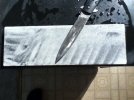
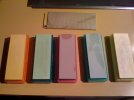
Love my 120 Shapton Pro (the white one in the first photo. Stones engineered to cut modern alloys work so much better (for me) than the Arks.
The biggest sharpening revelation for me was when I FINALLY learned to go coarse enough in the beginning of the task.
IMG_3712.jpg


Or you could use the DMT extra coarse diamond plate shown behind this line up (I use it mostly to flatten the stones).
Doesn't take long with the 120 . . . hours you say.
The New Team.jpg

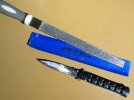
If you are in a big hurry go straight for this diamond file. Quick as a wink. ;)
IMG_3692.jpg
 
I will do that and use the diamond to flatten the stones too. But you don't think that it could have been a void.?
 
could have been a void.?

Gosh could be I suppose but I have never heard of such a thing in modern milled steel let alone in a pretty decent knife such as the Henckle.
Nah . . . pretty unlikely bordering on the impossible.

PS: I look forward to hearing what the cool guys say.
Voids in blade steel huh ?
 
Might be best to draw the edge across a coarse stone (vertically, as if cutting into the stone), and grind the apex flat to the full depth of the chip/gap in the edge. And for that job, since it seems your existing stones aren't working well, a more aggressive stone is needed. Something like a SiC (Norton Crystolon) or a good quality double-sided C/F aluminum oxide stone (Norton India) should handle that pretty easily. Once the chip is fully ground away, then use the same coarse stone to reset the bevels to a full apex (full-length burr 'flipped' from both sides, before moving on). You should then be able to refine it on the 'Fine' side of the same stone and/or follow with your Arkansas stones (or not; see below).

Since you mentioned the edge is 'polished like a mirror' after working with the Ark stones, it sounds like those stones might be glazed heavily and not grinding well, if that's all they're doing. If so, they'll need to be reconditioned at the surface, to restore grinding efficiency. If they're that bad off, it may be best to avoid relying on them until they've been reconditioned. More than likely, this is just an issue of the stones being too glazed or simply not aggressive enough for the job. A coarse synthetic stone (SiC/AlOx) fixes problems like these about 99.9% of the time.

BTW, if there is a 'void' in the steel (probably unlikely), the solution is exactly the same. Just vertically grind the edge away past the 'void' and reset the bevels. If that's really the problem, the bad steel needs to come off, no matter what.
 
Last edited:
Something like a SiC (Norton Crystolon) or a good quality double-sided C/F aluminum oxide stone (Norton India) should handle that pretty easily
Agreed. I think the problem is that you didn't go coarse enough in the first place. Even a soft Ark is going to take quite a while to grind away the steel.

Whenever I am fixing chips or significantly damaged edges on that type of steel, I stay on the coarse side of a Norton India until the chips are completely gone. Only after I have an even bevel with no chips, would I start moving up to finer grits.

Keep in mind, if you have a chip of, for example, 3/32" depth from the edge to the deepest part of the chip, you are not grinding out the chip. You are grinding off 3/32" of steel from the entire rest of the edge until it is even with that chip, and then creating a new bevel.

For small chips, I may sharpen at a greater angle than normal until it is gone, and then create the new bevel at the angle I want. Going to a vertical angle is the extreme of that approach, and is the best approach for bigger chips, though you will end up with a flat edge and will still have to recreate the edge bevel and possibly thin the blade road.
 
Back
Top