Recommendation? True long term storage options

Joined
Dec 30, 2014
Messages
436
I have a great envy for those who have had knives passed down from fathers/grandfathers and as I have only two knives that I know my father owned I am determined to leave behind my collection to my children and grandchildren. Over my active collecting years I have maintained my carbon knives with either Mineral oil or Renaissance wax. But as I approach my later years I need to settle on a long term storage system that will give me some measure of peace of mind should I become unable to care for them due to whatever circumstance. There is no one to take over the care should I be unable to and I am not ready to distribute them yet. Yes I have given many of those who will inherit them a few knives mostly stainless Case or Victorinox for their daily needs. Luckily I have no need to sell the collection

Currently I am leaning towards a light but thorough coating of a quality silicone spray of some type followed by vacuum packing or perhaps just vacuum packing on a dry day with desiccant packs. Has anyone had experience doing likewise? Of course the tubes and boxes will be stored in the best manner for cardboard, airtight box with desiccants.

I would like to know of anyone who has found a good system for the care of carbon steel traditional knives that requires minimum maintenance and minimum cost.

Thank you for taking the time to read my rambling and I look forward to your replies.
 
Do some research on VCI products to see if that’s something that might work for you. Volatile Corrosion Inhibitor.

They don’t require that anything be applied to the knives. I have been using VCI products for 15+ years and no corrosion problems yet. That being said, it’s difficult to say whether or not I would have had corrosion problems if I had not been using them.

I believe they work as advertised. I just can’t prove it.
 
Forgive me, but if your carbon steel blades have a patina, "long term" storage solutions may be a moot point.
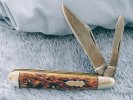
c.1911-1921 Robeson 622119 ShurSharp "English Jack".
IMG_20250721_120802890~3.jpg
Zero corrosion/pitting. There is no doubt in my mind this knife has spent a significant part of its early life stashed in a sock drawer.
WHY I have no idea. The pull on both blades is a reasonable "5"; about the same as a 93 mm SAK; Not a nail breaker/need a steel fingernail tool or pliers to open either blade.
I suspect the original owner used it a little, allowed a patina to develope, then for whatever reason, put it away in a sock drawer. Maybe at around 4.25 inches closed, it was "too big" for his/her every day carry?
As far as I know, This is my only over 100 year old knife with carbon steel blades.
(I also have a c.1916 to 1928 Challenge Cutlery pen knife, but it is equipped with stain less blades.)

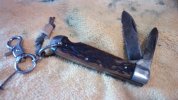
.My next oldest Carbon Steel knife is a 1930's to 1947 4 line Camillus "Navy Knife"/33 Easy Open precursor.
IMG_20240916_142823.jpg
The blades are in the same general condition; no active red rust, no pitting.
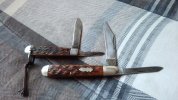
Here it is with the Robeson:
IMG_20240621_081416.jpg

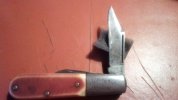
A 1950's-1960's Ulster Number 10. I think I might have gotten this one in trade from a mechanic who kept it in his tool chest. No A/C in that shop.
IMG_20240225_180817.jpg

Once my carbon steel blades get a patina, I don't oil or wax them. The only oil the flats get is any excess that comes from oiling the joints without using a syrenge.

None of my carbon blades have active red rust. Any pitting, is from improper cleaning by a previous owner. (My Western 742 Stockman, for example. I am sure a former owner used it to process rabbit, squirrel, fish, and possibly fowl and big game, and put it away "wet".

There are plenty of 50 plus year old "users" with carbon steel blades that are in excellent condition, have a patina on the blade(s) and no rust, that have not had special storage treatments, or were in climate controlled storage.

IMHO a ziplock bag + a fresh dissectant pouch per knife should be more than enough for long term storage.

Question: The folks who are going to inherit the knives with carbon steel bladed ... You said you've given them some knives with stainless blades.
Have you considered giving them a carbon steel bladed knife, and teach them how to care for them, that the blades DO patina,but the patina DOES NOT damage the blade - it helps PROTECT the blade, and the patina does NOT contaminate nor change the taste of food?
(Fook used carbon steel cutlery and cast iron pots/pans/cauldrons/griddles to for over 1500 years and counting. "People" and/or "humans" ain't extinct and ain't dying from food poisoning from carbon steel cutlery and cast iron cookwear. 😇👍
 
The edged weaponry museum in Intercourse, PA uses bowling alley wax. I use Renaissance wax.
 
I use renwax as well. My understanding is it makes a solid "coat" when dry that is best for undisturbed long term storage. Moving the joints/etc can interfere with the coat and is best reapplied.

Fwiw I don't actually ALWAYS strictly follow this. There are a few knives I have taken out to photograph etc. I just handle them with gloves and wrap them back up, so far no issues. I check periodically.

There is probably something to the patina idea above but I assume this is more geared to keeping a knife "mint" or clean?
 
As Railsplitter said, VCI is the answer. And if you’re extra careful, a microcrystalline wax.
 
Do some research on VCI products to see if that’s something that might work for you. Volatile Corrosion Inhibitor.

They don’t require that anything be applied to the knives. I have been using VCI products for 15+ years and no corrosion problems yet. That being said, it’s difficult to say whether or not I would have had corrosion problems if I had not been using them.

I believe they work as advertised. I just can’t prove it.
This is interesting. How are you using them for your storage? Quick research looks like they're mostly advertising sealed bags
 
There are VCI sprays, papers, bags, wraps, drawer liners, and plastic tags. This is not an exhaustive list.
 
This is interesting. How are you using them for your storage? Quick research looks like they're mostly advertising sealed bags
I am happy to share my method but it probably won’t help too many folks as I’m still using products from a manufacturer that I believe went out of business.

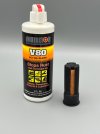
I started out buying their 12 gage “emitter” plugs. They are designed to be loaded into a shotgun chamber to protect the gun. They have an absorbent sponge inside. The manufacturer would ship them saturated with their VCI product. They dried out over time and I kept buying new ones for several years.

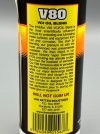
Then I realized that they also sold a VCI oil with the same corrosion preventing vapor technology as the plugs. I bought a bottle of that oil and instead of buying new plugs, I use the oil to saturate the plugs when they dry out. I do not put any of the oil on the knives. It’s simply not necessary.
IMG_2605.jpegIMG_2606.jpeg

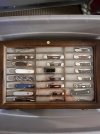
Then I place the saturated plug inside the storage case with knives. Then put the storage cases in totes that have a snap on lid.
IMG_2607.jpeg
 
I haven’t tried the V80 product yet. I use the Zerust plastic emitter tags and bags.
This is the brand Google kept showing me. But it wants to link me to their sealed baggies which seems impractical. I'll dig harder for the tags
 
Nobody has mentioned celluloid yet. If you have celluloid knaves separate them from your non-celluloid knives.
AND FROM EACH OTHER!!!
If one starts outgassing in the vicinity of one that isn't the outgassing one can cause a chain reaction. At the very least the outgssing one's acidic vapors DOES affect everything around it; ferris and nonferris metals, wood, bone, cloth/leather ...

I new a guy many, many years ago, that stored his unused celluloid knives in tupperwear containers.
1 knife to a container, the knife completely buried/covered in dry baking powder. He had a label on the lid with the knife info, since all you could see in there was the Arm & Hammer baking powder.
I don't know if his "solution" to outgassing worked. 😐
 
Forgive me, but if your carbon steel blades have a patina, "long term" storage solutions may be a moot point.
c.1911-1921 Robeson 622119 ShurSharp "English Jack".
View attachment 3120472
Zero corrosion/pitting. There is no doubt in my mind this knife has spent a significant part of its early life stashed in a sock drawer.
WHY I have no idea. The pull on both blades is a reasonable "5"; about the same as a 93 mm SAK; Not a nail breaker/need a steel fingernail tool or pliers to open either blade.
I suspect the original owner used it a little, allowed a patina to develope, then for whatever reason, put it away in a sock drawer. Maybe at around 4.25 inches closed, it was "too big" for his/her every day carry?
As far as I know, This is my only over 100 year old knife with carbon steel blades.
(I also have a c.1916 to 1928 Challenge Cutlery pen knife, but it is equipped with stain less blades.)

.My next oldest Carbon Steel knife is a 1930's to 1947 4 line Camillus "Navy Knife"/33 Easy Open precursor.
View attachment 3120489
The blades are in the same general condition; no active red rust, no pitting.
Here it is with the Robeson:
View attachment 3120490

A 1950's-1960's Ulster Number 10. I think I might have gotten this one in trade from a mechanic who kept it in his tool chest. No A/C in that shop.
View attachment 3120491

Once my carbon steel blades get a patina, I don't oil or wax them. The only oil the flats get is any excess that comes from oiling the joints without using a syrenge.

None of my carbon blades have active red rust. Any pitting, is from improper cleaning by a previous owner. (My Western 742 Stockman, for example. I am sure a former owner used it to process rabbit, squirrel, fish, and possibly fowl and big game, and put it away "wet".

There are plenty of 50 plus year old "users" with carbon steel blades that are in excellent condition, have a patina on the blade(s) and no rust, that have not had special storage treatments, or were in climate controlled storage.

IMHO a ziplock bag + a fresh dissectant pouch per knife should be more than enough for long term storage.

Question: The folks who are going to inherit the knives with carbon steel bladed ... You said you've given them some knives with stainless blades.
Have you considered giving them a carbon steel bladed knife, and teach them how to care for them, that the blades DO patina,but the patina DOES NOT damage the blade - it helps PROTECT the blade, and the patina does NOT contaminate nor change the taste of food?
(Fook used carbon steel cutlery and cast iron pots/pans/cauldrons/griddles to for over 1500 years and counting. "People" and/or "humans" ain't extinct and ain't dying from food poisoning from carbon steel cutlery and cast iron cookwear. 😇👍
I do love a good patina and many in my edc rotation have very nice patinas. that said looking at the knives in your photos is a good example of the tang area not getting the protection of patina not to mention inside blade wells do not patina easily. What I want to do is preserve my unused GECs and others in as close to pristine condition inside and out as possible. I am not ashamed to admit that I definitely have 'safe queens', but with a collection numbering in the many hundreds that is a bit difficult to avoid.
 
Nobody has mentioned celluloid yet. If you have celluloid knaves separate them from your non-celluloid knives.
I have one celluloid knife and it does not even live in the same building as the rest of the collection. I got real paranoid about them after seeing the damage that one did when it was left by my uncle in his nightstand drawer alongside other knives for many years. It is a shame as they can be so beautiful.
 
I coat my folder in Break Free Lubricant Preservative (not CLP). Wrap the folder in wax paper and place each folder in a separate sealed small plastic bag.

I have folders in storage for over 10 years with no problems and I live 50 yards from the Atlantic.

My experience with Ren-Wax has not been good.
 
I coat my folder in Break Free Lubricant Preservative (not CLP). Wrap the folder in wax paper and place each folder in a separate sealed small plastic bag.

I have folders in storage for over 10 years with no problems and I live 50 yards from the Atlantic.

My experience with Ren-Wax has not been good.
Thank you very much. Have you noticed any issues with different handle materials such as wood, stag, etc?
 
Thank you very much. Have you noticed any issues with different handle materials such as wood, stag, etc?
I have not had any problems. I don't drench the knife, I carefully wipe the blades and back springs down and put a few drops into the folder well. The LP tends to spread by itself.

Test a folder for a few weeks and see how it works for you.
 
Back
Top