
Tutorial -- Hewing with the broad axe

Joined
Aug 28, 2010
Messages
5,431
Just found a great blog by Mike Beaudry called "Mud Pond Hewing and Framing"
http://mudpondhewing.blogspot.com/
with lots of interesting reading, including a four-part tutorial on how to hew with a broad axe:
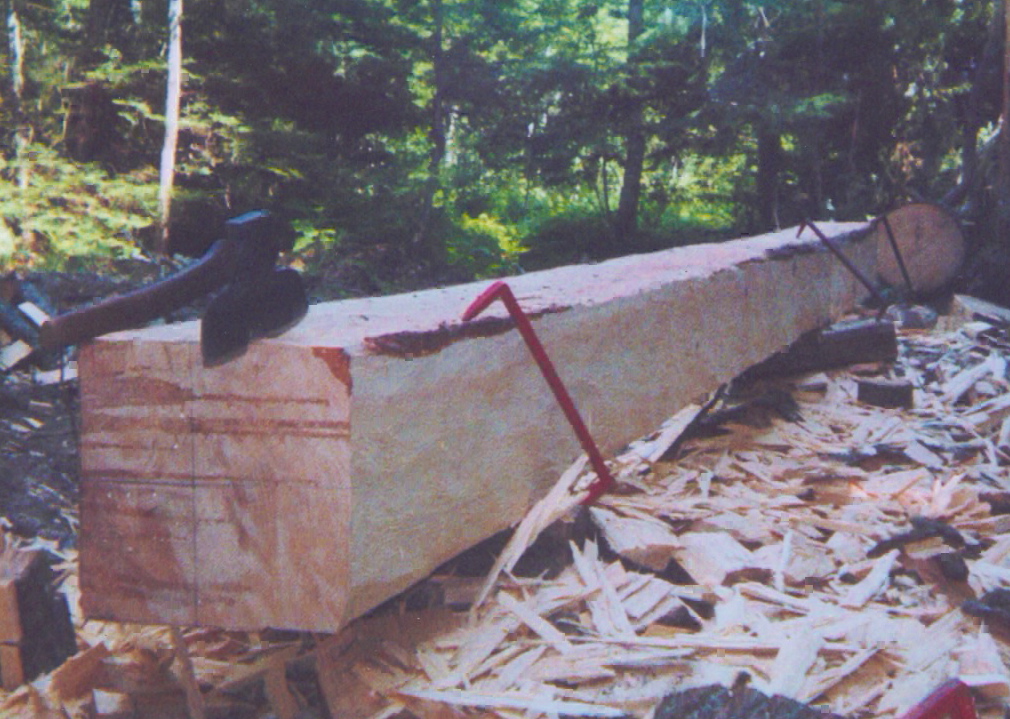
log+building+1.jpeg


Part 1 http://mudpondhewing.blogspot.com/2012/05/font-face-font-family-times-new-romanp.html
Part 2 http://mudpondhewing.blogspot.com/2012/05/hewing-with-broad-axe-part-2-layout.html
Part 3 http://mudpondhewing.blogspot.com/2012/05/hewing-with-broad-axe-part-3-scoring.html
Part 4 http://mudpondhewing.blogspot.com/2012/05/hewing-with-broad-axe-part-4-hewing.html

Other content includes history, works in progress, and reviews. From a review of the John Neeman bearded axe:

"This is the holy Grail of axes. I have been hewing for 35 years. In those years I have purchased axes looking for the perfect axe that would make hewing efficient, effective and fun. I believe after purchasing countless axes the search is now over..."
http://mudpondhewing.blogspot.com/2012/07/a-review-of-john-neeman-bearded-axe.html

In addition to this blog, there are YouTube videos with Mike Beaudry hewing.
 
Steve, nice links to the blog. Beaudry has some great stories and photos on his blog. Gives one an appreciation for the amount of work it takes to hew and build such structures.
 
Lovely stuff as usual Steve!

It's very difficult to find hewing guides and Mike made it look easy.
 
The blog page won't load for me. Anyone else using Firefox and having difficulty?
 
Thanks, Steve.

I'm going to pick up a timber on Sunday and I'm anxious to try my hand at hewing again. I forged the first of a pair of log dogs the other day while working on another project.
 
well, I have to say that the mudpondhewing blog is the best hewing site I've ever seen. let's call it........inspiring.
-
-
-
-
-
-
-
-
-
-step-by-step. the scoring and juggling process takes off so much wood!
-
1722F253-CB4F-43FF-B797-FC4764C78759-292-000000D533907642.jpg

87F720BC-58D4-4A1B-83BB-195E6A6D30CD-292-000000D52CA73610.jpg


-
above after juggling, below after making the first pass hewing.
-
8B3E407E-A34E-4C49-B53F-C34D96836A73-292-000000D52632B900.jpg

58074D5E-A5DD-48C8-9111-D41C9407AD43-292-000000D51E7AE4FC.jpg

-
-
-
the "finished" side, after two passes hewing. of course, I'll have to go back over this one more time to make it smoother......
37B7C2BD-303A-477A-860B-CB2E1220DAED-292-000000D5184266F0.jpg

1ECCFBD0-248F-4F0D-85EB-817A79775F82-292-000000D50D3C456B.jpg

-
-
-
-
-
I quite obviously have a long ways to go before becoming anything approaching proficient, but I finally get the marking-scoring-juggling-and-THEN-hewing bit. I had tried this waaaaay back when (maybe a year and a half ago?) after buying a gransfors 1900 double-bevel. but, I was too stubborn to go seeking out instruction. hewing dry aspen without scoring and juggling turned out to be quite the disaster, and I haven't tried until today. I've got a pile of logs (the start of 2013-2014's firewood) drying out, so I pulled down a nice piece of beetle-killed (but still green/wet) spruce. worked much better doing it the right way.

thanks to the blogger, and thanks to Steve for posting this! you always make excellent posts!


-ben
 
Last edited:
here's side #2.

you can see a couple of my supervisors in the background. they tend to keep their distance when the axes come out........

9FC198EE-C1D0-4881-AAFB-709061206AF0-292-000000D829C24F5A.jpg

CBF5A439-9673-49A3-B2A4-1B41C6935BBE-292-000000D81E68F8AE.jpg

A521281E-10D1-431F-80E1-0E9C345A2BE3-292-000000D81734E303.jpg

13FF6E32-12F2-46FA-A9BE-E8967505790D-292-000000D80F23E5F7.jpg

-
-
-
you can see I got a bit overly aggressive with my scoring this time, especially towards the near end. lost a small chunk there.
-
C8ACBF52-27B2-4E15-B4C8-69DE1EA968C2-292-000000D807C251BD.jpg


think I'll save sides 3 and 4 for tomorrow morning, and do the cleanup/finish-work on Monday morning. don't want to overdo it!

have a big bucket of chips and shavings to use for firestarter now............guess I'll have to start up the fire pit here in a few hours.


-ben
 
Good job, Ben. It more work than it looks like in the videos, ain't it?

heck, I could drop that line into just about any thread in any message board in the whole of the interwebs.

it's ALWAYS more work than it looks in the video!


-ben
 
When I was hewing the 6x6 beam that is still laying in my yard, I used only double bevel axes. I scored really close to the chalk line because I wanted to split most of the waste off and not bother hewing a significant amount off to get to the line. I did screw up in a spot or two scoring too deep, especially working about a big spike knot.
 
The Foxfire series of books from the 1970s and '80s contain interviews of old-timers who remember how things were done in the early 1900s and Great Depression. In Foxfire 10, there is a section about hewing cross ties for the railroad. The cross ties were 8'-6" long and typically 7" by 9", and were sold for about 50 cents each.

Some quotes from the book:

Dan Crane: "A lot of people hewed. They had to. That's the only way they had to make a few dollars to buy groceries with... The cross ties were made out of white oak, red oak, and all different kinds of oak for a long time. After several years, we started hewing them out of pine, too. After they creosoted the heart pine, they would last a pretty good while. And a lot of times, we would get trees that would have three or four cross ties in them. The hewed cross ties came from the heart of the tree, and they would last longer than the sawed ones that were cut out of any part of the tree, so the railroad would pay more for a hewed one than a sawed one..."

"And all we ever used to hew with was a three-and-a-half pound Sager double-bitted axe. We never used a broadax."

"We'd hew the cross ties mostly in the fall of the year after the sap went down..."

"My daddy could hew ten a day. Eight was a good, easy day's work. He'd hew ten a lot of times. I could hew six or seven myself, and I was just a boy then sixteen or seventeen years old."

Dan Crane showed the writers of the book how to hew a cross tie. There's a photo of him hewing a log using a double bit axe. Here's a link showing another photo of him holding up the finished cross tie that he hewed for the demonstration:

http://books.google.com/books?id=l7E9SysL_OkC&lpg=PA29&dq=foxfire%20hewing&pg=PA28#v=onepage&q=foxfire%20hewing&f=false

By the way, these Foxfire books tend to have a lot of good information and stories about life in Southern Appalachia when people were more self-reliant. Foxfire 5 was an interesting read, with chapters covering Ironmaking, Blacksmithing, Flintlock Rifles, and Bear Hunting.
 
Hello,

It was the log house building film from Finland that drew me into this forum.

I am a woodworker out of Holland so blades are not my primary interest but related to my work and even much of my so-called free time.

Well, I just wanted to try out some of the features - I sadly already discovered the need to check the, remember me, square to avoid rejection of your entry - and hewing is of interest to me as well so I put up this film of me hauling a needed beam out of a big slab of pine wood on an improvised basis.
[video=vimeo;54860464]http://vimeo.com/54860464[/video]

Thanks,

E. DB.
 
Hello,

It was the log house building film from Finland that drew me into this forum.

I am a woodworker out of Holland so blades are not my primary interest but related to my work and even much of my so-called free time.

Well, I just wanted to try out some of the features - I sadly already discovered the need to check the, remember me, square to avoid rejection of your entry - and hewing is of interest to me as well so I put up this film of me hauling a needed beam out of a big slab of pine wood on an improvised basis.
[video=vimeo;54860464]http://vimeo.com/54860464[/video]

Thanks,


E. DB.


Here's the video you posted:

http://vimeo.com/54860464
 
Hello,

It was probably more like 4x8 and it is rare that pre dimensioned wood comes onto this property that way, only stems or slabbed material.

Ben, I am sure you will get a better surface when you use newly cut, that is to say still green, wood. That's where dimensioning with an axe is most suitable.

E.DB.
 
Back
Top