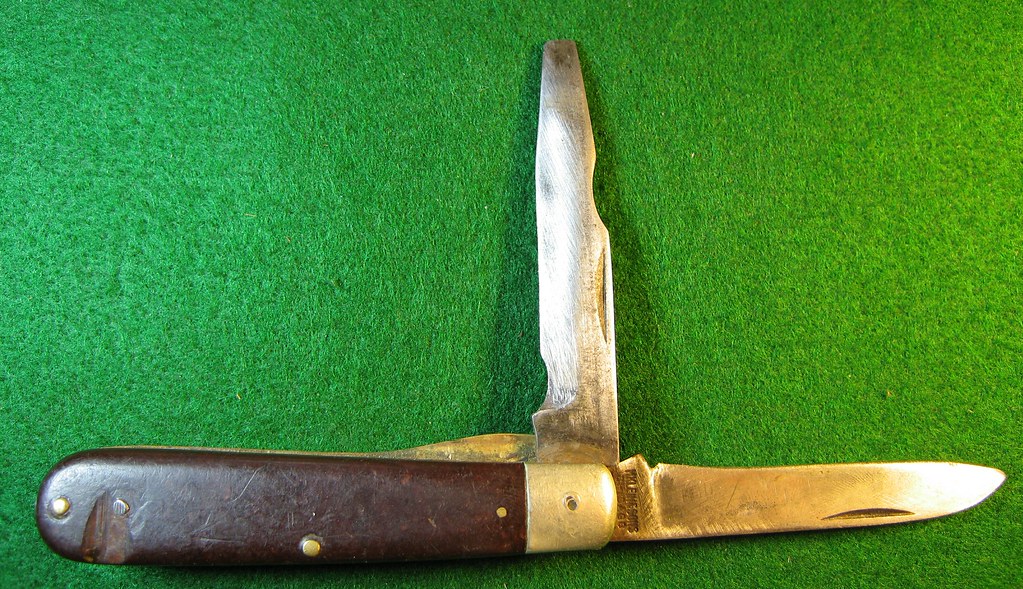
Here is one I've been working on for a while, and I thought I'd share a rough draft and get some further information from you collectors.
Among the classic working mans pocketknife patterns which has survived basically unchanged for nearly a hundred years is the Electricians knife. I believe every division of Imperial Schrade, and all of its predecessors as well as most of its competitors have made them at one time or another. It was an early utility, or workmans pattern, much like the horticulture knives which also have been made for a long time. Electricians knives were in great demand during the second world war, and government contracts were filled by several companies, and even gave rise to a few companies seeking a piece of the government contract pie.
During WWII, "Food Rationing" and "Gas Rationing" were instituted and ration coupon books can still occasionally be found in attics. These are the most often remembered civilian restrictions in America's past to help in the war effort. Some others are less known but were more important in the effort to conserve resources on the home front, freeing them for the manufacture of war goods. Some of the more important orders issued were the "Steel Act" and the "Copper Order", these limitations or conservation restrictions almost completely shut down production of common manufactured goods available to civilian consumers. One very important order affecting the cutlery industry was the "General Limitation Order on Cutlery No. L-140" of the "War Production Board". This order sharply curtailed cutlery production for most civilians.
Knife makers were scrambling to find military contracts, for only with a priority provided by a contract could they acquire the steel and brass needed to make knives. And only with a promised supply of materials could they take the contracts! The new owner of the Dwight Devine works (Ulster Knife Company), Albert Baer, astute businessman that he was, managed to find a deal on a large supply of steel, brass and other metals in early 1941. On a prospective buying trip to visit the recently closed Remington Dupont cutlery plant, he learned that LF&C was also closing, and deferring the Remington purchase to PAL, bought every bit of steel and other metals in the LF&C inventory for two cents a pound. Eventually during the war, brass was in such short supply that most available was routed to munitions manufacturing. Knives made during the war which traditionally used brass liners, pins, and blade liner locks such as the TL-29 electrician / Signal Corps knives used steel instead for these parts. The use of brass was resumed after the war.
In its basic form, an electricians knife is based upon a two bladed barehead jack, very much like a short bolstered Barlow pattern. The most widely used master blade is the spearpoint, though not exclusively so. The secondary blade which pretty well defines the pattern, is a flat slotted screwdriver blade, usually with a wire insulation stripper feature of one type or another. Most, though not all, feature a blade lock on the screwdriver blade. Bails (also called shackles) are also commonly seen on this pattern, though not always.
The knife takes its most common name from the military specification "TL-29," TL standing for "Tool - Linemen". According to Tom Williams, Camillus historian, the Camillus electrician's knife is a #57 pattern and Camillus has produced this pattern since WWI. The military designation suggests its adoption in 1929. As produced during WWII, the TL-29 came in a kit, TE-33", consisting of a leather dual belt pouch CS-34", the TL-29" knife, and a pair of TL-13A cutting pliers. Evidenced by surplus stocks from the period, the knives were also supplied individually wrapped in waxed paper in cardboard boxes of a half dozen knives each, so were likely issued also without the pouches and pliers as needed.
The TL-29 knife continues in production to this day, though Im not sure it is still a Military contract item. Stories abound from former military personnel as to when the knives were issued and for what purpose. One gentleman states that they were specifically made for use in removing the cowling from Huey helicopters. Others remember them being included in aviation maintenance tool bags. Most common earlier remembrances were that they were used by soldiers of the U.S. Signal Corps for laying field telephone wires. Demolitions use was also mentioned, but the screwdriver blade was not of the appropriate size and shape for making holes for blasting caps and fuses.
As to who exactly was the first cutlery to produce this pattern, I havent a clue. Cattaraugus is credited with a 1909 patent for the liner lock used on the screwdriver blade. Some knives of this pattern are describerd in catalogs as being without the lock, and also without the bail, both of which I believe are specified in the TL-29 military specifications, though I havent located that sheet as of yet.
The 3 3/4" number 2042SD is the first of this pattern illustrated in the Schrade Cutlery Companys 1926 catalog. This ebony wood handled example had a nickle silver empire shield and bolsters, brass linings, and a brass blade lock for the screwdriver/wire stripper blade. The large spear point master blade did not have a lock, a feature rarely seen on even later renditions of this pattern. It was available with or without the shackle (bail). This knife was a barehead, having only the front bolsters, and no rear.
In 1926 the 3 5/8" number 2053 ½ was also listed. It featured stag jigged bone handle with a nickle silver propeller shield and bolsters. Unlike the 2042SD, this one was tipped or had small read bolsters for decoration and reenforcement. It also use a sheepfoot master blade, and a differently ground screwdriver blade, both with a long mark. The screwdriver blade did not feature a lock on this on this one.
Listed as well in 1926 was a third variant, the 3 5/8" number 3053 ½, which added a pen blade to the 2053 ½.
A 3 5/8" number 8443 was listed which had all the features of the 2053 ½, except it used a spear point blade as the master, and a third blade, a leather punch pinned to the other end of the knife. It is named the Automobile and Electricians knife, and is illustrated with Auto-Electric etched on the master blade. It does not have a blade lock.
The 1929 catalog lists a 3 3/4" number 2043SD with shackle. It is the same as the ebony handled 2042SD but with jigged bone handles.
In 1930, another variant, the 3 5/8" number 2311SD appears with cocobola handle, and the number 2314BSD with black celluloid handle. Both are sleeveboard patterns rather than the previous equal end knives. Both featured blade locks.
A knife listed in 1934 appears to fit the definition of the pattern, but for the addition of a bottle opener to the screwdriver blade. That is the 3 5/8" Screw Driver Jack Knife number C2153SD. It has stag jigged bone handles with NS bomb shield, both ends steel bolstered with no bail, and a spear master blade with the screwdriver/opener combo blade, no lock. The same knife with caps and shield omitted, cocobola handles is number 2151SD.
A 3 3/4 number C2141SD cocobola handled electricians knife was listed with lock, and available also with shackle.
This lineup was produced pretty well from the years introduced until the company was sold to the Baers in 1946.
Catalog resources are spotty at best, usually missing altogether from the war years of 1941-1945, and pick up again in 1946-47 with the Ulster/Kingston knives. Unfortunately, the Schrade Walden catalogs are missing until the early 1950's.
With the Schrade Walden Electricians knives, the first one in my catalogs appears in 1950, the number 204, which is noted as being the same as the old number C2041SD, a Schrade Cut Co number. It has the same features as the C2042SD listed in 1926, except that it had the blade lock. It was available with shackle or without. In 1954, it was listed with and without a shackle. In 1959, it was offered as the #204WW and 204WWSHA with the new Wonda-Wood impregnated wood handles. This is also the last year it is noted and illustrated as being available without the shackle.
Records indicate that in 1959, the Sears Roebuck #9478 was a Kingston K-29 Electricians knife in mahogony plastic, and in 1962 it was changed to the Ulster TL-29 Electricians knife in Wonda-Wood with bail. In 1963, the number for the Ulster TL-29 was #9529, and 9560 in 1966. At some point, it was changed to the Schrade 204, then the Imperial Work Mate RJ750 in 1985.
The 1960 and 1961 Ulster catalogs listed their Electrician pattern, the 3 3/4" TL-29W with Wonda-Wood handles, and the Kingston version, the 3 3/4" K-29 with mahogany grained plastic handles, both with the center safety lock. Neither were shielded. The Kingston version was the one sold to Sears. Schrade Waldens catalog of the same year listed the 204SHA, no longer offered without the shackle, but with Wonda-Wood handles and empire shield. It was named Handyman in the catalog this year for the first time. In 1965, the 204SHA was noted to be hardwood. It continued to appear every year basically unchanged until the 1970 catalog where the shield was deleted, and it appears to be delrin handled. At that time, it began to be listed as 204S. The handle material was changed to delrin. The handle was not described until the 1974 Belknap catalog where it was called Genuine Woodgrain Delrin. It was named Master Electrician in this catalog, and retained the bail and blade lock. The 204S was omitted from the 1976 Schrade catalog. An Electrician pattern knife is not seen again until the appearance of the Irish produced Tradesman line in the 1991 catalog, the TM2 and three blade TM3.
The Ulster TL29 appeared in the 1970 Belknap catalog, now with shackle, and the mahogany grained plastic handles formerly used on the Kingston branded K-29.
ISC also made the electrician pattern under the Imperial stamp. In 1985, they introduced a new Work Mates series of knives with carbon steel blades, woodgrain jigged delrin handles, nickle silver bolsters. The four knives were the 3 3/4" RJ750 Electricians knife, the 3 3/4" RJ751 using a hawkbill blade in place of the spear master blade, the 4" RJ752 with a large single hawkbill blade, and the 3 1/4" RJ753 Linemans single sheepfoot blade, all four with bails, the RJ750 and RJ751 having locks for the screwdriver blades.
The Remington catalog of 1936 shows their 3 3/8" #R-2111 giving the same general specifications as the Schrade Cut Co and other makers TL-29 pattern. Here is a partial list of brands I have seen during a recent eBay survey of the Electrician knives while doing this research. It is not a list of cutleries who produced them for the military, before, during, or since WWII.
Boker
Camillus
Camco
Case
Colonial
Imperial
Kingston
Ka-Bar
Klein
Kutmaster
Queen
Remington
Schrade
Schrade Cut Co
Schrade Walden
Ulster
Utica
(cont.)