
User handle shape vs scale material.

Joined
Sep 28, 2005
Messages
4,527
I'd like to start a discussion of the importance of handle shape versus what material is on the handle.

Personally I feel that the shape of the handle; and more importantly the top and bottom profile; is by far more important than the texture of the scales put on. To me (with 20+ years of in hand-experience) the shape of the handle is much more relevant as over the last few years I have noticed that I rarely have a good grip on the sides of a knife in use that would make the handle material more important. I have found that the grip comes from the top and bottom of the handle and this renders even a slippery handle useable if designed properly, as I prefer a dextrous grip as opposed to a straight hammer grip. This is one reason (laziness may be a contributing factor too) that I do not fill my fileworked spines in with epoxy- I find that it gives more addition to the grip than rough textured scales do.

I liken this to my opinions of a choil- if a handle is properly made there is no need for aid in "choking up" onto the metal as the handle will already facilitate the grip. I have no need for rough handle material if the handle fits my hand properly in the first place. In looking at my favorite user knives I find that they have smoother handles (even the micarta ones) that fit my hand well enough that I would not worry about having them in smooth metal, and I do not like to use guards either. Similar to the Leek and JYD- both very comfortable in hand while being a very slippery material:
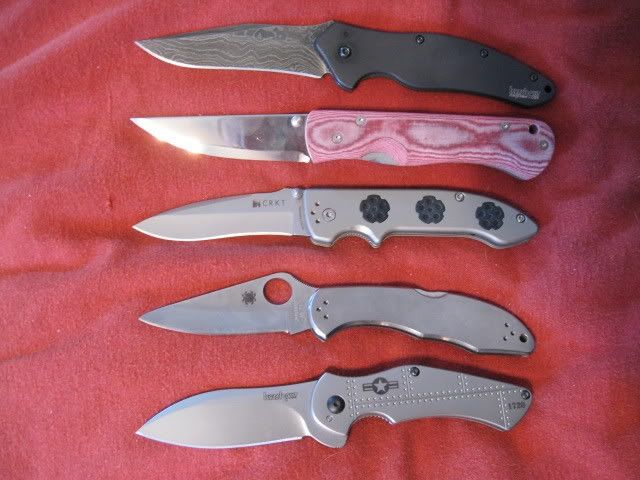
BUSSTRcomparisons.jpg


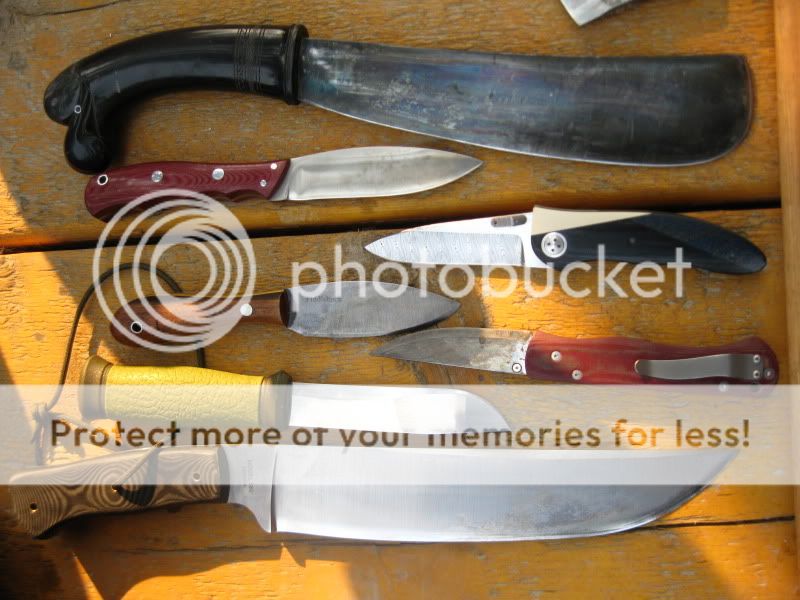
The following are some of my smoother knives that work very well for me to hopefully demonstrate my point better:
IMG_0619.jpg

The Golok is a good example as the shape of the handle brings the hand to the butt when chopping so the force of the swing keeps it in hand due to the drop at the butt. the EDC from Fiddleback, the Canadian special, the Elishewitz Kaiser and BUSSTR all have smooth handles yet I have not worried about slippage ever due to how they fit the hand, even wet the Kaiser is firm in my hand and it has polished G10/Micarta/Carbon Fiber scales- and I've used it in kitchen, cleaned fish and performed general bushcraft with it in various conditions without my hand slipping up- actually I would have liked the blade brought back another 1/4" or so closer to my hand.

My scandinavian heritage has had me carrying this pair a bit- both have smooth handles, no guard, and I have not had a retention issue with either due to the dropped butt and curves in the handles:
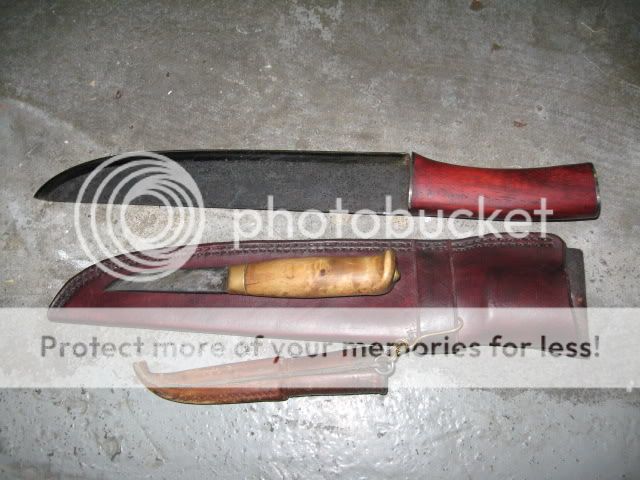
IMG_6225.jpg


I'd like to hear from the textured handle crowd (as well as the handle shape proponents) as to why they prefer more texture to their handles as I see it as trying to make up for poor handle design. I look forward to hearing your opinions.
 
....I'd like to hear from the textured handle crowd (as well as the handle shape proponents) as to why they prefer more texture to their handles as I see it as trying to make up for poor handle design. I look forward to hearing your opinions.

Or is a great handle shape merely an excuse for not bothering to put a decent texture on the handle?

Seriously though, all this comes down to personal preference, actual use and the overall design. On some knives I prefer a smooth handle, on others texture...

Rafael
 
I feel the shape of the handle and the material it is made of (texture, feel, etc.) go hand in hand.
 
I feel the shape of the handle and the material it is made of (texture, feel, etc.) go hand in hand.

This is kind of what I was getting at. To me the handle shape is everything, and the handle material is more the "frosting on the cake". If a handle is well designed I can see it handled in almost anything and it will still be a great handle (barring things like extreme cold and metal handles- but that is easily combatted by gloves).
 
I pretty much agree in principal. I have several smooth handled knives with contours that fit my hand well, and I have never found them to feel slippery.

Kevin
 
I'd like to start a discussion of the importance of handle shape versus what material is on the handle.

Personally I feel that the shape of the handle; and more importantly the top and bottom profile; is by far more important than the texture of the scales put on. To me (with 20+ years of in hand-experience) the shape of the handle is much more relevant as over the last few years I have noticed that I rarely have a good grip on the sides of a knife in use that would make the handle material more important. I have found that the grip comes from the top and bottom of the handle and this renders even a slippery handle useable if designed properly, as I prefer a dextrous grip as opposed to a straight hammer grip. This is one reason (laziness may be a contributing factor too) that I do not fill my fileworked spines in with epoxy- I find that it gives more addition to the grip than rough textured scales do.

I liken this to my opinions of a choil- if a handle is properly made there is no need for aid in "choking up" onto the metal as the handle will already facilitate the grip. I have no need for rough handle material if the handle fits my hand properly in the first place. In looking at my favorite user knives I find that they have smoother handles (even the micarta ones) that fit my hand well enough that I would not worry about having them in smooth metal, and I do not like to use guards either. Similar to the Leek and JYD- both very comfortable in hand while being a very slippery material:
BUSSTRcomparisons.jpg


The following are some of my smoother knives that work very well for me to hopefully demonstrate my point better:
IMG_0619.jpg

The Golok is a good example as the shape of the handle brings the hand to the butt when chopping so the force of the swing keeps it in hand due to the drop at the butt. the EDC from Fiddleback, the Canadian special, the Elishewitz Kaiser and BUSSTR all have smooth handles yet I have not worried about slippage ever due to how they fit the hand, even wet the Kaiser is firm in my hand and it has polished G10/Micarta/Carbon Fiber scales- and I've used it in kitchen, cleaned fish and performed general bushcraft with it in various conditions without my hand slipping up- actually I would have liked the blade brought back another 1/4" or so closer to my hand.

My scandinavian heritage has had me carrying this pair a bit- both have smooth handles, no guard, and I have not had a retention issue with either due to the dropped butt and curves in the handles:
IMG_6225.jpg


I'd like to hear from the textured handle crowd (as well as the handle shape proponents) as to why they prefer more texture to their handles as I see it as trying to make up for poor handle design. I look forward to hearing your opinions.


C.L.A.K.,

Do I really have to settle for one or the other, not both? If one favours a particular shape to retain the glossy slickness of a haft which has literally been waxed, to each his own.

Every knife I have either made for myself or have had custom made had quite specific slab/haft profiles, were of fairly specific lengths and widths, had one or more swells to fill my palms and yes, well textured with the equivalent of 80 grit, were checkered or deeply notched.

With warm regards,

-E
 
E- I do feel that you can have both, however I was trying (unsuccessfully it seems) to start a dialogue with those that like the grippy handles as I do not subscribe to that school of knife usage. Would you care to elaborate why you prefer the notching/ checkering over a smooth handle. I find that the grippy material wears pockets much faster and creates more hotspots than smoother handles of the same shape.
 
I tend to agree. The shape is overall more important. However I have found myself doing more delicate tasks, where I sort of only grip the knife with my finger tips to cut out a specific shape in material or something, and find the texture comes more into play in that regards. But, overall, for most tasks I do having a very secure grip is mostly for state of mind. For instance, my Spyderco Centofante 4 has smooth FRN, and it is very thin in both dimensions for the handle, and doesn't contour to add much grip at all. yet I still love to EDC it. Mostly for the Wharncliffe blade.

By the way, what is that knife which appears to have red micarta scales and has a pocket clip on it in your pictures? Looks to be scandi ground, and has the staining of high carbon steel.
 
This is kind of what I was getting at. To me the handle shape is everything, and the handle material is more the "frosting on the cake". If a handle is well designed I can see it handled in almost anything and it will still be a great handle (barring things like extreme cold and metal handles- but that is easily combatted by gloves).

Handle material is more than just "icing" to me, I think they are equally important. They are not mutually exclusive. Take for instance the Spyderco Endura 4, I had it and loved the handle shape but the FRN , not so much (didn't like the saber grind either but that is another story). I replaced it with the Endura 4 G-10 and I love that knife now. Still great handle shape but the G-10 makes a huge the difference to me. Shape may take a slight edge if I really "had" to pick though. ;)
 
E- I do feel that you can have both, however I was trying (unsuccessfully it seems) to start a dialogue with those that like the grippy handles as I do not subscribe to that school of knife usage. Would you care to elaborate why you prefer the notching/ checkering over a smooth handle. I find that the grippy material wears pockets much faster and creates more hotspots than smoother handles of the same shape.

C.L.A.K.,

Why do I prefer a more textured grip? Personal preference to be sure. My hard use knives are expected to remain in my grubby hands when covered in sweat (where I live it's quite hot in the summers), mud, blood, slime, goo, sludge, grease, fat and any number of other substances that are known to cause a knife to slip from the hand or lose control during a cut. I would also expect my hard use knives to chop, hack and slash, which is where my motivations behind my grip preference is derived.

I am also an advocate for lanyard holes and a fair length of lanyard to provide a loop around the thumb, forearm or wrist to further keep things under control. The loop of lanyard will go where it makes the most sense for how secure my footing is and what I'm cutting. I see the bond between my hand and my knife in very practical terms of safety. If safety requires compromise to aesthetics, so be it.

As I am partial to fairly large knives, having more surface area, which is precisely what those knurled, checkered, notched or otherwise textured hand grips give you, is what keeps the knife under control when fluids of all kinds find their way between the hand and haft. Gravity and momentum are only friends if they can be kept at bay when the knife grip remains firm even when in a completely disgusting state. I generally only wipe my knives off after I'm done using them, not during.

Note that I would argue completely differently for knives that are display case duchesses that never cut anything more frightening than a sheet of paper before returning to their silica gel laced sarcophagi. For such knives, the grip could be completely aesthetic, impractical if not utterly useless. I demand a bit more from my knives in the hard use category.

Wearing through pocket material faster you say? I don't ask any pocket knife I own to do the chores I'm describing. If you were specifically interested in this topic for small folding knives, I might change my opinion somewhat since I do not generally skin and gut a carcass with a 2" pocketknife if I have any choice in the matter. I might accept a lesser grip on a light, small folding knife since it's tasks are going to be proportionately less demanding.

As for "hot spots" are you referring to problems with chaffing and/or blistering of the hands? If the grip is well shaped, even prolonged wrist snaps on a well textured handle will not pose a problem. That may be personal experience and your mileage may vary. My wife gave up on me having butter soft hands the better part of two decades ago. If you make use of hand tools regularly enough, hard use knives among them, the hands will tend to follow. If you learn to play most stringed instruments, there tends to be a toughening of the fingertips and I see the issue of "hot spots" similarly. It is also a simple matter to wear gloves, I simply don't bother the majority of the time.

To each his own, but like many things, we develop our personal preferences from what has been found to work well and my specific uses may differ from yours. It is also possible we have different expectations around comfort or aesthetics.

Warm regards,

-E
 
Last edited:
...For instance, my Spyderco Centofante 4 has smooth FRN, and it is very thin in both dimensions for the handle, and doesn't contour to add much grip at all. yet I still love to EDC it. Mostly for the Wharncliffe blade.

The Centofante 3 and 4 are great knives. On these particular knives I think the smooth handle is a plus, because I use them for light work only. Like you, I really like the Wharncliffe blade on the 4.

Rafael
 
I tend to agree. The shape is overall more important. However I have found myself doing more delicate tasks, where I sort of only grip the knife with my finger tips to cut out a specific shape in material or something, and find the texture comes more into play in that regards.
By the way, what is that knife which appears to have red micarta scales and has a pocket clip on it in your pictures? Looks to be scandi ground, and has the staining of high carbon steel.
The knife is made by STR (his forum is on here), it was a short run, I'm not sure if another will go on. usually when doing delicate cuts I have my pinch grip on the blade itself so I never thought about that aspect. Thanks for the comments.
C.L.A.K.,

Why do I prefer a more textured grip? Personal preference to be sure. My hard use knives are expected to remain in my grubby hands when covered in sweat (where I live it's quite hot in the summers), mud, blood, slime, goo, sludge, grease, fat and any number of other substances that are known to cause a knife to slip from the hand or lose control during a cut. I would also expect my hard use knives to chop, hack and slash, which is where my motivations behind my grip preference is derived.

I am also an advocate for lanyard holes and a fair length of lanyard to provide a loop around the thumb, forearm or wrist to further keep things under control. The loop of lanyard will go where it makes the most sense for how secure my footing is and what I'm cutting. I see the bond between my hand and my knife in very practical terms of safety. If safety requires compromise to aesthetics, so be it.

As I am partial to fairly large knives, having more surface area, which is precisely what those knurled, checkered, notched or otherwise textured hand grips give you, is what keeps the knife under control when fluids of all kinds find their way between the hand and haft. Gravity and momentum are only friends if they can be kept at bay when the knife grip remains firm even when in a completely disgusting state. I generally only wipe my knives off after I'm done using them, not during.

Note that I would argue completely differently for knives that are display case duchesses that never cut anything more frightening than a sheet of paper before returning to their silica gel laced sarcophagi. For such knives, the grip could be completely aesthetic, impractical if not utterly useless. I demand a bit more from my knives in the hard use category.

Wearing through pocket material faster you say? I don't ask any pocket knife I own to do the chores I'm describing. If you were specifically interested in this topic for small folding knives, I might change my opinion somewhat since I do not generally skin and gut a carcass with a 2" pocketknife if I have any choice in the matter. I might accept a lesser grip on a light, small folding knife since it's tasks are going to be proportionately less demanding.

As for "hot spots" are you referring to problems with chaffing and/or blistering of the hands? If the grip is well shaped, even prolonged wrist snaps on a well textured handle will not pose a problem. That may be personal experience and your mileage may vary. My wife gave up on me having butter soft hands the better part of two decades ago. If you make use of hand tools regularly enough, hard use knives among them, the hands will tend to follow. If you learn to play most stringed instruments, there tends to be a toughening of the fingertips and I see the issue of "hot spots" similarly. It is also a simple matter to wear gloves, I simply don't bother the majority of the time.

To each his own, but like many things, we develop our personal preferences from what has been found to work well and my specific uses may differ from yours. It is also possible we have different expectations around comfort or aesthetics.

Warm regards,

-E

Thanks for the clarification. I too use my big knives as choppers, my small knives as carvers among other things and medium knives for pretty much anything, and don't feel that I am giving up anything for aesthetics. I have to have soft hands as a massage therapist, but still do work pretty much all of my knives and don't really have safe queens (and generally hate gloves). Maybe I feel that I have experienced more lacking designs with rough handles to make up for it, than great handles with rough handles.

Maybe it is my nordic background but my puukos and leuko do not have rough handles and I've never let them fly when using them, along with nessys and folders that I use in wet, dirty, fishy, bloody environments. Plus none of my axes are rough and I've never lost grip either (I use a 8# head hewing axe if I can- the new handle is almost done, and I used all smooth knives for that as well) It appears that we are polar opposites as I am against lanyards (for myself) as well- never used them and never seemed to need to.

I'm not trying to convince anybody that what they experience/ feel is wrong- as a beginning maker I just want to understand better why they feel the way they do. Thanks for the comments.
 
Back
Top