
Vanadium Carbides in S30V and in S110V Are Same Hardness ?

Wowbagger

Gold Member
Joined
Sep 20, 2015
Messages
8,074
There are just bucket loads more in the S110V but of the same hardness right ?
If yes, as I suspect, then it makes sense to use the same sharpening equipment for the former as the latter.
What got me on this was my Para2CamoS30V.
When I got it I debured the factory edge a little with a DMT 8,000 stone and put the knife in my pocket.
The edge lasted very well for quite a while after this. I used it for my toughest cutting task of trimming hard rubber. This kicks the stuffing out of any blade that isn't pretty much super steel.
Once the Para2S30V finally got dull enough to loose performance and accuracy I sharpened it on the Edge Pro with Shapton Glass stones (220, 500, 1000, 4000) to hair whittling and it went back in the pocket and back to work. In very short order the edge was a bit rolled or flattened in places and rough feeling when pulled across my finger nail.

I resharpened it on the Edge Pro with DMT Aligner stones double back taped to the Edge Pro's blank plate (a nice progression of stones from about 220 to the 8,000) and put it back in my pocket and back to work and it has gone weeks getting dull very slowly just as when I first got the knife.

This hard rubber is a material that makes a good test for me since I have been trimming the stuff for decades.
Conclusion; even though the S30V has much less vanadium carbide it is just as important to use diamonds to do the sharpening.
. . . so the carbides are the same hardness in both ? ? ?

How does this relate to blades with far less vanadium such as Case's CV alloy ? ? ?
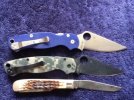
IMG_5311.jpg
 
I read somewhere that vanadium carbide can take various forms of varying hardness.
I don't know how this translates to knife steels.
 
The vanadium carbides in both are approximately the same hardness. Both also have some chromium carbides which may have some difference. M390 and Elmax, for example, have little or no vanadium carbide but the chromium in the chromium carbides is partially replaced by vanadium which increases the hardness of those carbides. Still not to the level of the vanadium carbides though.
 
If you want to abrade VC or TiC particles while sharpening, it means using Diamond or CBN “stones”. The OP comments make sense to me. M390 has 4% V much like S30V. Elmax has 3% V, just a little less than M390. I think the sharpening results with M390 or Elmax would be very similar to S30V.
 
There are just bucket loads more in the S110V but of the same hardness right ?
If yes, as I suspect, then it makes sense to use the same sharpening equipment for the former as the latter.
What got me on this was my Para2CamoS30V.
When I got it I debured the factory edge a little with a DMT 8,000 stone and put the knife in my pocket.
The edge lasted very well for quite a while after this. I used it for my toughest cutting task of trimming hard rubber. This kicks the stuffing out of any blade that isn't pretty much super steel.
Once the Para2S30V finally got dull enough to loose performance and accuracy I sharpened it on the Edge Pro with Shapton Glass stones (220, 500, 1000, 4000) to hair whittling and it went back in the pocket and back to work. In very short order the edge was a bit rolled or flattened in places and rough feeling when pulled across my finger nail.

I resharpened it on the Edge Pro with DMT Aligner stones double back taped to the Edge Pro's blank plate (a nice progression of stones from about 220 to the 8,000) and put it back in my pocket and back to work and it has gone weeks getting dull very slowly just as when I first got the knife.

This hard rubber is a material that makes a good test for me since I have been trimming the stuff for decades.
Conclusion; even though the S30V has much less vanadium carbide it is just as important to use diamonds to do the sharpening.
. . . so the carbides are the same hardness in both ? ? ?

How does this relate to blades with far less vanadium such as Case's CV alloy ? ? ?
View attachment 928662
Its the volume, not the hardness of the carbides
 
"The vanadium carbides in both are approximately the same hardness. Both also have some chromium carbides which may have some difference. M390 and Elmax, for example, have little or no vanadium carbide but the chromium in the chromium carbides is partially replaced by vanadium which increases the hardness of those carbides. Still not to the level of the vanadium carbides though."

Larrin, 4% vanadium and little/no vanadium carbide? This is where I get lost. I can understand the value being changed by the heat treat but to this point? Thanks Larrin.

Joe
 
I covered that some in the 154CM article where I showed this image:
vanadium-vs-wear-resistance.jpg

https://knifesteelnerds.com/2018/05/21/154cm-development-properties-legacy/

With too much chromium added the Cr dominates the other elements and its carbides are formed instead. Vanadium is a strong carbide former but it apparently isn’t stronger than 20% Cr. This is all confirmed by both Thermodynamic calculations and reported experimental values.
 
Apparently it's going over my head. The graph looks like it's wear resistance and not carbide amounts or percentages. The 154cm paper doesn't get into that either best I can tell. Anyways, the chrome uses the carbon up first, then what is left can start making vanadium carbides?

Joe
 
Apparently it's going over my head. The graph looks like it's wear resistance and not carbide amounts or percentages. The 154cm paper doesn't get into that either best I can tell. Anyways, the chrome uses the carbon up first, then what is left can start making vanadium carbides?

Joe
I think what he is trying to show with the graph is that with a relatively low percentage of Vanadium (for Elmax and M390) and a much higher percentage of Chromium, wear resistance is much lower than you would expect from a vanadium alloyed steel. This is due to the fact that the high amount of Chromium dominates the other alloys and Cr carbides are formed instead of V carbides. But some of the Cr is partially replaced by V in the carbides, thereby making the carbides harder than "pure" Cr carbides are. So wear resistance is higher than a Cr only alloy steel.
 
I think what he is trying to show with the graph is that with a relatively low percentage of Vanadium (for Elmax and M390) and a much higher percentage of Chromium, wear resistance is much lower than you would expect from a vanadium alloyed steel. This is due to the fact that the high amount of Chromium dominates the other alloys and Cr carbides are formed instead of V carbides. But some of the Cr is partially replaced by V in the carbides, thereby making the carbides harder than "pure" Cr carbides are. So wear resistance is higher than a Cr only alloy steel.
Exactly
 
Doesn't it also matter how much carbon is added, because the added carbon makes room for both chromium and vanadium carbides.

M390, for example, has a ton of chrome: 20 percent, compared to 18 percent for Elmax and 14 percent for S30V.

But M390 also has more carbon: 1.9 percent, vs. 1.7 for Elmax and 1.45 percent for S30V.

B/U says it adds a lot of chrome to M390 for stain resistance, while the vanadium is there for wear resistance.
 
If you want to abrade VC or TiC particles while sharpening, it means using Diamond or CBN “stones”. The OP comments make sense to me. M390 has 4% V much like S30V. Elmax has 3% V, just a little less than M390. I think the sharpening results with M390 or Elmax would be very similar to S30V.

I long believed that too. And as a result I believed especially the higher grits should be diamond stones if you wanted to cut the carbides along the apex when refining it.

Then I read this scientific test that seems to show that diamond stones over 600 grit actually degrade the edge. It also states that opposite of what I thought grits higher than 600 are better done with softer stones, even carbide rich steels.

Here’s the article: https://knifesteelnerds.com/2018/06/18/maximizing-edge-retention/

600 grit dmt
600-grit.jpg


8000 grit dmt
8000-grit.jpg
 
Doesn't it also matter how much carbon is added, because the added carbon makes room for both chromium and vanadium carbides.

M390, for example, has a ton of chrome: 20 percent, compared to 18 percent for Elmax and 14 percent for S30V.

But M390 also has more carbon: 1.9 percent, vs. 1.7 for Elmax and 1.45 percent for S30V.

B/U says it adds a lot of chrome to M390 for stain resistance, while the vanadium is there for wear resistance.
Carbon is important for the overall composition of course, but does not greatly affect the VC carbides in this case. Here are calculations for a range of Cr and C:
M390-Cr-phases.jpg

M390-carbon-phases.jpg
 
Back
Top