
Victorian Picnic Companion

Joined
Nov 11, 2006
Messages
2,697
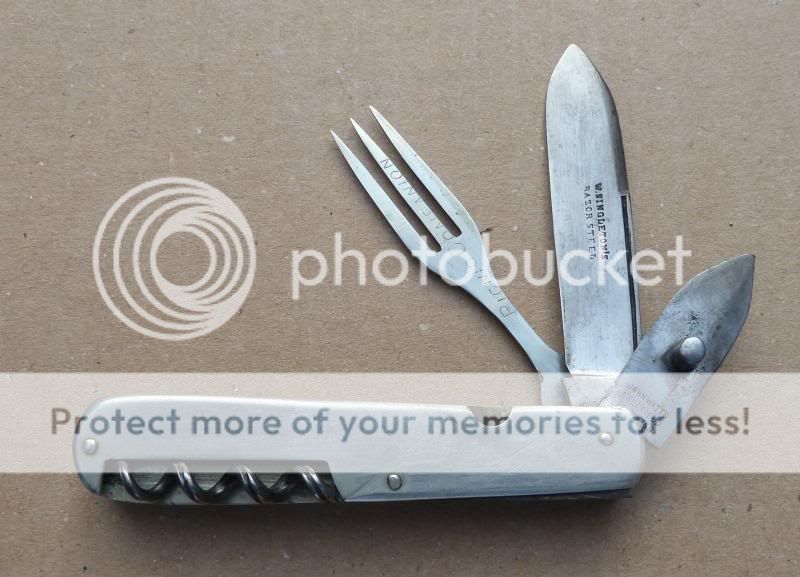
One of a few knives recently acquired at an antiques fair. W Singleton and Co dates to 1879. William Singleton passed in 1892 and the company continued as Singleton & Priestman from 1895. The tin opener was made by John Watts. It was quite common for Sheffield makers to outsource various attachments as needed. The fork is marked the Picnic Companion. As always, any comments or further information greatly appreciated. Thanks.

P1050998_zps1686602d.jpg

P1060001_zpsf99b15e7.jpg
 
Beautiful piece S-K. Thanks for posting it :)
 
Very interesting knife. It would make an excellent addition to a pick nick even today. Thanks for showing us this old beauty!
 
That knife looks in great shape - I hope I look that good when I am 130!!

There is nothing you can't do picnic-wise, if you have that beauty!! Great find s-k!!
 
Clearly the knife majored in quality, impressive finish and was a top of the range item I suppose. Many a picnic and companion glasses must have been enjoyed thanks to it over the last 130 odd years. THREE different centuries! :D:thumbup:

I find it interesting and unusual that the handles are all metal, you would generally think that stag or ivory would've been on board at that time. What is the metal, alloy, stainless?

Thanks, Will
 
Looks like aluminum to me, Will. If that's the case, it's not so surprising; aluminum used to be considered almost a semi-precious metal.
 
Interesting knife. Things turn up, but what I find interesting is the thumb stud. I always thought that feature was a relatively recent phenomena on knives.
 
Interesting knife. Things turn up, but what I find interesting is the thumb stud. I always thought that feature was a relatively recent phenomena on knives.

Others can correct me if I'm wrong (not that I'd need to ask :D), but I believe what you're seeing as a "thumb stud" is actually a nubbin that's part of the can opener, ie, a part that's braced against the can while the blade is worked back and forth, and not a protrusion whereby to open that particular blade.

~ P.
 
Others can correct me if I'm wrong (not that I'd need to ask :D), but I believe what you're seeing as a "thumb stud" is actually a nubbin that's part of the can opener, ie, a part that's braced against the can while the blade is worked back and forth, and not a protrusion whereby to open that particular blade.

~ P.

And we have a correct answer here! ~P wins a cookie.:D

The stud sticking out was indeed braced against the can rim, once the blade was punched down into the lid, and worked around, using the stud as a fulcrum. This was the old pre-WW2 era means of can opening.

Carl.
 
And we have a correct answer here! ~P wins a cookie.:D

The stud sticking out was indeed braced against the can rim, once the blade was punched down into the lid, and worked around, using the stud as a fulcrum. This was the old pre-WW2 era means of can opening.

Interesting. Thanks for the teaching lesson.
 
Thanks for the comments everyone. The old can opener is the same design as that found on late 1800s and early 1900s British Military knives. That was the feature that initially attracted my attention. Will, I think the scales are made of nickel.
 
Back
Top