Vinegar/Bleach won't finish evenly

Erin Burke

KnifeMaker...ish
Joined
May 19, 2003
Messages
1,330
I am working on a 1080 guard that I wanted to artificially age/darken. I'd heard of some folks using a mix of vinegar and bleach to develop a nice patina. So that's what I tried... a 50/50 mix of white vinegar and bleach. I took the mix outside (because I'm always concerned about fumes from unknown chemical mixes). Below you can see some before and after shots from this process.

BEFORE
4957165887_06c023566c_b.jpg


AFTER
4957166075_536f096209_b.jpg


The AFTER shot illustrates a VERY FRUSTRATING problem that I am having. The patina is forming very unevenly. In fact, one small strip on the edge of the front face of the guard (easily seen in the photo) will almost not react to the chemicals at all. At first, I had assumed that there was some oil or grease in this area that was inhibiting the process, so I re-sanded, cleaned with acetone, with soap/water, and with rubbing alcohol and tried again... with the exact same results. I have sanded repeatedly. I have rinsed and washed with everything under the sun... still that same spot will not react to the vinegar/bleach. I am using a hooked section of wire to dip the guard in the mix and agitate. Any ideas on what the problem might be and how to resolve it?:confused:
 
I don't have any suggestions for you, but that is a really nice guard and should look great once you get this figured out.
 
I have not heard of mixing vinegar with bleach. The common method is to cold blue the part to be aged, Then apply the bleach to the part, or dip it. There is something in the cold gun blue that causes rapid oxydation, and I have used 4 different brands with what seems to be equal results. The lower carbon steels etch faster than high carbon blades, so it only takes a few minutes. Sometimes as little as 2 to get a nice etch on low carbon. You then wet sand the rust crud off with 400grit wet&dry paper, and oil it. When you apply the bluing, daub it on. If you wipe it on, the etching will show streaking.
 
did you wash it well and clean it of any oil .

if the surface is not clean well you will get uneven problem .

i learn it from elector etching that when i get un even etch is cos i did not clean the surface well enough ..
 
It's been awhile since I've been in chemistry class but my thoughts go like this:

Bleach is a Base.

Vinegar is an Acid.

Mixing them together will neutralize them.

Try vinegar alone, maybe?

There could be a fault in my thought process.....
 
What they said.
I also believe you polished the steel too much.
From the pics, it seems about 600 or even 800 grit.
High polish will actually protect metal from etching and oxidation, the opposite of what you want. Try stopping at 200 grit finish, just to see what happens.
To obtain a good patination you also need time and repeated "baths" followed by polishing with 00 steel wool.
Hope this helps:

http://www.armourarchive.org/essays/russeting.shtml
 
yeah, I'd try just the vinegar....and warm it if at all possible....i put mine in a pvc pipe and put a space heater next to it....after 4 hours or so, you should have a pretty nice etch
 
I have aged using FCl first, then bleach. Muriatic acid (HCl )also gives a fast aging. The fumes can be deadly, so use it carefully.
 
For what it's worth.... I like it. :thumbup:

Your are trying to "age it", you did. It would probably not age any more evenly if done naturally over the years.

IMO, you nailed it.
:thumbup: :)
 
Thanks for all the replys. I think I have the guard finished.

For those that don't hang out on Knife Dogs, you can check out my WIP for this knife HERE.

Several folk recommended using vinegar alone. I have used warm vinegar before for etching hamon. In fact, that's what I did for the blade on this knife. I can tell you that the vinegar/bleach mix works MUCH faster than vinegar alone. The guard started turning a nice rich black/brown after about 7-10 seconds in the mix. What is really cool about the mix is you also get that slightly brownish tint rather than the dark black/gray of FeCl or long exposure to vinegar.

I never really figured out why that small portion of the guard wasn't developing the same dark color as the rest, but by repeated dipping followed by light polishing with flitz I was able to even out the color manually. I am happy with the results... and the knife is currently all clamped up gluing. Thanks for the help everyone. I'll post some photos when it's done.

Erin
 
Erin,more than likely you had some hard spots in the guard that caused the uneven patinaing,it's kinda like damascus,either normalize or H/T and the patina will come out more even.
Stan
 
Erin,more than likely you had some hard spots in the guard that caused the uneven patinaing,it's kinda like damascus,either normalize or H/T and the patina will come out more even.
Stan

Yeah... I had thought about this. I wonder if I overheated that part when grinding and ended up hardening it when I dipped it in my water bucket. {shrug}
 
The light spot in the etch could also be decarb. Hot rolled bars often have a fair bit in the rolled edge and less in the skin. I've seen it show up in the etch as a white spot before. Nice gaurd! ~Herb
 
Well, whatever you do, don't try what I told you, because it will work.

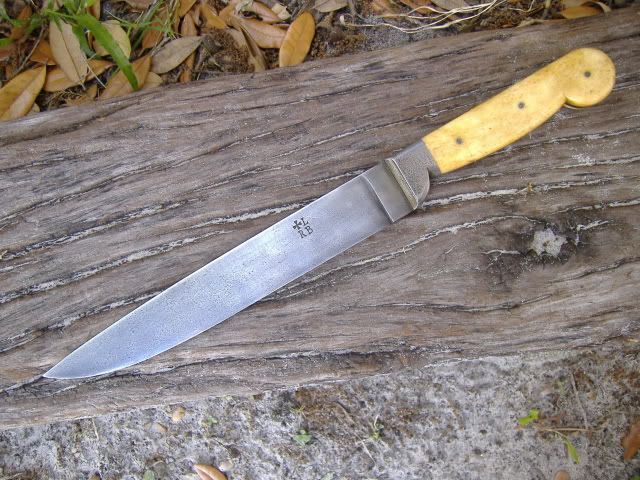
pennyknife769_640x480.jpg

I agree with LRB.... If you follow his recipe, your results will be horribly successful and tragically simple to produce...;):thumbup:
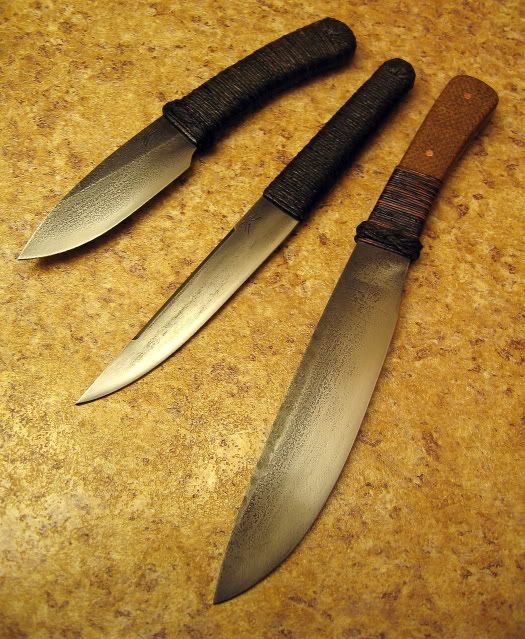
IMG_0077.jpg


It only gets more hideously aged with a longer soak (25 minutes or so)
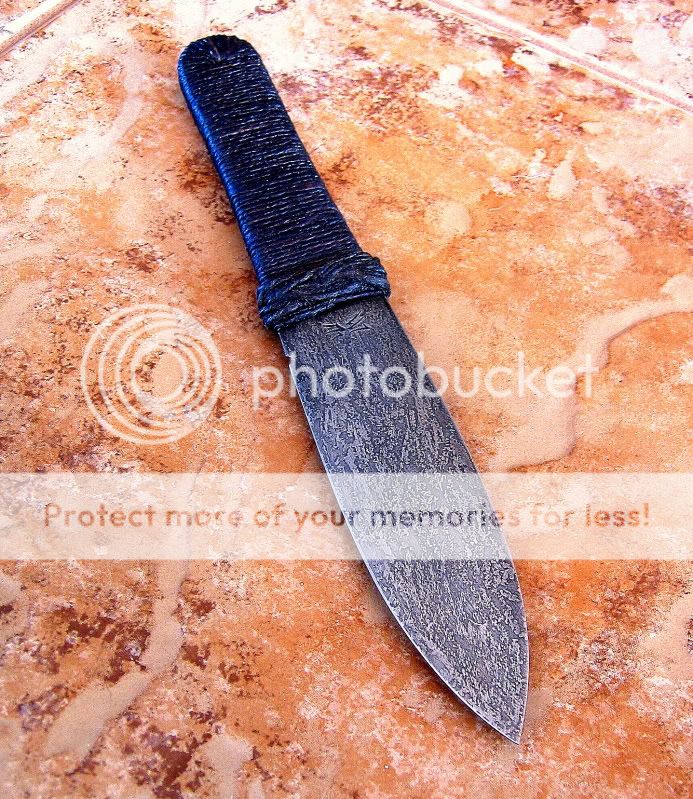
IMG_0127-2.jpg
 
Back
Top