Vinegaroon for maple: How to get consistent brown color?

Joined
Jul 26, 2008
Messages
1,006
So I picked up some maple from the local wood store today and decided to try my vinegaroon on it to see how it would turn out.... My other maple turned out a nice dark brown with the vinegaroon, but for some reason this new maple turned out a dark grey.:confused: Any idea why one would turn out brown and the other grey? I prefer the look of the dark brown for my knife handles.
 
Before I started lurking here I did a bunch of studying on a blackpowder site. vinegaroon, as you call it is a popular stain for custom stocks, but the concensus was that there were no gaurantees to how the color would turn out. As you have discovered even two peices of the same wood offer no gaurantee. Some say it might have to do with the age of the mix, temp, kept air tight, light tight ect. I don't think anyone ever managed to nail it down enough to claim a predictable color or outcome other than it won't be the color it started out.
 
Thanks for the reply. Well, at least it still turns my leather a nice consistent charcoal black. Maybe the Aqua Fortis they used was better for getting browns, but I have yet to try it.
 
By all means wait for some other replies. I just remember what I read there, but I'm getting older and the memory ain't what it used to be.
 
I believe if you stain the maple with a very strong solution of black tea before the vinegaroon you both a) get a nice brown color and b) put tannins into the wood that react with the vinegaroon to give you better color.

On 2nd thought, I may be thinking of Aqua Fortis...too tired to go searching through bookmarks.

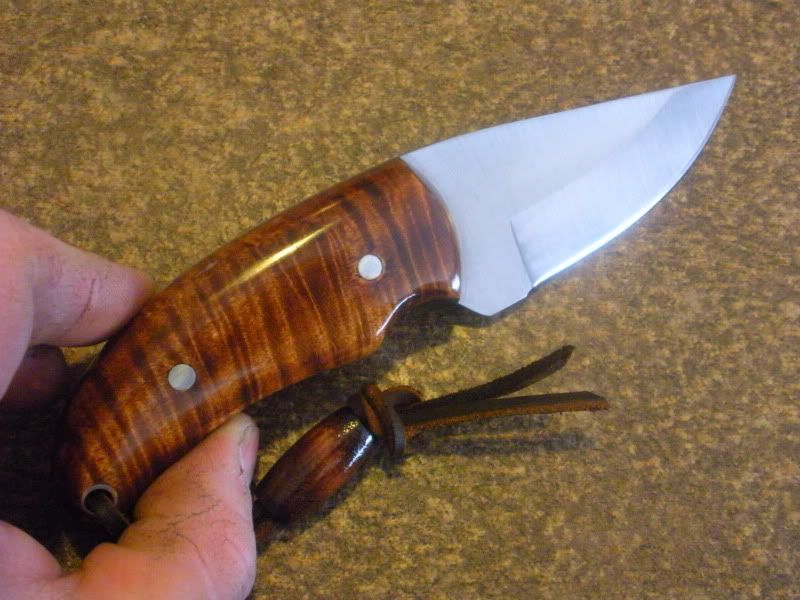
I just finished a handle of beautiful curly maple and used Fiebing's Pro Oil leather dye to get my color...I think it was Bill Moran who used a similar method.

This is light brown mixed with a touch of mahogany.
DSCN4038.jpg


Wish the picture and lighting were better, its a very very pretty combination that really brings out the figure.
 
I loved it...went on very well, no streaking, and really really made the figure jump! A lot easier than messing with vinegaroon or acids and heat. Perhaps Moran was on to something ;)
 
1) Actually many times when using either vinegaroon or aqua fortis the wood will look gray before adding a finish - use a bit of paint thinner as a quick "finish" to see how it looks - you will most likely be surprised. Also sometimes adding tannin as suggested will help the color, but then again sometimes it will just be darker.
2) Every piece of wood even from the same board will generally be unique - with maple you also have two or three common types being sold and especially for knife handle material you sledom know for sure: red maple, silver maple, and sugar maple are the three most common and will "dye" up differently, but even of the same type the wood will do what it will do.
3) Leather dye can be good and gives a good look, but it also has a tendency to fade since it is generally not color fast when exposed to sun light much. A better alternative are the wood stains offered by LMF or Jim Chambers for muzzleloaders since all have been developed specifically for maple and hard use.

No matter what though, IMO NOTHING makes the grain jump in maple and some other woods like aqua fortis does when done right and especially when followed up by using an oil or oil based varnish finish and FWIW I've been finishing maple for 40+ years and have tried just about everything out there
and now use AF exclusively along with my own real boiled linseed oil varnish.

 
What you are looking for with the vinegaroon is a reaction of it with the tannins in the wood, so the results vary with the tannin content. So the above mentioning tea has some basis. The tea has tannins in it, so if you soak your wood in the tea it will add tannins to the wood and give you a darker result, read not so gray looking, still a bit of a uncertainty in the end, test first. Turns oak rather black as oak has more tannins in it.
Aqua fortis is nitric acid with iron in it as well, AKA swimming pool cleaner from Home Depot or such. I think it acts on the sugars, i think the heating creates the sugars, in the maple ans so it also varies from piece to piece. Maybe some body else could comment on this process.

http://www.trackofthewolf.com/pdfs/aquafortis.pdf?AspxAutoDetectCookieSupport=1
Cheers Ron.
 
Last edited:
Mungo Park
I believe swimming pool acid is muriatic acid - AKA hydrochloric acid - not nitric acid.
 
Back
Top