
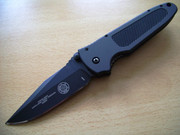
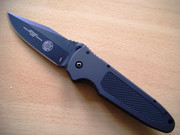
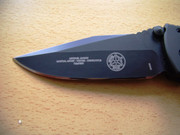
An original MOD Tempest:
Michael Janich on his design:
The final form of the Tempest is a bit different than my original design, but I'm still very proud of it and pleased to carry mine on a daily basis.
Here are the major design features and their reasons for being:
1) A Bowie-style blade provides plenty of "belly" or curve to the cutting edge for efficient slashing, yet keeps the point of the blade on the knife's centerline.
This ensures a direct transfer of energy during a thrust and keeps the knife from drifting during penetration.
The wide blade profile produces a wide wound channel during a thrust and allows for a gradual taper of the blade bevel.
This makes the blade strong, but still allows it to be sharpened to a keen edge.
2) A 3.5-inch blade is legal to carry in most areas (in fact, it is the maximum legal limit in Colorado - a personal consideration) yet is long enough to reach vital anatomical targets such as the carotid, the brain (through the eye), the liver and spleen, and (on thinner opponents) the aorta.
3) The tapered handle shape of the Tempest allows the user to focus the strength of his grip on the last three fingers (middle, ring, and pinky) to anchor the handle to the fleshy pad of the palm.
This increases the surface area in contact with the handle and allows for efficient management of "impact shock" when the knife hits a hard target.
The tapered shape also provides a striking surface on the butt of the handle (though it is smaller than I wanted it to be) that can be used for striking with the knife open or closed.
Finally, the index finger cutout is a functional guard that, along with the tapered handle, keeps the hand from sliding forward during the impact of a thrust.
4) The pronounced ramp on the back of the handle and extending over onto the back of the blade is designed to allow the thumb to extend forward.
This further tightens the grip of the hand and provides a positive index for the thumb to guide the blade.
I'm a big believer in using the thumb as a guide to allow the blade to be employed instinctively.
This is similar to the Filipino extended thumb grip, but does not require that the thumb be held away from the back of the blade.
5) The reversible clothing clip allows the knife to be carried point up in the pocket (mine is the only MOD knife with this option).
This is my preferred carry method since it allows the user to grasp, draw, open, and use the knife without having to change his grip on the handle.
This is much faster and more reliable in the heat of a fight.
I hope this gives you some insight into the Tempest design.'
Michael Janich
Specs:
Length open: 8" (20,3 cm)
Length closed: 4.5" (11,4 cm)
Blade length: 3.5" (8,8 cm)
Blade thickness: 0.1" (3,75 mm)
Steel: 154CM
Blade coating: Titanium Carbonitride
Hardness: 60 HRC
Handle material: Mil-Spec Type III hard anodized aluminium, inlayed on the front with Kraton
Lock: Linerlock (1,9 mm thick)
Weight: 112 grams
With steel pocketclip
Michael Janich on his design:
The final form of the Tempest is a bit different than my original design, but I'm still very proud of it and pleased to carry mine on a daily basis.
Here are the major design features and their reasons for being:
1) A Bowie-style blade provides plenty of "belly" or curve to the cutting edge for efficient slashing, yet keeps the point of the blade on the knife's centerline.
This ensures a direct transfer of energy during a thrust and keeps the knife from drifting during penetration.
The wide blade profile produces a wide wound channel during a thrust and allows for a gradual taper of the blade bevel.
This makes the blade strong, but still allows it to be sharpened to a keen edge.
2) A 3.5-inch blade is legal to carry in most areas (in fact, it is the maximum legal limit in Colorado - a personal consideration) yet is long enough to reach vital anatomical targets such as the carotid, the brain (through the eye), the liver and spleen, and (on thinner opponents) the aorta.
3) The tapered handle shape of the Tempest allows the user to focus the strength of his grip on the last three fingers (middle, ring, and pinky) to anchor the handle to the fleshy pad of the palm.
This increases the surface area in contact with the handle and allows for efficient management of "impact shock" when the knife hits a hard target.
The tapered shape also provides a striking surface on the butt of the handle (though it is smaller than I wanted it to be) that can be used for striking with the knife open or closed.
Finally, the index finger cutout is a functional guard that, along with the tapered handle, keeps the hand from sliding forward during the impact of a thrust.
4) The pronounced ramp on the back of the handle and extending over onto the back of the blade is designed to allow the thumb to extend forward.
This further tightens the grip of the hand and provides a positive index for the thumb to guide the blade.
I'm a big believer in using the thumb as a guide to allow the blade to be employed instinctively.
This is similar to the Filipino extended thumb grip, but does not require that the thumb be held away from the back of the blade.
5) The reversible clothing clip allows the knife to be carried point up in the pocket (mine is the only MOD knife with this option).
This is my preferred carry method since it allows the user to grasp, draw, open, and use the knife without having to change his grip on the handle.
This is much faster and more reliable in the heat of a fight.
I hope this gives you some insight into the Tempest design.'
Michael Janich
Specs:
Length open: 8" (20,3 cm)
Length closed: 4.5" (11,4 cm)
Blade length: 3.5" (8,8 cm)
Blade thickness: 0.1" (3,75 mm)
Steel: 154CM
Blade coating: Titanium Carbonitride
Hardness: 60 HRC
Handle material: Mil-Spec Type III hard anodized aluminium, inlayed on the front with Kraton
Lock: Linerlock (1,9 mm thick)
Weight: 112 grams
With steel pocketclip