Was This Old Case Sodbuster Modified?

Joined
Feb 28, 2012
Messages
584
I just got a black, CV Case Sodbuster Jr. According to the tang stamp, it was produced in 1973 (7 dots). I noticed that this old Sodbuster is different in a couple of ways than my modern Sodbuster. I'm wondering if the old knife was modified, or if Case just made the old ones differently. Here are the differences I noticed:
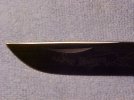
  1. Tip is sharper, less belly
  2. Swedge on the blade
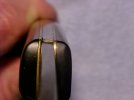
  3. Back square sits lower

Here is a comparison of the tip:
soddie1.jpg


Here is a picture of the swedge:
soddie2.jpg


Here is a comparison of the back square. Notice the new Sodbuster (top) sits higher and at an angle.
soddie4.jpg


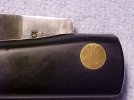
In this picture, the old Sodbuster is in the open position. Because of the low back square, there is a step between it and the spring.
soddie3.jpg


I'm wondering if anyone out there has a Sodbuster Jr. from the 70's and can tell me if it looks the same as this one. Thanks!

- Calvin
 
Last edited:
Interesting... Different pin placement too.
Mark

You're right, Mark. I didn't even notice the end pin placement.

I'm guessing this has to do with the different spring. The modern Sodbuster's spring wraps around to cover the entire end of the handle, while the old Sodbuster has a shorter spring. With less spring material, they probably had to place the pin further away from the end.

Here's a picture:
soddie5.jpg


On a side note, Obesessed with Edges noted the different springs in post #18 of this thread: http://www.bladeforums.com/forums/showthread.php/913886-Sodbuster. He also noted the thicker blade and shorter ricasso. He was comparing the full sized Sodbusters, not the Jr's. On the two Jr's I have, I do see a thicker blade, but the ricasso on both appear identical, as you can see from the first pictures in the first post.

I also think I see a swedge in Obsessed with Edges picture of the old Sodbuster. It's ever so slight.

- Calvin
 
Last edited:
I just dug out my 5 dot small Sodbuster. The spring cutout at the tang has the same (aprox) 90 degree cut, and like yours the spine of the blade is ever so slightly shy of the spring. also noted is the ever so slight swedge. pin placement and spring height are the same as your older one. All apears identical except for an ever so slight difference in the height of the step between the blades spine and spring. also, on your newer model it looks as if the spine has a slight rise going back from the kick to the spring cutout. the older ones both have a continuous (arch) or radius along the spine of the blade.
looks like mine is a 1980-1989
 
Last edited:
It's likely the old one is just that different by design. I have a large 1970 Case soddie (2138), and there are some notable differences from the current-gen models. Most notably, a longer cutting edge on the 1970 (with correspondingly shorter tang), and significantly thicker blade stock on the 1970 as well (seen in last pic). I've set it alongside my 2009 2138 SS model for comparison:

There's also a similar difference in the height of the end of the springs between these two, as in your example. I don't have a pic of that yet.
 
Last edited:
Here are some pics of my 1981 Sodbuster. It seems to match the 70's model in the OP.

swedge and less belly
Sod1.jpg

backspring and blade not aligned
Sod4.jpg

back square is lower and vertical
Sod5.jpg

In addition, the end pin is in the same position as it is in the OP.


-Hank icon15.gif
 
Last edited:
Thanks, Hank.

So the common complaint I read about the Case Sodbusters, the lack of a sharp tip, wasn't an issue in the 70's.

Does anyone know why the back square doesn't line up with the spring? This seems to be intentional.

I just got a GEC Bullnose and it's the same way - a tiny step between the spring and back square.

- Calvin
 
Last edited:
David, is there also a swedge on the 1970 version?

I almost thought 'no', but then double-checked it. It's got just a hint of swedge, from about mid-blade forward. The grind is about 1/16" wide at most. Very subtle.

This pic doesn't show the whole blade, but you can see the beginning of the swedge in the upper right corner of the pic:
 
Last edited:
This has been a great thread up to this point with some great pictures from many of you. What with all the talk of long/short ricassos, blade grinds, under-blading, etc., I feel that these Case Sod Busters are awfully hard to beat at their price point. I have two 3 5/8" Sod Buster Jrs. and one 4 5/8" Sod Buster Workman all with no under-blading, very sharp edges out of the boxes, consistent blade grinds, etc. and all three purchased new for just under a 20-dollar bill each.

casesodbusterjryellowco.jpg

casesodbusternavyblueco.jpg
 
Last edited:
Is the rear pin exposed (on the interior of the spring) on the 1970s models? On my modern Sodbuster Jr. it is exposed, so I'm curious if this is a characteristic of all Sodbusters, just the Jr. model or just the modern ones. If the rear pin was through the spring on the older models, this might explain why the placement is different.
 
Is the rear pin exposed (on the interior of the spring) on the 1970s models? On my modern Sodbuster Jr. it is exposed, so I'm curious if this is a characteristic of all Sodbusters, just the Jr. model or just the modern ones. If the rear pin was through the spring on the older models, this might explain why the placement is different.

Yes, it's exposed on mine (1970 2138). Almost fully-recessed into a groove in the spring, but exposed nevertheless.
 
One other curious thing I've noticed, in comparing my 1970 & 2009 large soddies, the 1970 has just a little bit of convex to the blade grind, more so on the obverse (front) side. I thought I'd seen a little of the convex in the pictures of it, but hadn't checked it with a straight edge until now. The large 2009 2138 SS is a true flat grind, and my small 2137 SS (2008) is a hollow grind.
 
Back
Top