
Water Quenching question

Joined
Oct 7, 2006
Messages
36
Hi :)

It has been some discussion about oil temperature when doing oil quenching with vareous types of oil. Also steel temperature have been debated between different oils and water quencing.

But what would be appropriate water temperature during water quenching, or does'nt it make any difference ?

Best regards,
Ronald Pettersen
 
As far a efficiency [how quickly it cools ] room temperature is better. As far as cracking risk, warm [ ~ 150 F] is better .
 
Ha ha, Glad I double checked my calculation. Its preatty far from boiling allright :-D
 
Don't quench in water. About the only way to do that is through "interrupted"
quench - where you quench for about 1 sec and then continue the cooling in a very controlled fashion, with wet burlap.

Unless you want to hear the sickening sound of cracking steel and watch results of few hours of your labor go down the tube.
 
But is it possible to get a good hamon doing oil-quencing ?

Yes, depending on the steel (but that's more of a function of the steel than the quench medium). You can get quite a nice hamon by clay-coating and oil quenching a good, high-carbon, simple steel (1095, W-1, etc).

-d
 
Thanks Deker,

Nice looking and being martesenite ? Reason for asking is that I want to make a 10" tanto and want the hamon mostly for strength/edge hardness and not so much for looks...

I never made this size of knife before.. well I am working on a chopper of scandinavian design, but that is my first large knife...

I see now that for future post, I should perhaps be a bit more spesifik.

I will check if the steel supplier knows the equivalent amerikan standard. the composition i am using is <<<C 1,0 - Si 0,30 - Mu 0,45 - P max0,015 - S max0,015 - Cr 0,15>>>
 
Ok, Now the steel mill confirmed that this is "similar" to K-990. For fellow europeans, this is Oeberg 20 steel. So is this a water hardening steel. The mill confirmed it is water hardening, but they did not know about the hamon thing. They never (!!!) heard about clay hardening...

Anyone made hamon with K-990 and water quenching ?

Any advice appreciated. Share your experience folks..
 
Never heard of hamon ?? That's funny !! That steel is like our 1095 [the small amount of chromium won't have any real effect] .You could do a search here for 1095 information.It can be hardened in water or a very light oil.
 
Thanks Mete,

Yeah it is funny. They even said that hardening to maresenite will make it impossible to sharpen. Perhaps I was able to talk to the least knowledgable person at the mill.

Thanks for the usefull info. I found plenty info on 1095 hardening ;)
 
I used to quench in water (interrupted quench), got some pretty vivid hamons. However, cracked too many blades for it to worthwhile (weird that 1084 cracks easier than 1095 :confused: ). So now I just use olive oil. Never cracks and you get a decent hamon. :thumbup:
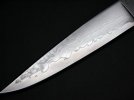
 
1084 is high in manganese and deep hardening, this is why it will crack easier in water than 1095. I quench all my blades in oil. Here's a W2 blade with hamon that was oil quenched.
 

Attachments

  • small-fighter.blade-2.jpg
    small-fighter.blade-2.jpg
    31.4 KB · Views: 291
1095 oil quenched:
hamon3.jpg
 
I think water is used more for imparting sori (curvature) in Japanese style blades than for the actual hamon (and because some people just like to live on the edge :). Don Fogg, Don Hanson, Burt Foster, and many others have gotten terrific hamons from oil.

John
 
One water quench I did first resulted in a recurve blade which dropped the tip almost 1/4"....i decided to go for broke and to re-ht....the second water quench took that tip from a 1/4" recurve to almost 1/4" sori before the blade cracked and the hardened edge delaminated along the clay line in a spectacular failure. It was my first water quench and i had no idea of how different the clay thickness would affect the steel's curvature. Good learning experience...
 
Thanks guys :)


Do any of you have pictures of blades that have cracked during clay quenching ?

Reason for asking is that the japanese swordsmiths have done water quenching with steels of far lesser quality for centuries. I wonder if the problems with waterquenching is related to blade geometry more than quenching media.

I dont mind cracking a few blades if I can get the satisfaction that comes with the successfull ones :D
 
I believe the steel is important.

I believe Japanese smiths worked with steels that were very simple, pretty much just had carbon in it (usually around .70 to .80 %) -so basically 1080 or 1060.

As Don mentioned 1084 is deep hardening due to the Manganese, whereas 1095 doesn't have any.

I quenched another two blades made from 1095 in water yesterday and they didn't crack. (They were also normalized twice).

Whereas, 1084 cracks in water every time for me. I'm going to stick with oil for 1084.
 
Nothing to add except to say what stunning Hamons Don & TikTok posted ! Some really wild banding there too Don ! Down right Beautiful or should I say Don right Beautiful !
 
BTW where is Skodje ? While the Japanese have been making swords for centuries don't assume they didn't have failures !!! Their failure rate , even with the best , was fairly high .
 
Back
Top