What are swaybacks used for?

Status
Not open for further replies.
Joined
Feb 4, 1999
Messages
5,786
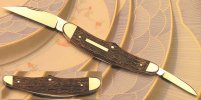
I have a gorgeous Bret Dowell swayback with a stainless steel shield (his first!) and it is my first swayback. Handling the knife, it struck me that the handle seems like it's on "upside down" as if it is intended to be held with the edge facing toward the user for pull cuts, like a paring knife. Is this right? Anyone know what the swayback style is made for and why it seems like the handles are on the "wrong way?" They look cool, but I want to know more about the pattern. Thanks!
 
Basically, you're correct, the proper way to use it is in a pull cut (to do this safely, simply keep the edge parallel to your body - or put another way - just don't have the point pointing at you while you're pull cutting) -- gives a lot more control and precision during the cut. This is true for congress patterns also. As a matter of construction, you'll notice most swayback patterns have a wharncliffe, sheepsfoot, or hawksbill master blade - the swayback design allows the handle and spring to be back out of the way of the flat or hooked edged blade.
 
Last edited:
I wondered the same thing when I got my first custom swayback... Unfortunately I sold it before I actually tried using it:o I later bought a Case Pocket worn single blade swayback and carried it daily for about a month. I now find the pattern quite useful, but not a great "all around user". In fact I have a Bret Dowell in my possession now that I carry once in a while. I think swaybacks are best suited for pull cutting, but they are also great for opening packages and actually aren't bad for a lot of tasks once you start using them.

Will I ever make one my primary carry? Not likely. I think the aesthetic appeal of swaybacks is the main driving force of their recent popularity
 
I EDC my Case Swayback Jack. It does everything well, but I find it excels at pull cuts, like you mentioned: cutting apples, cheese, anything where you draw the blade towards the thumb. I love Jacks, and the Swayback variety is downright curvaceous--the Marilyn Monroe of pocketknives.
 
The wharncliffe blade is outstanding for whittling purposes. It also excels in getting out the occassional splinter. I like it because it just looks cool.

I also have a Bret Dowell swayback, with a stainless federal shield.

mybretdowellswayback2.jpg
 
I'd guess pulling style cuts. Looks to me like they stuck a wharncliffe/sheepsfoot blade onto a back contoured handle for those unsure about the utility of a hawkbill.

But mostly I think it is novelty for novelty sake. This applies for most patterns. Make something that looks cool and people will buy it. Devise a rationale that sticks, and you've just devised a rationale for the average knife nut to add one to the collection.

It kind of reminds me of a time when I wondered what sunfish/elephant toenail patterns were intended for. Common thought was that they were for sailors/rope cutting. Looking back at the old ads, this seems to be true. Except when it was pushed as a work knife. Or as a camping knife. What it boils down to is, it was just another interesting pattern to attract new sales of folks wanting a novel knife shape.
 
I thought they were for ringing the bells at Notre Dame?

No wait, that's a hunchback. :D

A swayback is a great daily use knife and excels at tasks like whittling, pruning, slicing or peeling fruit, etc. I thought they were a bit goofy at first - then I got one and discovered otherwise!

Give one a try!

Bose1003.jpg
 
If you look at most hand tools used in wood working like example a plane blade they have no rounded edges or curves to the blade. chiseles are they same. As a carpenter when it comes to this pattern and wood working its like a free hand blade that has more power and control on the peice you are working on than any other pattern, 1 because its shaped proper and 2 because you get more power and controll in a pull stroke. All seriousness aside though.
Peel an apple pushing your favorite knife. Then peel an apple drawing your favorite knife toward you. Then use a sway back. which one wins?
 
Not a swayback (but a humpback) that's in my top 3 edc because its a wharny (and small -3 3/8").

Mike
 

Attachments

  • Ryuichi_Kawamura12.jpg
    Ryuichi_Kawamura12.jpg
    41.8 KB · Views: 49
Quote: "That Kawamura is a beauty!"
It sure is, and except for the secondary blade, the pattern is very like the '09 Case/Bose Colab. Norfolk. i.e. the Serpentine Pen is a great pattern.
roland
 
If you look at most hand tools used in wood working like example a plane blade they have no rounded edges or curves to the blade. chiseles are they same. As a carpenter when it comes to this pattern and wood working its like a free hand blade that has more power and control on the peice you are working on than any other pattern, 1 because its shaped proper and 2 because you get more power and controll in a pull stroke. All seriousness aside though.
Peel an apple pushing your favorite knife. Then peel an apple drawing your favorite knife toward you. Then use a sway back. which one wins?
This is so informative - thank you!
 
I recently picked up a kizer swaggs swayback as an EDC knife. It does all those scoring cuts for boxes well, opens letters well because of that long fine tip

Pull cuts are basically my method to open clam shell packaging. And it cuts through those fairly easily.


I am still getting used to the button lock tough. It locks closed which is weird
 
I have a gorgeous Bret Dowell swayback with a stainless steel shield (his first!) and it is my first swayback. Handling the knife, it struck me that the handle seems like it's on "upside down" as if it is intended to be held with the edge facing toward the user for pull cuts, like a paring knife. Is this right? Anyone know what the swayback style is made for and why it seems like the handles are on the "wrong way?" They look cool, but I want to know more about the pattern. Thanks!
To cut stuff. 😀
 
Status
Not open for further replies.
Back
Top