What are the striations on satin blades?

foxyrick

British Pork
Joined
Dec 26, 2006
Messages
2,254
I've noticed this on a few of my satin blades. Sorry, no photos at the moment but I can post some tomorrow if need be.

You can see what I mean though in Chibbi's post in the pictures thread (beautifully clear photos Chibbi - I hope you don't mind me using one as an example.) It's the second photo down and the striations are visible under the 'Custom Shop' lettering:

http://www.bladeforums.com/forums/showpost.php?p=6600488&postcount=1128

So, what causes these marks?

I was a little concerned when I first saw them, on my satin flat AD, thinking it was a flaw of some sort. I think they are visible on all (certainly most) of my satin blades though, so I don;t think they are a flaw as such. I still wonder what causes them...
 
do you mean the marks running vertically or horizontally?

the vertical is the grit patter from the grinder, sand paper, or whatever process they use to do the satin finish.

the horizontal could be residual marks from the cnc cutting process, essentailly the "corregated bevels" that werent ground completely off. if they are uniform in distance and orientation, thats what I'd assume they are.
 
The striations roughly parallel to the edge are what I'm talking about. They seem pretty randomly distributed other than their direction. On Chibbi's picture, they are visible just under where the light changes from darker to brighter, below the lettering.
 
I see those same striations on some of my satin finished INFI blades. Probably has something to do with the grain structure particular to the alloy content and heat treat? The back or top of my BATACLE has a strange wavy pattern somewhat like a pattern welded steel. Pretty cool lookin' whatever it is.
 
I don't think that they are scratches - I can't feel anything with a fingernail. They look more like marks in the steel.

I'll try to get some photos of my own tomorrow.
 
I saw the same things in my Culti. I agree that they look more like they're in the steel than from any process of shaping it.
 
the nature of infi's chemical make up give it excellent red hardness - so it might be that the blades get fairly hot during the cutting process, leaving a slight residual image from the heating?

i'd really have to see larger pictures or clearer examples of it :confused:

it just seems that if it's only on the blade, and only horizontal that it would be from the cnc, since thats the direction of the cuts taken by it.
 
Just because you can't feel them with your fingernails, doesn't meet they aren't scratches. Sometimes when I grind, I move to finer grits to fast, and I can see (not feel) the deeper scratches underneath the polished surface. It does kind of look like markings under the surface. And the only way to get rid of it is to start back at the low grit and start all over.

I don't think it's from the grain structure/heat treat either. I've seen a good amount of modded Busse knives in person that has had the surface repolished, and if it is the grain/heat treat, it should continue to show.

I'm no expert though, this is just all speculation. :D
 
Yep. Some of my blades - very few - look like they are painted with cracking paint. I figure it's no big deal b/c, like you, I can't "feel" these marks at all. But yes, I've noticed them too.
 
http://www.certyourself.com/index.cfm?do=hardware&hardid=2795#

i really wish I could find a better picture of a surface roughness comparator. basically - if there is a type of finish done before the satin finish process that isn't completely removed and it is of a very high finish, you may not be able to visually perceive the depth of the irregularity, but it is apperent because of the stark contrast to the vertical finish lines.

the difference could be as little as 0.000032", but because it's perpendicular to the pattern you see it.

:confused:
 
definitely not scratches, those are on every satin blade...on some less recognisable, but there they are.
I think it comes from the structure and heat treat...would be nice to hear the truth from the Boss, tho'...:thumbup:
 
I think that if they come from grain/HT, it would be consistent on every satin, but it isn't. Some are more visible while some are less, I think that's the human variance of whoever grinds the knife if they took more or less steel off the surface. But like I said earlier, just speculation. :thumbup:
 
I think that if they come from grain/HT, it would be consistent on every satin, but it isn't. Some are more visible while some are less, I think that's the human variance of whoever grinds the knife if they took more or less steel off the surface. But like I said earlier, just speculation. :thumbup:

How can they be from grinding when they run horizontal not vertical?:confused:
 
How can they be from grinding when they run horizontal not vertical?:confused:

When a CNC machine cuts out a blank knife and does the primary bevel, I assume all the cuts are horizontal. All the flat stock steel I order are cut horizontally. Here's a bad example, but you can see the CNC cutting the knife horiztontally: http://www.youtube.com/watch?v=yoZzuIv6zeE

After the main profile and bevel are cut out, it is then given to someone to get sharpened and put a satin finish on, and that's when you get the vertical lines from a belt grinder. To get rid of all the horizontal lines and achieve that satin finish, you need to work from lower grit to higher grit. If you move up to fast, the finer grit belts cannot cut deep enough to penetrate the deeper lines, meaning you might have not worked that area enough with the lower grit to remove ALL horizontal lines, leaving those fine thin marks behind "under" the polished surface.


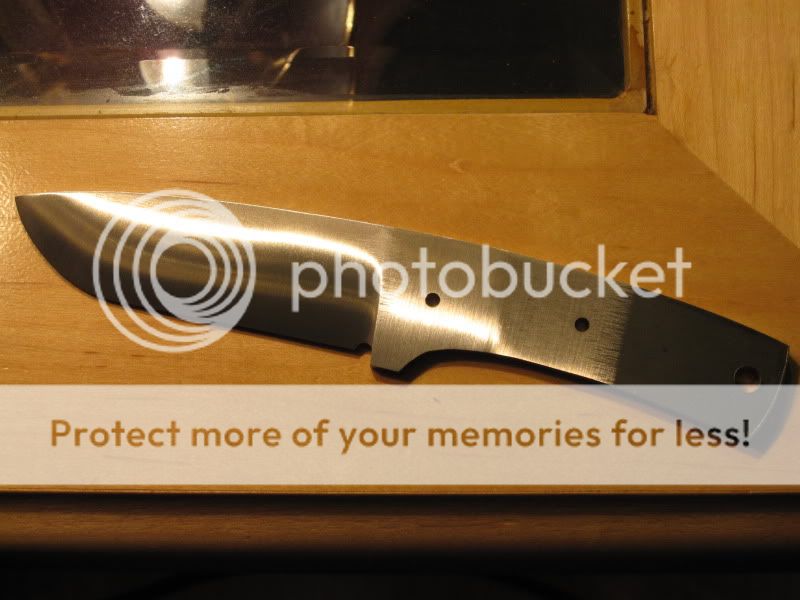
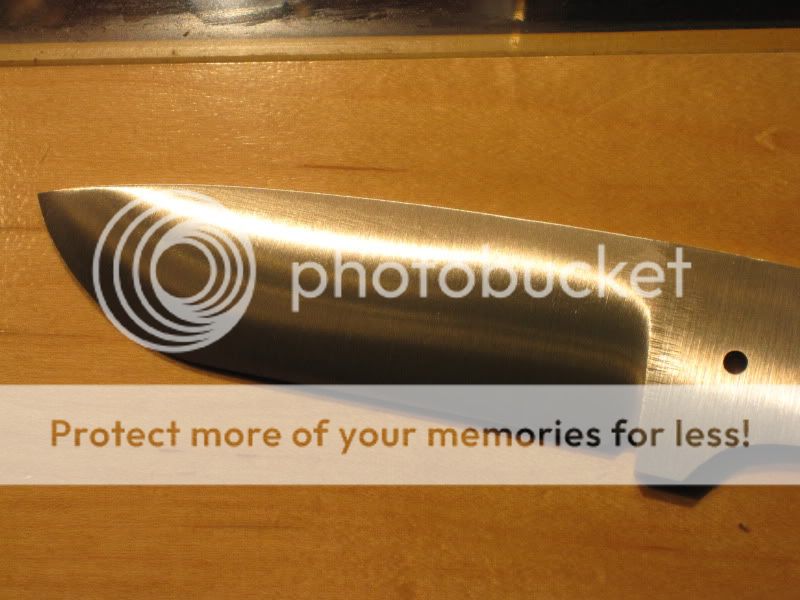
Here's an example of a knife I am making. You can see the the horizontal marks from the CNC near the tip, plunge line, and tang. I've had to go back and regrind the whole knife to get rid of it.

IMG_2991.jpg

IMG_2992.jpg
 
Last edited:
definitely not scratches, those are on every satin blade...on some less recognisable, but there they are.
I think it comes from the structure and heat treat...would be nice to hear the truth from the Boss, tho'...:thumbup:

at a roughness height 0.000128" you wouldn't be able to feel them with your fingers. you probably woulndt even be able to get a good idea of how tall they were by looking at them with the naked eye.

How can they be from grinding when they run horizontal not vertical?:confused:

as was shown in the above post, cnc marks that are left over were remain from the horizontal cuts made by the end mill. however, in grinding the grinding wheel tends to grab, remove, shift, grab, remove, shift, causing a perpendicular set of markings even though the cutter is running lengthwise. I don't think thats what this is because the lines are so wide and regular, and I don't think jerry would use a grinder for these during the satining process.
 
Back
Top