- Joined
- Dec 1, 2001
- Messages
- 2,871
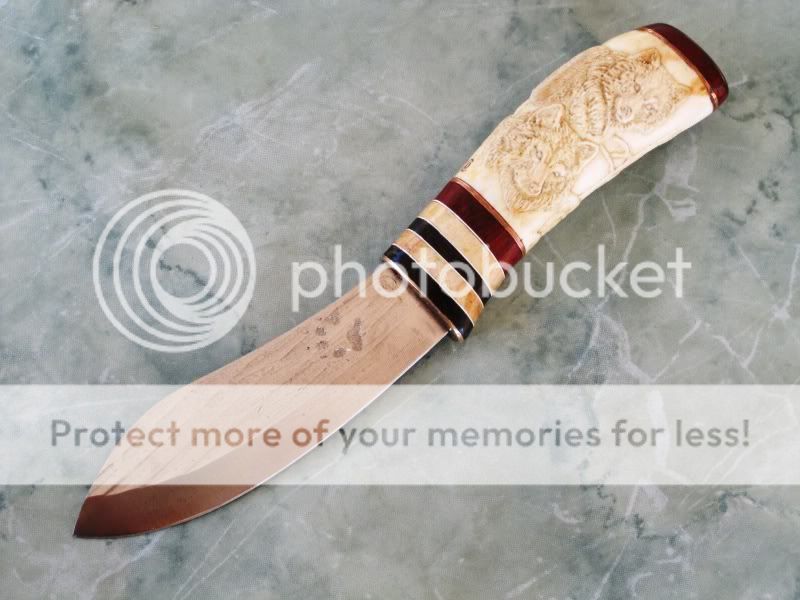
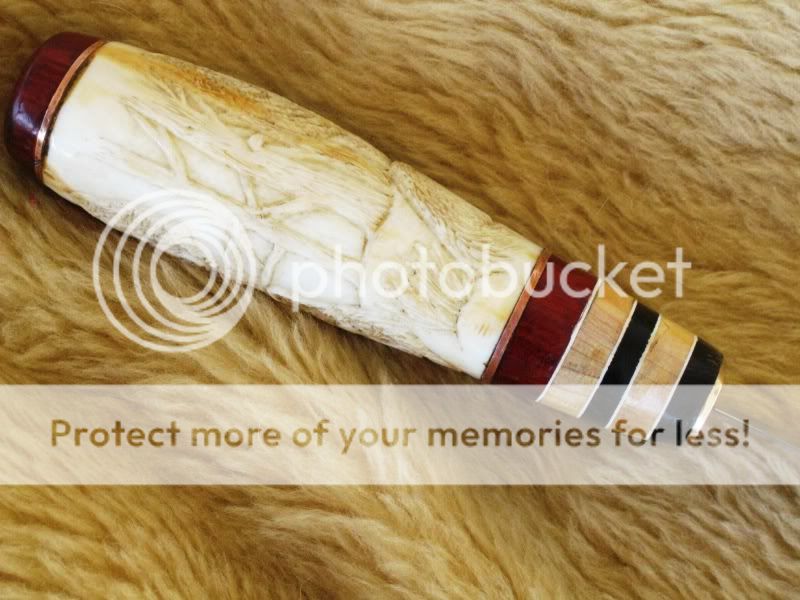
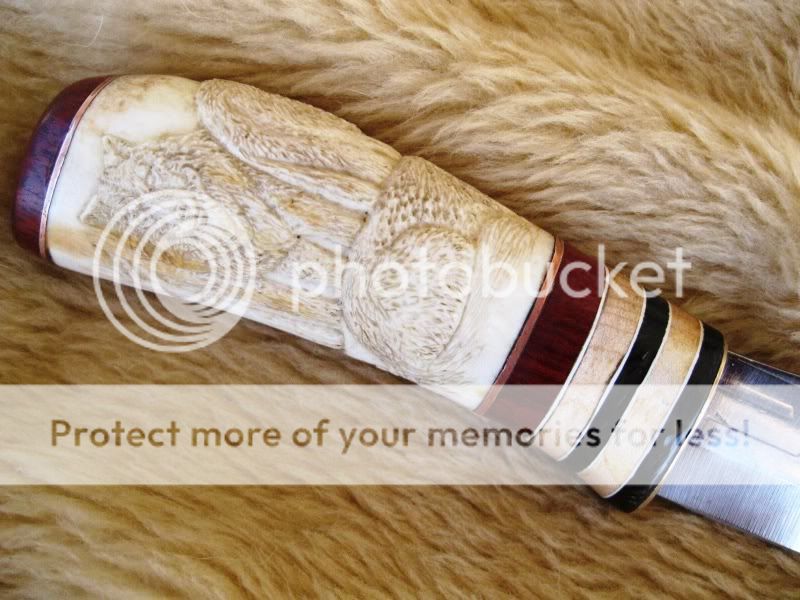
...when you take a custom nessmuk type knife made by Dirk Potgieter from a butcher knife blade and an ample amount of smooth stag, purpleheart, maple and wenge? You get this WIP...
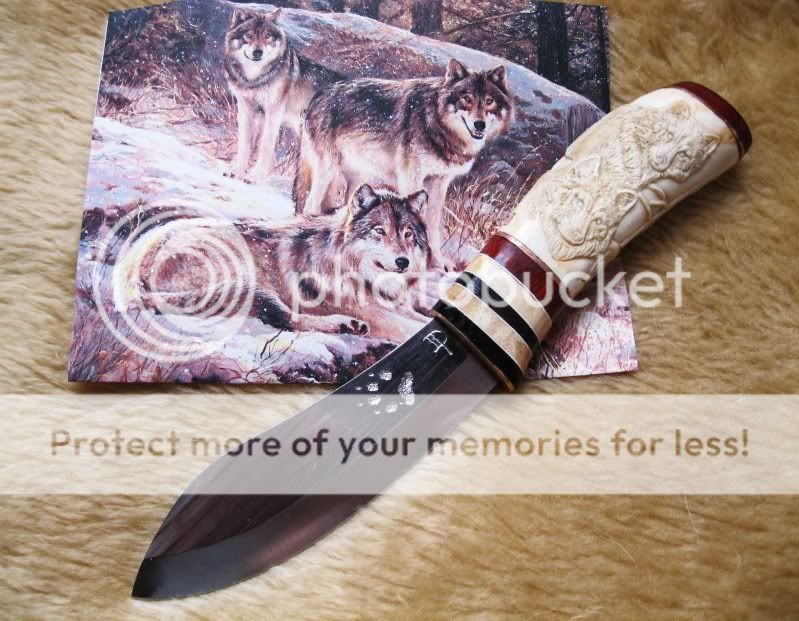
I’ve dealt with Catherine DeFelice (Knifecarver) before and she does fantastic knife handle carvings. I rounded up a knife with a stag handle and asked if she would consider performing her craft. The subject I was interested in was wolves…an animal she knows very well. Her answer was yes. I sent the knife to her and some pictures of wolves,
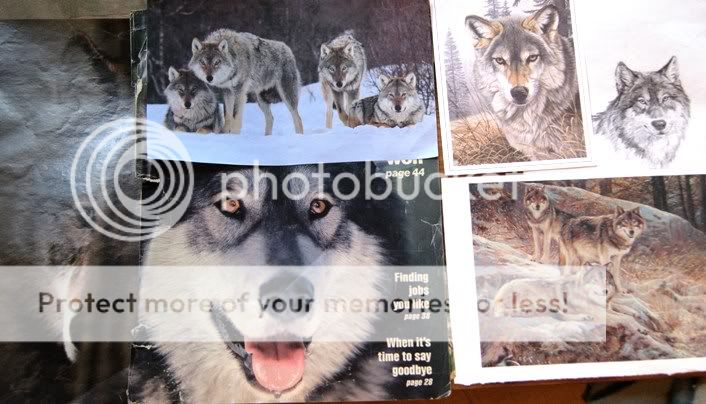
she picked one that we both felt would work well on the knife handle...
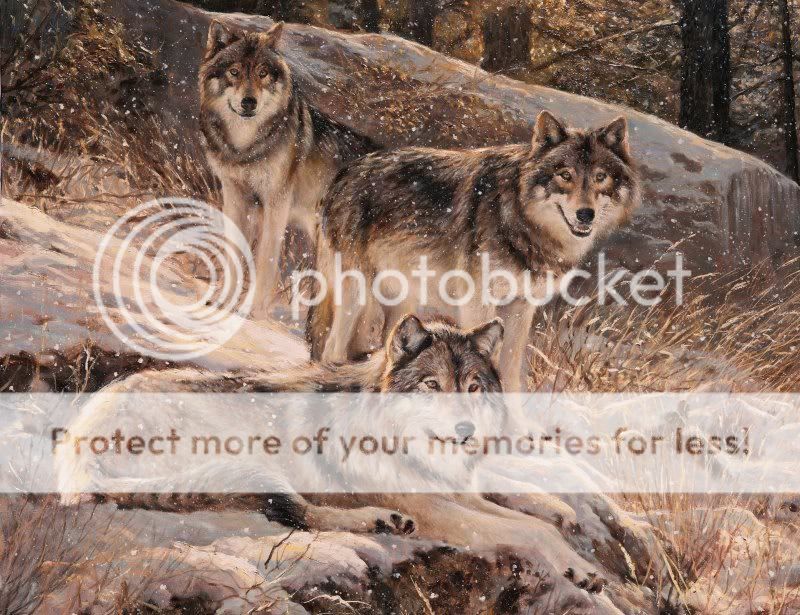
I gave Catherine the go-ahead and then we talked about doing a WIP (Work In Progress) thread for the forums. This is the start...
In Catherine's own words…
Step #1. You should ALWAYS tape up the knife blade. Blue painters tape works great.
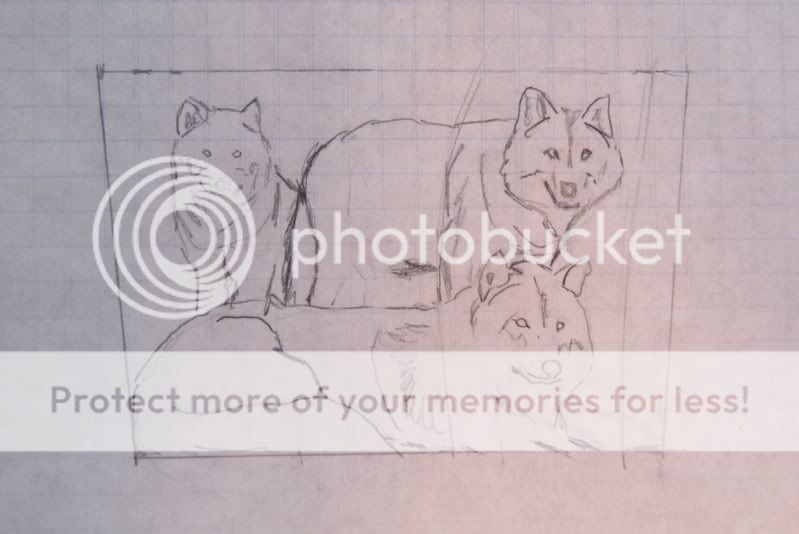
Step #2. I measured the work area of the knife handle and drew the dimensions on grid paper. Then I drew the repositioned wolves from the picture I/we liked.
Step #3. The wolves from the picture were the exact size I needed, so I copied the picture, cut them out and taped them on.
Right:

Top:
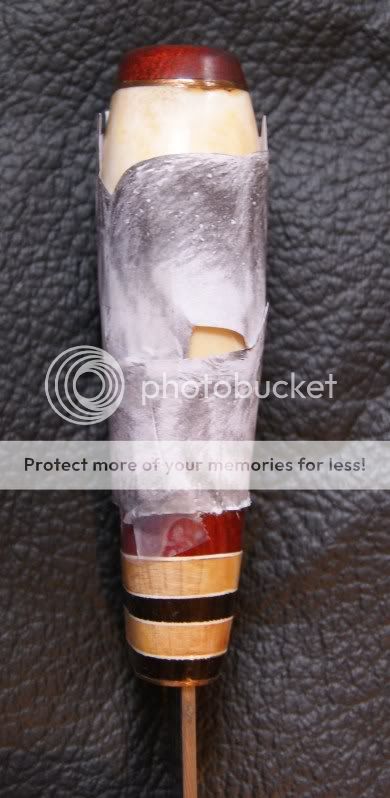
Left:

Bottom:
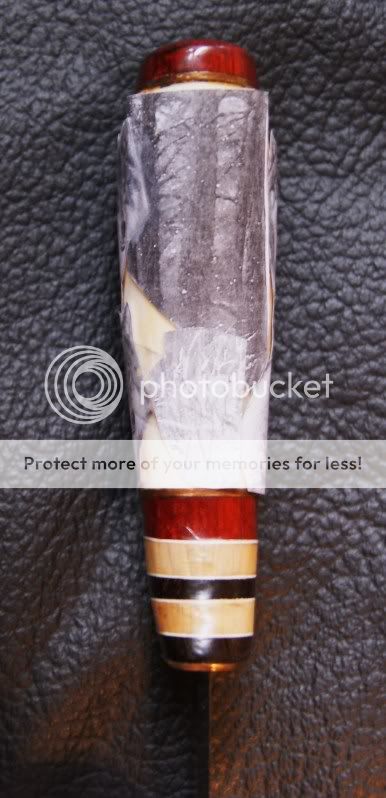
Knife in sheath:
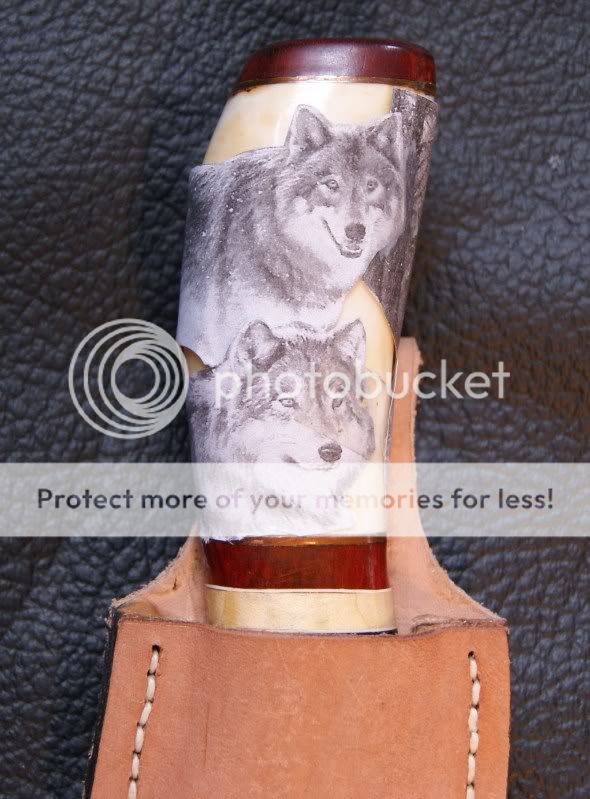
Step #4. Transferring the picture. Leaving the pictures on the knife and lifting the tape where needed, I trace what I can with a fine tip pen. Next, I take the pictures off. I take a piece of tracing paper & a piece of carbon paper, and cut it to the size of the picture I drew on the grid paper. I draw the wolves from the grid onto the tracing paper, tape the tracing paper to the knife so it lines up with the picture and slip the carbon paper underneath. Then, I trace simple face and body details.
Left side of knife handle...
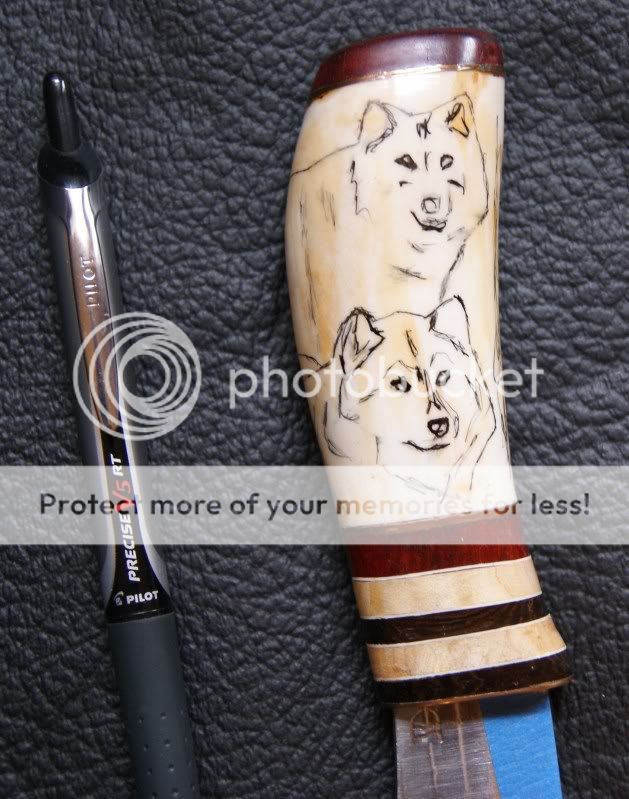
Right side of knife handle...

Step #5. Picture Collage. I keep a file, on my computer and on paper, of animals, plants, etc. for reference material. I put together a collage to look at as I carve. I highly recommend a book called, "How to Draw Animals" by Jack Hamm, if you are serious about carving or drawing animals. I'm not copying any of these pictures when I carve or draw. They are only a guide.

I will try to start carving tomorrow. I'll have Greg take a picture of me in action!
If you would like to contact Catherine DeFelice (knifecarver), with a question or asking about one of your knives getting her skilled treatment... she is at knifecarver@att.net and she is also on Facebook... www.facebook.com/profile.php?id=100002263107888
Step #6. Carving. Always wear a respirator! I use a Foredom Micro-Motor (rotary tool) to carve, at 1/2 speed and a Wilton vacuum-base ball vise to hold the knife. I'll be using Dremel tool #9902 to outline the wolves, remove stag and add fur lines as I shape the wolves. I use a glue brush to clean dust off my work. I picked the middle wolf to work on because he has to look like he's behind the 1st wolf and in front of the 3rd wolf. This is done by making his legs and body lower in depth than the 1st wolf. I'm using a magnifier and only carving 1/32" to less than 1/16" deep. I'm shaping the material I remove so it blends into the handle and only the carving sticks out. The best way to describe carving is to treat it like you are drawing the animal with a cutting tool instead of a pencil. You just keep drawing till it looks like your picture. There is now approx. 2 hours of drawing, etc and 2 1/2 hours of carving into this project.

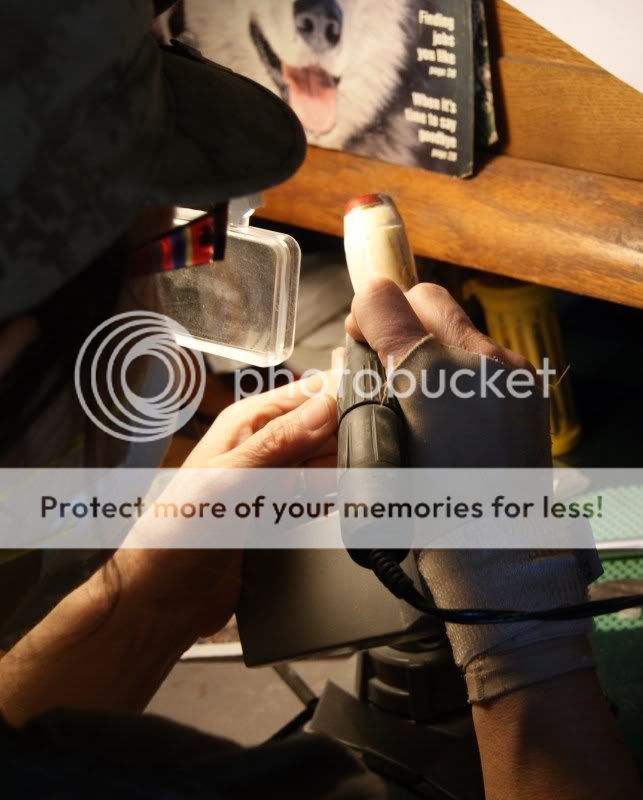
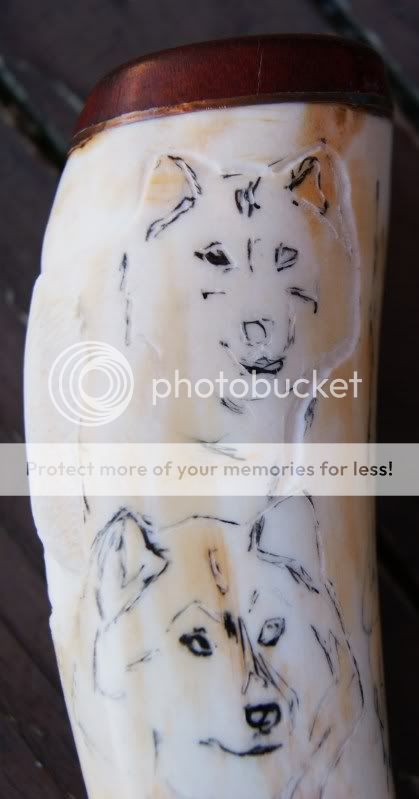
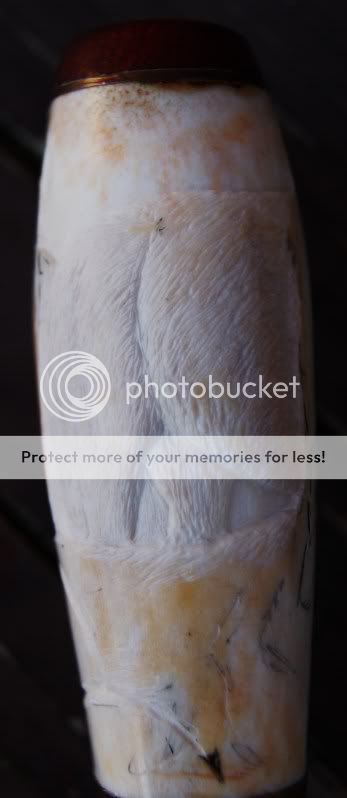

More pictures from Catherine. Just looking at the pictures, I have to say Cathy has some great dexterity, a keen eye and a huge amount of patience. I'm amazed!
OK... Cathy's narrative and the new pictures:
More About Carving
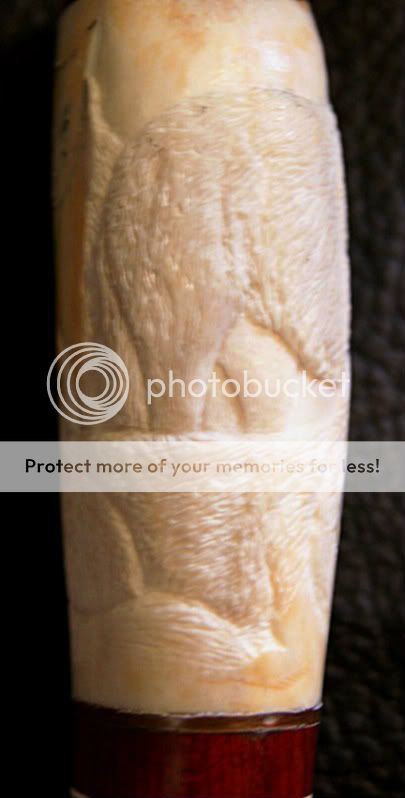
I have 11 1/2 hours into the knife so far. The middle wolf appears to be done, but I'll scrutinize it until I think it's finished. Because I'm working with a magnify glass, I need to look at the wolf from a distance to see what it's missing. As I look at the photo's of the knife, I can see that he needs some muscle tone in his back legs.
I'm working on the 1st wolf now. I save the face and eyes for last. They are the hardest and most important part. Eyes are the windows to the soul, it can make or break the whole carving. Profiles are easier.
This style of carving is called Bas-Relief, carving that appears to be 3-D and lifelike. In reality, it is a 2-D carving that tricks the eye. This is achieved by tapering, tucking & receding images into the background & creating a sense of perspective.
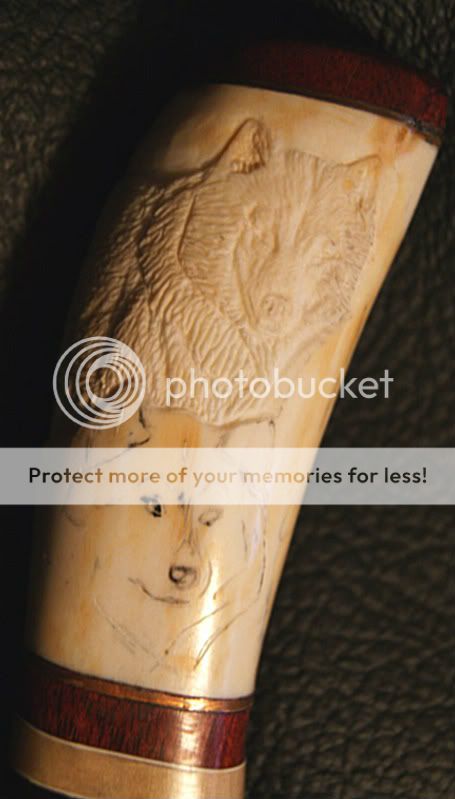
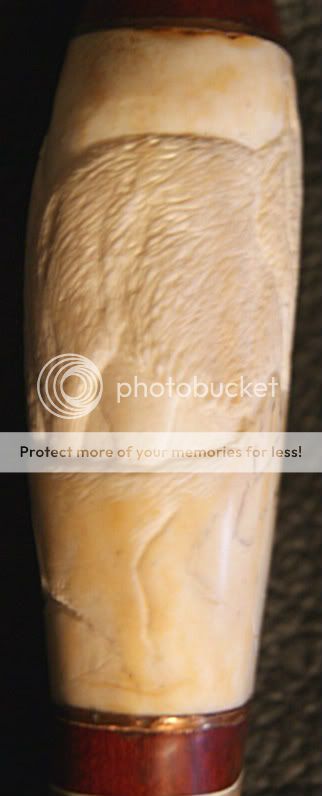


STILL CARVING
I now have 16 hours into this knife. I told Gary 20. I don't think I'm going to make it, more like 22 to 24 hours. I still have to carve the last two faces, finish the landscape & background, sand, add a little paint to the eyes & nose, etc and carve foot prints into the blade. Think I'll make it?

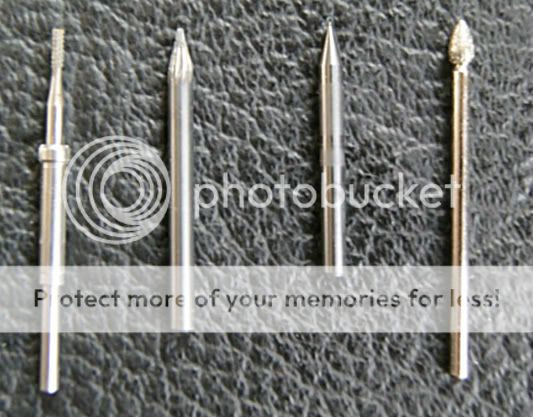
I've been using these 4 tools. They are shown, in order of importance from left to right. #1 TOOL-used for removing stock, adding fur, shaping & some undercutting. #2 TOOL-used for making the fur deeper & detailing in general. #3 TOOL-Is actually a broken end mill. Sometimes broken tools work better than new. I use this for fine detail-eyes, nose and undercuts.(An undercut is a cut between the raised carving and the background. It's almost like trying to slip the tool under the carving and lift the carving away from the knife. This cut is what makes the carving POP! and look 3-D. #4 TOOL-is an acorn-shaped diamond impregnated tool. I've been using this to clean up the background which will make sanding easier.
I have a steady hand, but I use both hands when I carve. I NEVER trust my vise to not slip because I'm constantly changing it's position, almost 2nd nature, sometimes I don't tighten it enough. My other hand helps to hold the knife or the handpiece of the tool. More important than a steady hand is Breathing Control, something I learned as a competition shooter (P.A.L.)
As I work on this knife, I can't help but think how beautiful the patina on this knife is! Sometimes, I can almost see what belongs on a knife because of the grain, almost like seeing pictures in the clouds, and this knife screamed Wolves! Unlike scrimshaw, my carvings beg to be held, touched and in this case, pet. The oils from your hand will add to the patina & the carvings add to the grip. I hope to finish this up before the end of the week.\
Catherine just e-mailed some more pictures and her narration. I have to apologize for the clarity of the pictures... not Catherine's fault...
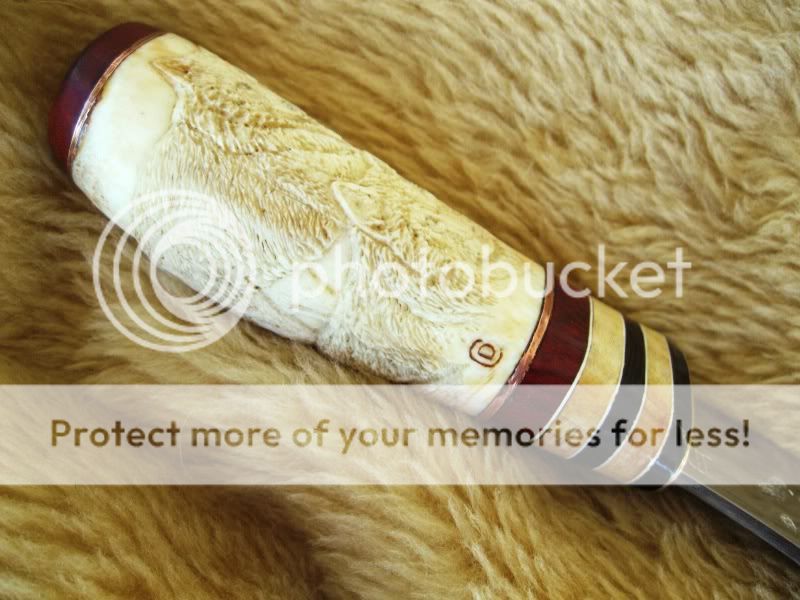
ALMOST DONE!- I finished the faces on the last two wolves. They came out so good that I had to touch up the face & body on the 1st wolf. I realized that I could go much deeper with this carving so I went over all my cuts and added more depth. I put in grass. Then I undercut all the carvings. I used my diamond tip tool and a fine grit sand paper to smooth over the background. I try to remove all unnecessary tool marks. I want people to wonder How I did this. Only you Guys know! (Don't put me out of business!) The cut stag blends into the handle so it looks like it belongs there. Then I took a polishing pad and on a low speed, so as not to burn the piece, I polished everything. Now I just need Gary's input on where to put the paw print on the blade, and then I'll add a little color.
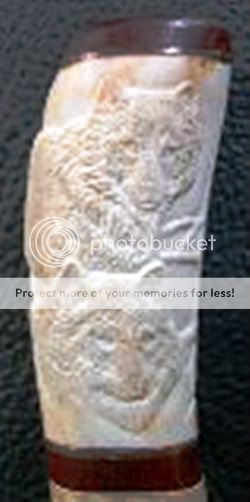
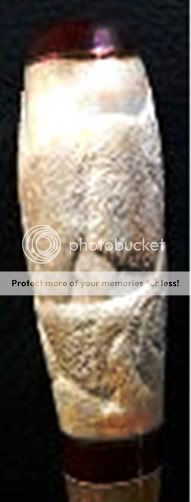
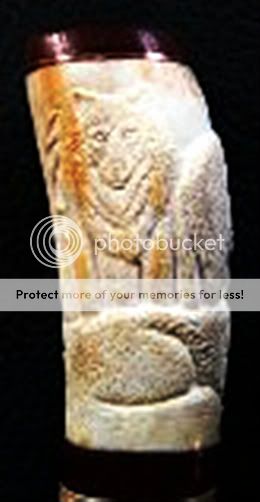

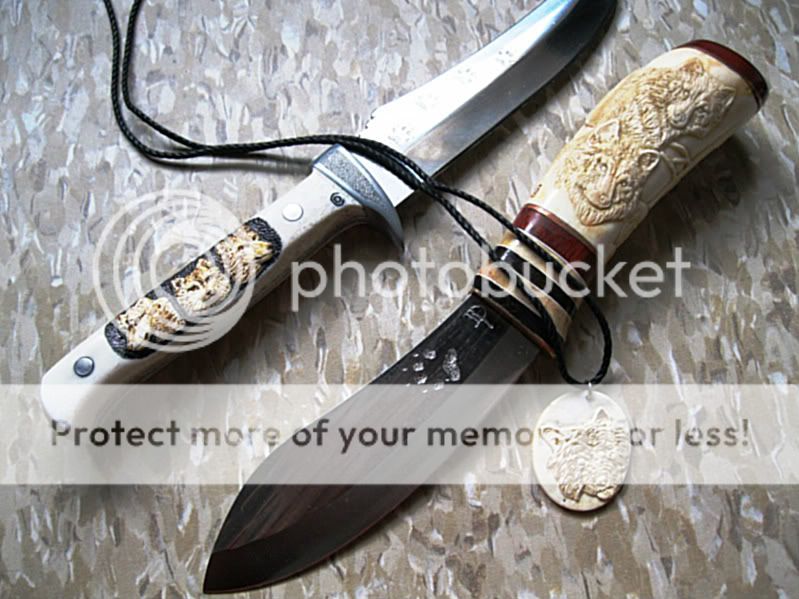
Catherine will also 'stiple' a wolf foot print on the blade...

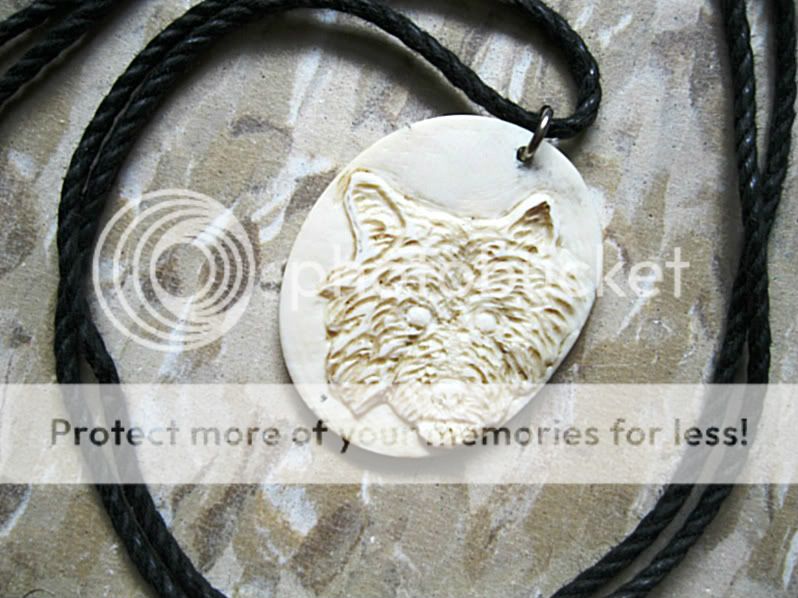
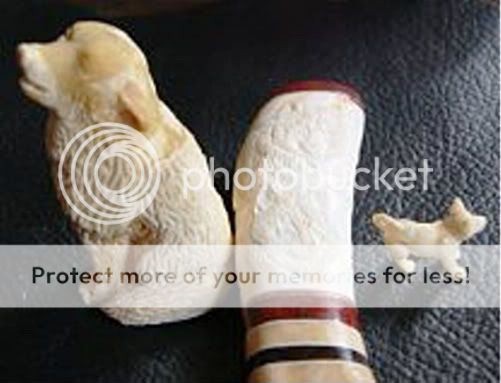
I like wolves so much that I carved these also. They are carved in bone. The little one I carved for my husband when he was in the hospital, it's Thor as a puppy. The big one was a ham bone. I filled the hole with epoxy and bone dust so I'd have a bigger piece to work on but the epoxy turned yellow. Just thought you'd appreciate them too!

Catherine e-mailed me with the final pictures and her narration today. Sorry for the delay in getting them posted.
Final Steps:
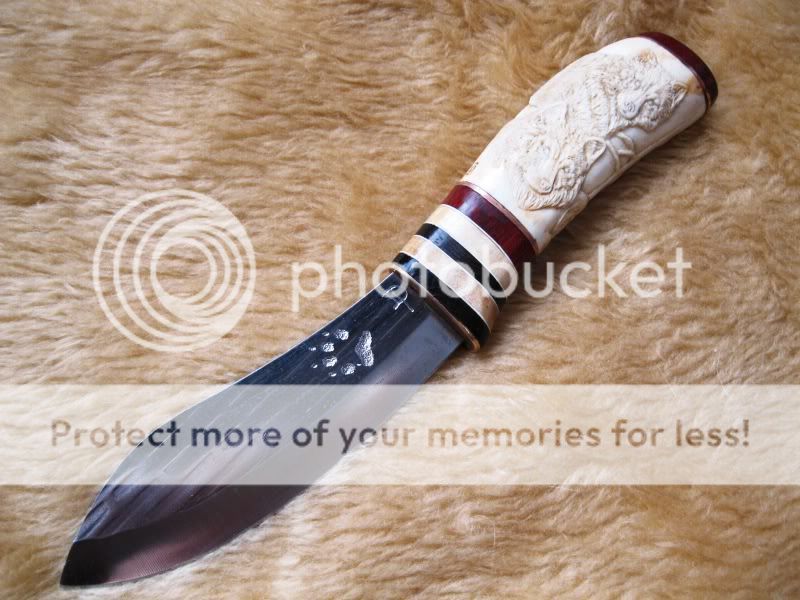
Gary wanted a little color on this knife, but after experimenting with color in the eyes and trees, I was really unhappy with the results. So, I went with some colored wax. I rubbed this into the carving and then buffed it out. This brought out the carving, the way handling the knife everyday would, giving it a hand worn look. The paw print is stippled into the blade. When Gary approves of these pictures, I'll sign the knife and give him a letter of authenticity. When the knife is signed, it is done.
If you are interested in carving, you can use a soft piece of wood and a knife to start. I started on a ham bone. Try to think of your subject in simple shapes, for example, a head is a circle, a nose is a triangle, etc. And draw, draw draw. Even I don't draw enough.
(Cathy showed me pictures of the handle with coloring... I have to agree, it looks better uncolored. I'm still trying to decide if I want the stippled wolf print plain or blackened.)
Left side of handle...

Top of handle...

Right side of handle...
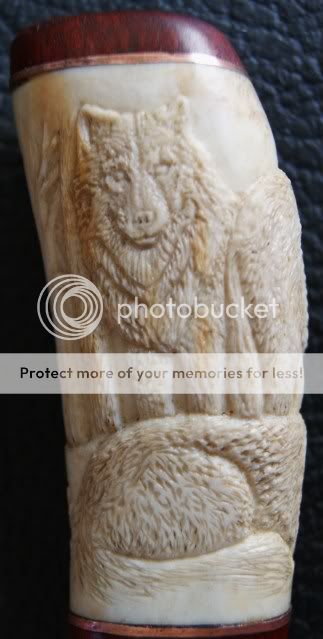
Bottom of handle...

Stippled wolf print (uncolored)...
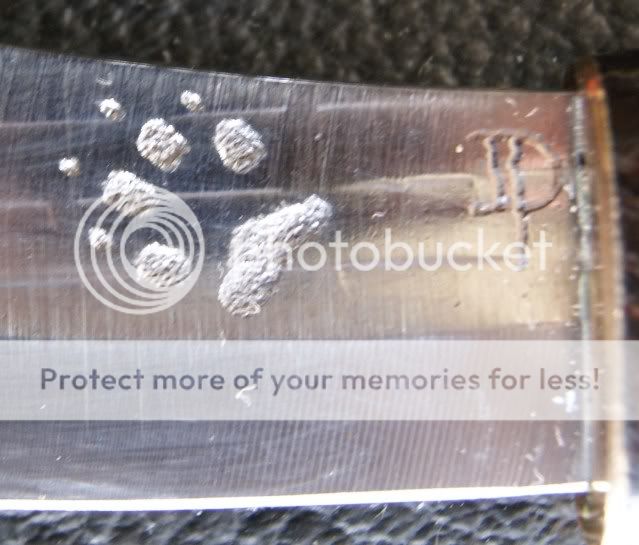
Stippled wolf print (darkened)...

Received the entire knife pictures from Cathy and went back & forth trying to decide on the uncolored or blackened stippled paw print. I finally decided on the uncolored. This has gotta be the most fanciest nessmuk style of knife anyone has seen!

I’ve dealt with Catherine DeFelice (Knifecarver) before and she does fantastic knife handle carvings. I rounded up a knife with a stag handle and asked if she would consider performing her craft. The subject I was interested in was wolves…an animal she knows very well. Her answer was yes. I sent the knife to her and some pictures of wolves,
she picked one that we both felt would work well on the knife handle...
I gave Catherine the go-ahead and then we talked about doing a WIP (Work In Progress) thread for the forums. This is the start...
In Catherine's own words…
Step #1. You should ALWAYS tape up the knife blade. Blue painters tape works great.
Step #2. I measured the work area of the knife handle and drew the dimensions on grid paper. Then I drew the repositioned wolves from the picture I/we liked.
Step #3. The wolves from the picture were the exact size I needed, so I copied the picture, cut them out and taped them on.
Right:
Top:
Left:
Bottom:
Knife in sheath:
Step #4. Transferring the picture. Leaving the pictures on the knife and lifting the tape where needed, I trace what I can with a fine tip pen. Next, I take the pictures off. I take a piece of tracing paper & a piece of carbon paper, and cut it to the size of the picture I drew on the grid paper. I draw the wolves from the grid onto the tracing paper, tape the tracing paper to the knife so it lines up with the picture and slip the carbon paper underneath. Then, I trace simple face and body details.
Left side of knife handle...
Right side of knife handle...
Step #5. Picture Collage. I keep a file, on my computer and on paper, of animals, plants, etc. for reference material. I put together a collage to look at as I carve. I highly recommend a book called, "How to Draw Animals" by Jack Hamm, if you are serious about carving or drawing animals. I'm not copying any of these pictures when I carve or draw. They are only a guide.
I will try to start carving tomorrow. I'll have Greg take a picture of me in action!
If you would like to contact Catherine DeFelice (knifecarver), with a question or asking about one of your knives getting her skilled treatment... she is at knifecarver@att.net and she is also on Facebook... www.facebook.com/profile.php?id=100002263107888
Step #6. Carving. Always wear a respirator! I use a Foredom Micro-Motor (rotary tool) to carve, at 1/2 speed and a Wilton vacuum-base ball vise to hold the knife. I'll be using Dremel tool #9902 to outline the wolves, remove stag and add fur lines as I shape the wolves. I use a glue brush to clean dust off my work. I picked the middle wolf to work on because he has to look like he's behind the 1st wolf and in front of the 3rd wolf. This is done by making his legs and body lower in depth than the 1st wolf. I'm using a magnifier and only carving 1/32" to less than 1/16" deep. I'm shaping the material I remove so it blends into the handle and only the carving sticks out. The best way to describe carving is to treat it like you are drawing the animal with a cutting tool instead of a pencil. You just keep drawing till it looks like your picture. There is now approx. 2 hours of drawing, etc and 2 1/2 hours of carving into this project.
More pictures from Catherine. Just looking at the pictures, I have to say Cathy has some great dexterity, a keen eye and a huge amount of patience. I'm amazed!
OK... Cathy's narrative and the new pictures:
More About Carving
I have 11 1/2 hours into the knife so far. The middle wolf appears to be done, but I'll scrutinize it until I think it's finished. Because I'm working with a magnify glass, I need to look at the wolf from a distance to see what it's missing. As I look at the photo's of the knife, I can see that he needs some muscle tone in his back legs.
I'm working on the 1st wolf now. I save the face and eyes for last. They are the hardest and most important part. Eyes are the windows to the soul, it can make or break the whole carving. Profiles are easier.
This style of carving is called Bas-Relief, carving that appears to be 3-D and lifelike. In reality, it is a 2-D carving that tricks the eye. This is achieved by tapering, tucking & receding images into the background & creating a sense of perspective.
STILL CARVING
I now have 16 hours into this knife. I told Gary 20. I don't think I'm going to make it, more like 22 to 24 hours. I still have to carve the last two faces, finish the landscape & background, sand, add a little paint to the eyes & nose, etc and carve foot prints into the blade. Think I'll make it?
I've been using these 4 tools. They are shown, in order of importance from left to right. #1 TOOL-used for removing stock, adding fur, shaping & some undercutting. #2 TOOL-used for making the fur deeper & detailing in general. #3 TOOL-Is actually a broken end mill. Sometimes broken tools work better than new. I use this for fine detail-eyes, nose and undercuts.(An undercut is a cut between the raised carving and the background. It's almost like trying to slip the tool under the carving and lift the carving away from the knife. This cut is what makes the carving POP! and look 3-D. #4 TOOL-is an acorn-shaped diamond impregnated tool. I've been using this to clean up the background which will make sanding easier.
I have a steady hand, but I use both hands when I carve. I NEVER trust my vise to not slip because I'm constantly changing it's position, almost 2nd nature, sometimes I don't tighten it enough. My other hand helps to hold the knife or the handpiece of the tool. More important than a steady hand is Breathing Control, something I learned as a competition shooter (P.A.L.)
As I work on this knife, I can't help but think how beautiful the patina on this knife is! Sometimes, I can almost see what belongs on a knife because of the grain, almost like seeing pictures in the clouds, and this knife screamed Wolves! Unlike scrimshaw, my carvings beg to be held, touched and in this case, pet. The oils from your hand will add to the patina & the carvings add to the grip. I hope to finish this up before the end of the week.\
Catherine just e-mailed some more pictures and her narration. I have to apologize for the clarity of the pictures... not Catherine's fault...
ALMOST DONE!- I finished the faces on the last two wolves. They came out so good that I had to touch up the face & body on the 1st wolf. I realized that I could go much deeper with this carving so I went over all my cuts and added more depth. I put in grass. Then I undercut all the carvings. I used my diamond tip tool and a fine grit sand paper to smooth over the background. I try to remove all unnecessary tool marks. I want people to wonder How I did this. Only you Guys know! (Don't put me out of business!) The cut stag blends into the handle so it looks like it belongs there. Then I took a polishing pad and on a low speed, so as not to burn the piece, I polished everything. Now I just need Gary's input on where to put the paw print on the blade, and then I'll add a little color.
Catherine will also 'stiple' a wolf foot print on the blade...
I like wolves so much that I carved these also. They are carved in bone. The little one I carved for my husband when he was in the hospital, it's Thor as a puppy. The big one was a ham bone. I filled the hole with epoxy and bone dust so I'd have a bigger piece to work on but the epoxy turned yellow. Just thought you'd appreciate them too!
Catherine e-mailed me with the final pictures and her narration today. Sorry for the delay in getting them posted.
Final Steps:
Gary wanted a little color on this knife, but after experimenting with color in the eyes and trees, I was really unhappy with the results. So, I went with some colored wax. I rubbed this into the carving and then buffed it out. This brought out the carving, the way handling the knife everyday would, giving it a hand worn look. The paw print is stippled into the blade. When Gary approves of these pictures, I'll sign the knife and give him a letter of authenticity. When the knife is signed, it is done.
If you are interested in carving, you can use a soft piece of wood and a knife to start. I started on a ham bone. Try to think of your subject in simple shapes, for example, a head is a circle, a nose is a triangle, etc. And draw, draw draw. Even I don't draw enough.
(Cathy showed me pictures of the handle with coloring... I have to agree, it looks better uncolored. I'm still trying to decide if I want the stippled wolf print plain or blackened.)
Left side of handle...
Top of handle...
Right side of handle...
Bottom of handle...
Stippled wolf print (uncolored)...
Stippled wolf print (darkened)...
Received the entire knife pictures from Cathy and went back & forth trying to decide on the uncolored or blackened stippled paw print. I finally decided on the uncolored. This has gotta be the most fanciest nessmuk style of knife anyone has seen!
Last edited: