What happened? Lamp short-circuited on me!

Joined
Aug 13, 2002
Messages
5,703
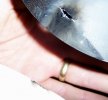
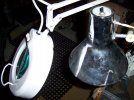
As you see in the pics, the two lamps came in contact and wham! Big flash of light, sparks and blackened holes in both lamps. The power bar breaker tripped. Scares the bejesus out of me. :(

Any idea of what happened and how do I keep it from happening again? Cause they will surely touch again as I use both sometimes to help my slowly failing eyesight.

Thanks
 

Attachments

  • lamp_short1.jpg
    lamp_short1.jpg
    48.5 KB · Views: 124
  • lamp_short2.jpg
    lamp_short2.jpg
    31.2 KB · Views: 105
I figure one of two things probably happened.

The most likely is a ground fault where there was a short in one of the lamps where either neutral or hot were leaking to the lamp and the lamp was ungrounded. It was "hot", and when it touched the other lamp, which was grounded, the electricity had a path to ground. Zap. Had you been grounded when you touched the live lamp (for example, had you also been touching the other lamp at the same time) then you would have received the zap.

The less likely thing is the two lamps were on two different circuits, and one of the circuits were wired improperly where ground and neutral were reversed. Kind of same thing above, but the problem is in the wall, not the lamp.

I'm guessing one lamp has a ground prong and one doesn't? If so, look for your problem in the one that doesn't.

You need a multimeter, you could figure this out in a few seconds. I think you should unplug both of them until you have this figured out, you could get zapped.
 
Patrice. You appear to have a very dangerous ground fault. Have someone check the wiring of the circuit TODAY and find out if it is the lamp with a ground short, or the socket that is wired wrong. There is a real risk of a severe shock if you touch the lamp and ground yourself at the same time. If you know how to check this, do it now...if not, get someone who does. This can kill you, or someone else in your house. Hopefully it is just the lamp. In the mean time. turn off the breaker and then unplug both lamps. Then turn the breaker back on.
 
Unplug both lamps, I would guess the incandescent lamp has a two prong plug and if you touch a continuity tester to one of the prongs with one probe, and the metal shell with the other, the tester will show continuity. The flourescent lamps usually have a three prong plug, the third prong being a safety ground connected to the outside shell. There is a possibility that your wiring is messed up and the ground is live (our house had one outlet that had that problem, and it almost killed my wife) there is a $15.00 (US currency) outlet tester that will show whether your outlet is wired properly.

-Page
 
As these lamps can be rotated etc. carefully check the wires . They may have worn through the insulation where they go through the lamp. As wire goes through metal there must be an O ring but they too can wear so check them.
 
Yep, as others mentioned, I would suspect a hot-neutral reverse in the outlet. It is easy to check with a tester from your local home improvement store, and easy to repair as well! Please do it before using the outlet or lamps again. We would like to keep you around here!
 
Thanks guys, I did not know that this was so dangerous. With your tips I will try and see if there is a break in the wiring somewhere in the lamps and check that the plug is wired right. I would suspect the lamp but you never know. Both are 2 prongs by the way.
 
The folks are talking about " reverse Polarity " where the hot and neutral are crossed . Hot always goes on the brass screw and neutral on the silver screw of all outlets .
 
You can buy a device that plugs in to the outlet to tell you if your wiring is wrong, they have several lights on them that will tell you what the problem is. Of course, they are no substitute for an electrician.

Scary! I'm glad you are OK!
 
if both are only 2 prong plugs, the both have wiring safety issues. There should never be any continuity between either pin on a two prong plug and the outside of a device. On a two prong plug you only have hot and neutral.
-Page
 
The fluorescent lamp should have a ground leg. The incandescent lamp is probably ungrounded, and is the culprit with a ground fault caused by the socket contacting the lamp reflector.
 
The search goes on.

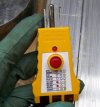
First I bought a tester as suggested (see pics) and found nothing wrong there. I'll do the rest of the house too to be on the safe side, thanks Page.

Stacy was right, I made a booboo, the fluorescent lamp is 3 prong. I tested continuity and can't find any between the legs and outside of either lamp. The only continuity I found was between the ground leg and outside of the fluorescent lamp, which I think is how it is supposed to be right?

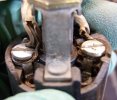
Now onto the wires. Couldn't find any cuts in there where the wire was exposed and could come in contact with the lamp. The only thing is this connection as seen in the pics. Ugly I know and I'll redo it but again, twisted it every which way and I can'T see how it could have contacted the inside of the deflector. And on that subject, wouldn't I have found burn marks also where the wire shorted on the reflector?

This is more complicated than anticipated. :( I am glad you guys are there to help.
 

Attachments

  • plug_tester.jpg
    plug_tester.jpg
    46.5 KB · Views: 15
  • ugly_connection.jpg
    ugly_connection.jpg
    53.7 KB · Views: 37
If there was even one strand touching the metal switch stem support there could have been a temporary short. You want to have insulation right down to the screwswith the only copper visable under the screws

-Page
 
Get a multimeter, you can get one at radio shack or harbor freight for less than 20 dollars. Next in ac voltage mode put one lead in the ground hole of a outlet, next put the other lead on the metal of the lamp while turned on. If you read 120v throw lamp away.
Cw
 
toss the black lamp in the trash and go buy a new one -- that is one ugly connection.
your life is worth more than the $20 to replace it -- and even if it doesn't kill you, it is a fire hazard.
 
Thanks Chris, I do have a multimeter but did not know how to use it like that.
I will keep these instructions for another time though.
1066 has it right. It is not worth the potential risk for a crappy old lamp. Should have gone that way earlier. Guess I needed the voice of reason. :thumbup:

Thanks for all your help.
 
Patrice Lemée;9285884 said:
Thanks Chris, I do have a multimeter but did not know how to use it like that.
I will keep these instructions for another time though.
1066 has it right. It is not worth the potential risk for a crappy old lamp. Should have gone that way earlier. Guess I needed the voice of reason. :thumbup:

Thanks for all your help.

You should trash it. But before trashing it, I think you should test it and confirm that's where the problem is.

To test it, set your multimeter in continuity testing mode (where, when you touch the two leads together you get a beep or an ohms reading) and touch one lead to the metal part of your lamp and touch the other part to the prongs on the end of the power cord and look to see if there is conduction. There shouldn't be, but there probably is.

If it were me, I'd want to know for certain what the problem was.
 
Guys

Another possibility which I didn't see addressed is that grinding dust (powdered metal) got into the lamp and coated the insulating surfaces of the socket creating a conductive path from the hot lead to the lamp hood. When the hood touched the flourescent lamp frame which was stated to be grounded, the sparks flew. This could have burned away the conductive coating which created the problem in the first place. So you might not find a short in the lamp.

Plug in the incadescent lamp and use a meter to check for voltage between the lamp hood and frame to the ground contact of an outlet. If no voltage is present, try flipping the two prong plug (if they aren't polarizede) and check for voltage again.

If you are worried about this happening again, you can have a ground fault outlet installed for the lamps or get an isolation transformer and power the lamps from it.

Jim Arbuckle
 
Good advice!
I'll start periodically checking my lamps for dust buildup and blowing them out

-Page
 
Blow all your electrical stuff down once in awhile, and pay attention to electrical motors as they collect dust with the small internal spaces and magnets that attract more. If motors get too much dirt they can go up like the 4th of July and just as violent.
 
Back
Top