This is a general observation. Logistics issues, escalating prices of raw materials and increased shipping costs are playing havoc now on manufacturers. The challenge for them is getting product out before the customer goes elsewhere. The past 12 months have created an insane demand level on consumer discretionary products due to the massive Covid stimulus checks, supplemental state and federal unemployment benefits and moratoriums on eviction and auto repo (this is not political). This will be ending soon (no political judgements), my question is how will the merchants who have taken advantage of this through dramatically increased pricing and purchase free for alls react when liquidity becomes more scarce, buying pool shrinks by a third and the market is flooded with “used” knives?

-
The BladeForums.com 2024 Traditional Knife is available! Price is $250 ea (shipped within CONUS).
Order here: https://www.bladeforums.com/help/2024-traditional/
You are using an out of date browser. It may not display this or other websites correctly.
You should upgrade or use an alternative browser.
You should upgrade or use an alternative browser.
What happens with prices in the next 6 months?
- Thread starter JLTX
- Start date

- Joined
- Feb 27, 2014
- Messages
- 17,936
Knife manufacturers have been increasing their prices for years, that’s nothing new. If they do it again, people will complain for a month or two and then life will continue like it has for many years.

- Joined
- Aug 11, 2020
- Messages
- 1,711
Knife manufacturers have been increasing their prices for years, that’s nothing new. If they do it again, people will complain for a month or two and then life will continue like it has for many years.
Knife prices have doubled in some cases just within the past six years.
Like the Duck said, it's nothing new.

- Joined
- May 9, 2002
- Messages
- 12,857
A lot has been put on the stimulus as a source of inflation. However, the lead times regarding raw material sourcing, production, design, and pure logistical headaches of logistics due to transportation and the shuttering of the world this time last year is most likely causing more necessary price increases than anything currently going on.
Manufacturers always look for reasons to raise prices. They generally operate on razor thin margins, so any reason to get ahead of the curve is exploited (exploited is not am inherently bad word). I see production knives regardless of country of origin or economic stimulation continuing to go up for some time. Truth be told, a lot of folks aren't going to like it, but expect prices and scarcity to continue for at at least 2 or 3 more quarters. The world has used up a lot of "stuff". Stuff takes time and money to make.
The question is going to be if the price of goods settles into the normal increase of the cost of goods in relation to natural inflation and cost of doing business.
I would expect that I will continue to buy mid/higher end stuff selectively over a bunch of lower end stuff. The cost of these knives will be felt, but the cost isn't what will keep me from buying them as I plan on being selective and just buying what really tickles my fancy. Others may just lay off the knives for a good while until prices come down (doubtful) or their cost of living earnings reach the same pricing as the knives.
Hard to say.
Manufacturers always look for reasons to raise prices. They generally operate on razor thin margins, so any reason to get ahead of the curve is exploited (exploited is not am inherently bad word). I see production knives regardless of country of origin or economic stimulation continuing to go up for some time. Truth be told, a lot of folks aren't going to like it, but expect prices and scarcity to continue for at at least 2 or 3 more quarters. The world has used up a lot of "stuff". Stuff takes time and money to make.
The question is going to be if the price of goods settles into the normal increase of the cost of goods in relation to natural inflation and cost of doing business.
I would expect that I will continue to buy mid/higher end stuff selectively over a bunch of lower end stuff. The cost of these knives will be felt, but the cost isn't what will keep me from buying them as I plan on being selective and just buying what really tickles my fancy. Others may just lay off the knives for a good while until prices come down (doubtful) or their cost of living earnings reach the same pricing as the knives.
Hard to say.
- Joined
- Feb 25, 2014
- Messages
- 1,520
If you have to keep pointing out "it's not political" then you already know it's a political opinion. There is a subforum called the Political Arena where you can ponder this to your heart's content.This is a general observation. Logistics issues, escalating prices of raw materials and increased shipping costs are playing havoc now on manufacturers. The challenge for them is getting product out before the customer goes elsewhere. The past 12 months have created an insane demand level on consumer discretionary products due to the massive Covid stimulus checks, supplemental state and federal unemployment benefits and moratoriums on eviction and auto repo (this is not political). This will be ending soon (no political judgements), my question is how will the merchants who have taken advantage of this through dramatically increased pricing and purchase free for alls react when liquidity becomes more scarce, buying pool shrinks by a third and the market is flooded with “used” knives?
If you have to keep pointing out "it's not political" then you already know it's a political opinion. There is a subforum called the Political Arena where you can ponder this to your heart's content.
I think a FAR bigger issue longer term is when high quality overseas manufacturers begin to charge more for their products. There are some absolutely stunning deals to be had from a number of manufacturers like Sanrenmu/Land/Civivi, Ganzo, CRKT, etc. They put pricing pressure on other knife makers. As their names/reputations gain footing, they'll begin to charge more and more, and that pricing pressure will be diminished, unless there is enough money to be made, which could attract new manufacturers to the knife market.

byjiminy
Basic Member
- Joined
- Oct 6, 2020
- Messages
- 97
Raw materials are in short supply, and jobs go begging. But the Federal Reserve and the market expect only temporary price hikes. Long-term inflation expectations haven’t really moved.
Also -

 wallethub.com
Also -
While 2020 was a year to forget in most respects, Americans excelled in terms of paying off credit card debt, getting rid of a record $82.9 billion in debt. This is a major accomplishment, considering that consumers have added an average of $54.2 billion in credit card debt per year over the past 10 years.
2023 Credit Card Debt Study: Trends & Insights
wallethub.com

- Joined
- Oct 18, 2018
- Messages
- 8,722
Raw materials are in short supply, and jobs go begging. But the Federal Reserve and the market expect only temporary price hikes. Long-term inflation expectations haven’t really moved.
Also -
2023 Credit Card Debt Study: Trends & Insights
I don't see How the debt was paid off?
"Stimulus" monies?
Stealing from Peter to pay off Paul. Now the credit card debt is Uncle Sam's.....good job!

Oh.....btw. This Isn't political, it's economics. Supply and demand.
Prices have nothing to do with costs. People think they do....they don't.
If there are NO buyers, prices come down to meet their expectations.
(I hope higher knife prices are all we have to worry about)
- Joined
- May 9, 2002
- Messages
- 12,857
But they totally do unless you are specifically talking about the knife industry or some subsect of manufacturing. I job cost my bids and price my retail based on a margin worked off my pricing of materials and goods that I purchase from manufacturers/distributors.Prices have nothing to do with costs. People think they do....they don't.
If there are NO buyers, prices come down to meet their expectations.
I price my retail at some % mark up over what it costs me. I look at what it costs me in $ to purchase, how long I expect to sit on it, and factor in a few pennies per item knowing that I am going to have to pay a person to sit behind a counter and move the product when a customer needs it. I simply mark it what I need to clear in order to move it and come out ahead. The only time I clearance things is if they have a self life, but if I am doing my numbers correctly, that's not a huge issue.
Now if you are talking macro at commodity pricing where the demand of supply stipulates pricing on a sliding scale, absolutely. Lumber, oil, steel, etc. The fluctuations of this sort of thing can be volatile and head-spinning. I certainly hope lumber doesn't continue to add nearly $40k to the average home construction.
However, the various sects of manufacrurering don't always play by these rules. In my line of work, my steel pricing is set based on futures projected 8 months in advance. Price increases weekly or even mid year don't happen. Instead, if distribution takes a bath, they make it up next fiscal year. Case in point, my steel costs usually jump 3% a year with natural inflation. I'm expecting a 17% in 2022. Steel is actually a small component of what I sell, so from a job costing/pricing standpoint it may only add $1200 to a $70,000 bid. Not out of the realm of normal when you are talking about adding $40,000 of cost on a $200,000 home in lumber alone.
So while I don't have to worry about fluctuations in steel pricing when it comes to bidding my jobs currently, the devil is that I will never expect those steel prices to come down to match the market price. They will hover higher and only trickle back until they meet the natural increase in costs of goods before finding another reason to go up over market.
I still think that the knife industry will be heavily governed by increased costs in pure logistics. Steel costs may factor in some, but that's a pretty small price of a knife. Machining/labor, tool investment probably make up some of the start up costs of what it takes to crank out a knife. Still, I bet not being able to GET the material and then not being able to reliably SHIP the finished product is going to play hell with what it costs us, the end consumer. Many of the fixed costs of manufacturing are always clicking along regardless of if anything is being produced. That erosion of profits will be passed along to the end user in some fashion.
- Joined
- Oct 18, 2018
- Messages
- 8,722
But they totally do unless you are specifically talking about the knife industry or some subsect of manufacturing. I job cost my bids and price my retail based on a margin worked off my pricing of materials and goods that I purchase from manufacturers/distributors.
I price my retail at some % mark up over what it costs me. I look at what it costs me in $ to purchase, how long I expect to sit on it, and factor in a few pennies per item knowing that I am going to have to pay a person to sit behind a counter and move the product when a customer needs it. I simply mark it what I need to clear in order to move it and come out ahead. The only time I clearance things is if they have a self life, but if I am doing my numbers correctly, that's not a huge issue.
Now if you are talking macro at commodity pricing where the demand of supply stipulates pricing on a sliding scale, absolutely. Lumber, oil, steel, etc. The fluctuations of this sort of thing can be volatile and head-spinning. I certainly hope lumber doesn't continue to add nearly $40k to the average home construction.
However, the various sects of manufacrurering don't always play by these rules. In my line of work, my steel pricing is set based on futures projected 8 months in advance. Price increases weekly or even mid year don't happen. Instead, if distribution takes a bath, they make it up next fiscal year. Case in point, my steel costs usually jump 3% a year with natural inflation. I'm expecting a 17% in 2022. Steel is actually a small component of what I sell, so from a job costing/pricing standpoint it may only add $1200 to a $70,000 bid. Not out of the realm of normal when you are talking about adding $40,000 of cost on a $200,000 home in lumber alone.
So while I don't have to worry about fluctuations in steel pricing when it comes to bidding my jobs currently, the devil is that I will never expect those steel prices to come down to match the market price. They will hover higher and only trickle back until they meet the natural increase in costs of goods before finding another reason to go up over market.
I still think that the knife industry will be heavily governed by increased costs in pure logistics. Steel costs may factor in some, but that's a pretty small price of a knife. Machining/labor, tool investment probably make up some of the start up costs of what it takes to crank out a knife. Still, I bet not being able to GET the material and then not being able to reliably SHIP the finished product is going to play hell with what it costs us, the end consumer. Many of the fixed costs of manufacturing are always clicking along regardless of if anything is being produced. That erosion of profits will be passed along to the end user in some fashion.
I agree we are in strange times.... ALOT is going on now, and we probably won't fully understand for a few more years, after the fact....
I agree with what you are saying, but I was looking at it's MOST simplest of views.
I'll exaggerate a story.
A pretend company believes everybody wants/needs a gizmo.
they spend Tons of money on market research, NPD, tooling and manufacturing, distribution, etc. etc.
They decide to sell the gizmo for $100.... It's a very expensive gizmo to make, and Alot of overhead.
The consumer likes the gizmo, they think it's neat.... but they aren't willing to buy it because their current Thing-a-ma-Bob works almost as good and costs Way Way less.
The Gizmo Company either has to add More value to their product, by making it even better. (maybe it's a better design or it's convivence, or better service, better warranty, something?) Or they WON"T sell any..... Just because something COSTS almost $100 to make, doesn't mean they can Sell it for that much...... They can Try to , but people still might not be tempted.
They would have to keep lowering costs.... until the market bites.
*different rant.
I know when I see all the landscaping companies that pop up.... With their Huge, Fancy trucks, and trailers, and fancy Ferrari versions of lawn mowers......
( I don't wanna pay for ALL That!!!)
I'd rather pay the local kid who lives down the street.
The American knife industry is starting to look That way.....
I've been seeing the price of Beckers and Others.... go Up and Up over the last couple years...
Someone here on BF said that knife prices doubled in about 6 years.
well..... They priced me into looking into the Custom market now..... Paying a tiny bit more, but getting More for it.
Once this inflation "adjusts" and people are use to paying whatever we end up paying..... we will see where everything Falls?
byjiminy
Basic Member
- Joined
- Oct 6, 2020
- Messages
- 97
I feel better about this than you. Individuals made a smart decision, they refinanced personal debt that cost them over 20% a year into public debt that cost them less than 2%. They agree to pay the debt through their taxes.Stealing from Peter to pay off Paul. Now the credit card debt is Uncle Sam's.....good job
As a percent of the economy, the debt service burden has fallen!
By the end of 2020, the debt-to-GDP ratio will have nearly tripled to over 100 percent of GDP. At the same time, the cost of servicing this larger debt has fallen, relative to the size of the economy...
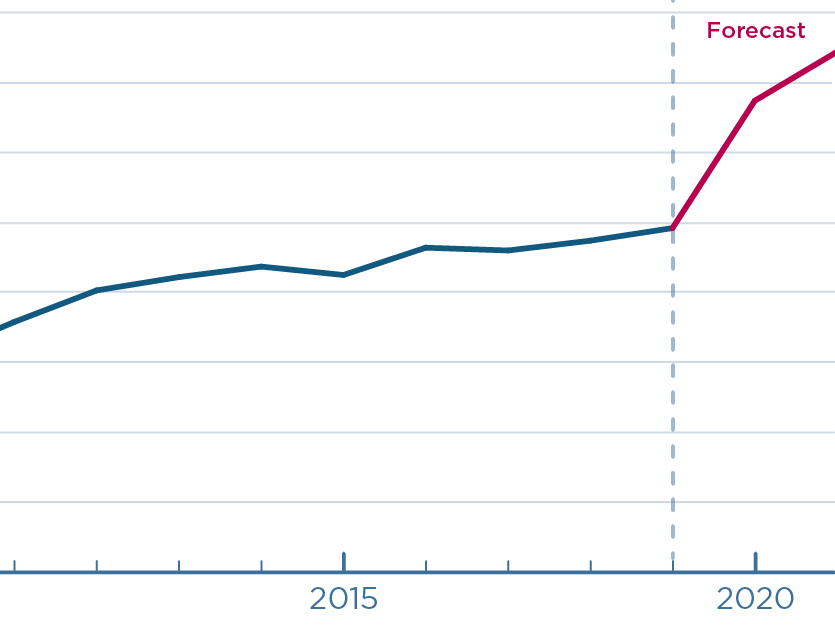
US debt has increased, but burden of servicing it has fallen
As a share of GDP, the cost of servicing US debt has fallen since 2000, even though federal debt has increased. In 2000, the US federal debt was 34 percent of GDP, relatively close to its post-war low. By the end of 2020, the debt-to-GDP ratio will have nearly tripled to over 100 percent of GDP...
I will never expect those steel prices to come down to match the market price. They will hover higher and only trickle back until they meet the natural increase in costs of goods before finding another reason to go up over market.
The Chinese Government has been watching steel prices as well.
China will step up adjustments on the trade and stockpiling of commodities and reinforce inspections on both the spot and futures markets, state broadcaster CCTV reported the cabinet meeting chaired by Premier Li Keqiang as deciding.

China says it will stabilise commodity market, asks coal producers to hike output
China will strengthen its management of commodity supply and demand to curb "unreasonable" increases in prices and prevent them being passed on to consumers, the country's cabinet said on Wednesday, as it urged coal producers to boost output.
 www.reuters.com
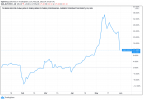
Here’s the price of iron ore in china year to date:
As to the retail price of knives over the next six months, well...