
-
The BladeForums.com 2024 Traditional Knife is available! Price is $250 ea (shipped within CONUS).
Order here: https://www.bladeforums.com/help/2024-traditional/
You are using an out of date browser. It may not display this or other websites correctly.
You should upgrade or use an alternative browser.
You should upgrade or use an alternative browser.
What have I got here?
- Thread starter BReid126
- Start date
- Joined
- Nov 4, 2010
- Messages
- 400
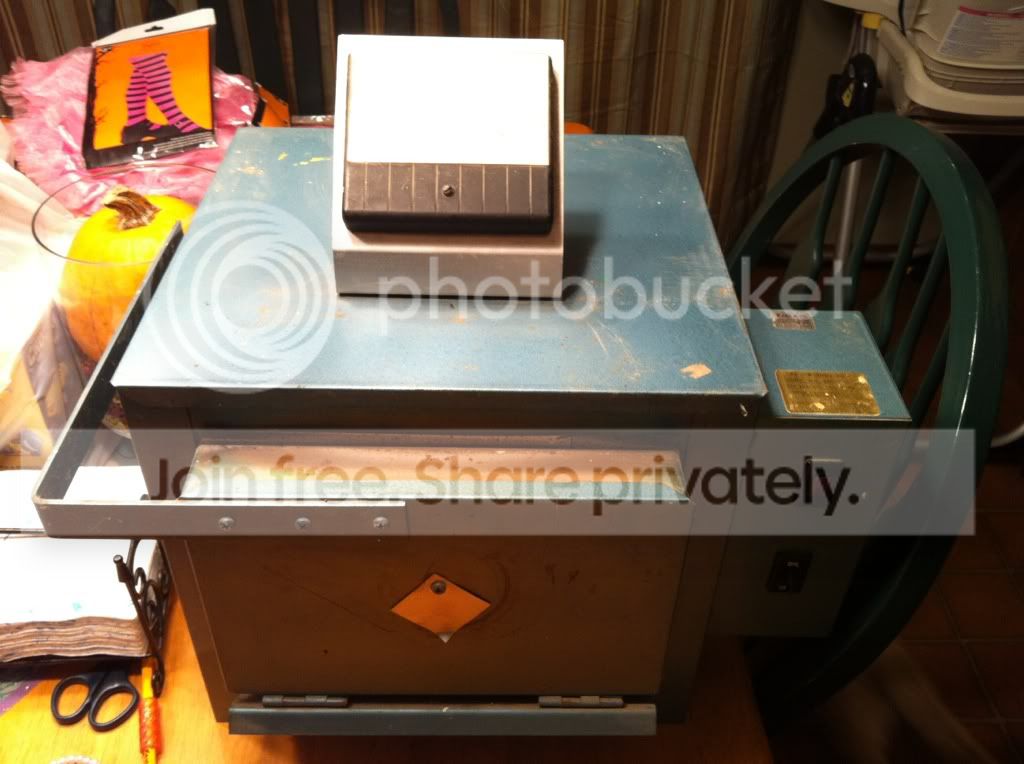
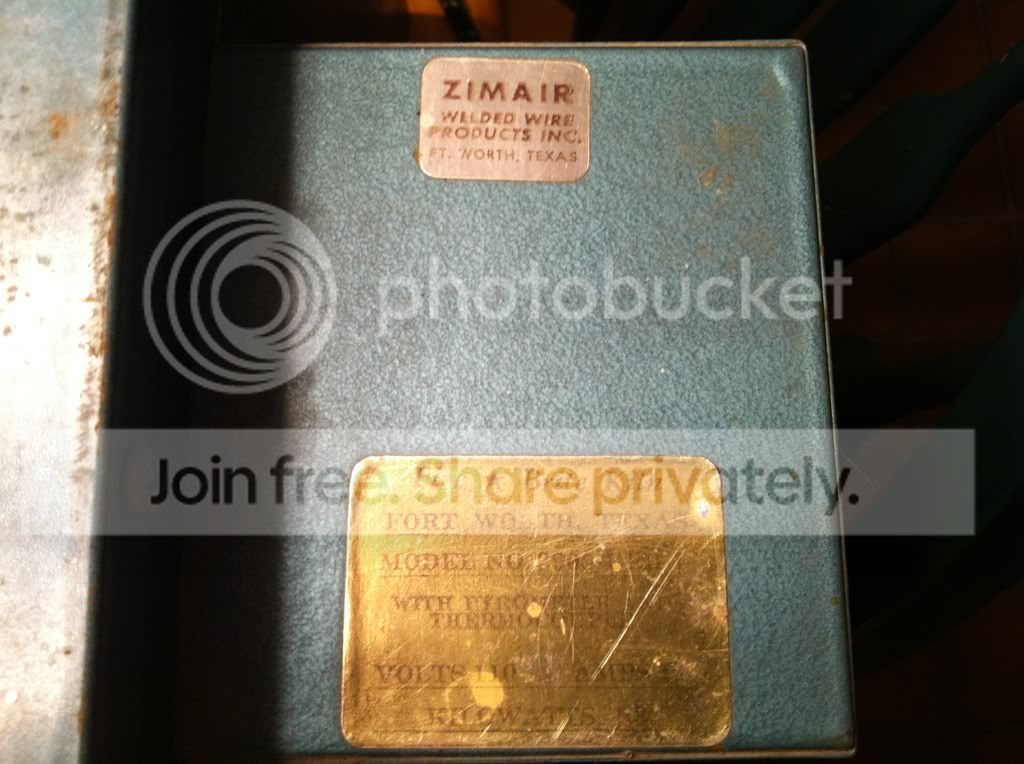
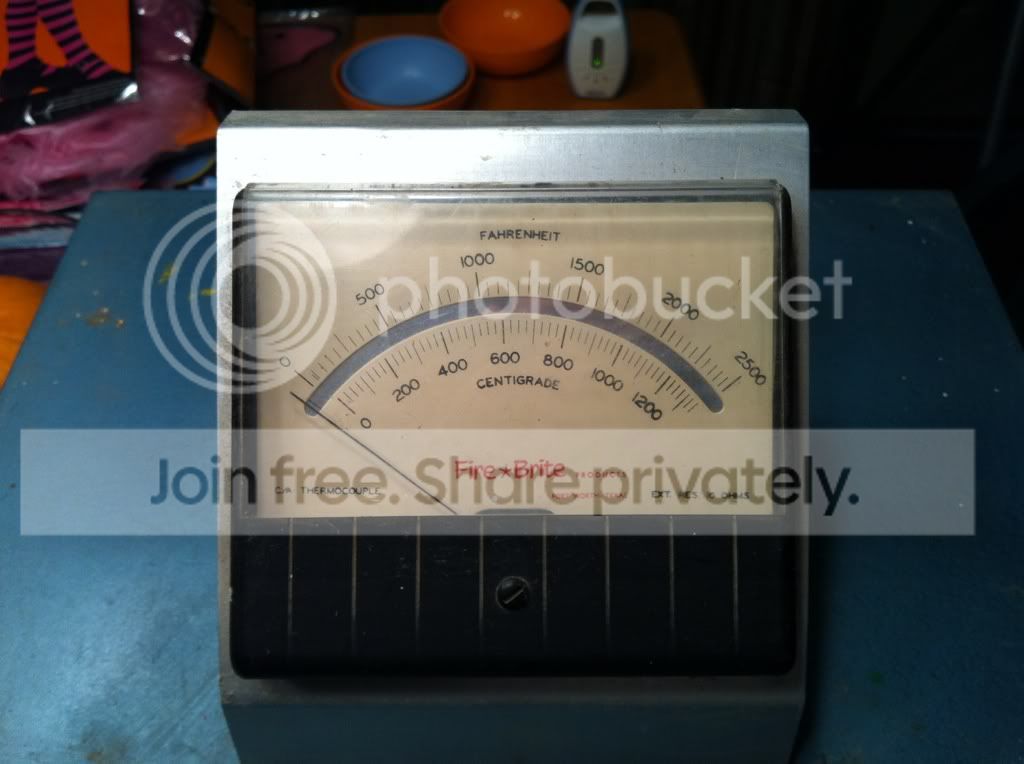
Not sure exactly what it started life as, small pottery kiln, heat treat oven, etc, but I would definatly get a digital pyrometer to make sure you know the exact temperatures it puts out and use it as a heat treating oven.
-Adam
-Adam

- Joined
- Feb 28, 2006
- Messages
- 3,494
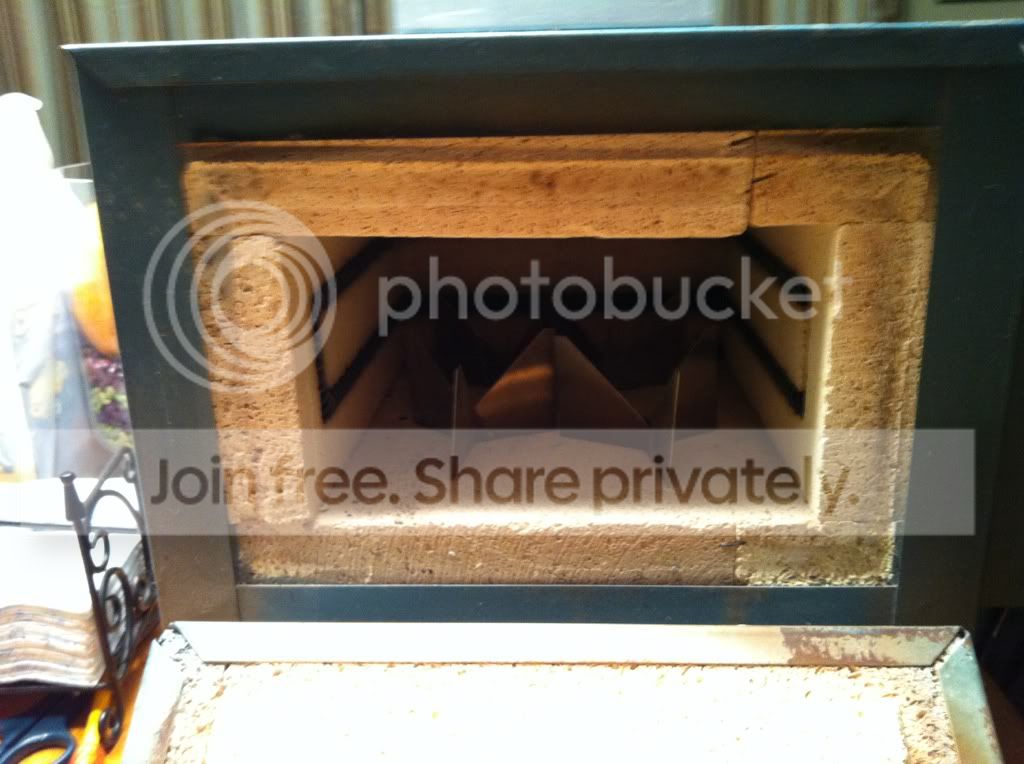
We do enamel work in small electric kilns like that. We are using one now in our high school jewelry making classes. We've rigged a heavier counter weight on the door handle to the left to help hold the door closed snug. Ours has the same little swing aside peephole in the door. Looks like your pyrometer is sitting over the exhaust port on top. It looks like yours might just have on/off switching though? Ours has an adjustable temperature dial (for what it's worth.) We use stainless steel trivets that look just about like those inside yours too to stand the enameled copper pieces up off the floor. I understand metal clays for jewelry making are quite popular these days, which would likely be fired in something like that.
I've used a jeweler's burnout oven (with what looks like to be a bit larger inner chamber) for heat treating small blades. Seems like that could do for small stuff.
I've used a jeweler's burnout oven (with what looks like to be a bit larger inner chamber) for heat treating small blades. Seems like that could do for small stuff.

Stacy E. Apelt - Bladesmith
ilmarinen - MODERATOR
Moderator
Knifemaker / Craftsman / Service Provider
- Joined
- Aug 20, 2004
- Messages
- 38,482
What Phil said.
Adding a PID control to that will be easy, as you just add a few components in the existing control box. All you will need are a PID, and SSR and heat sink, and a TC and sheath.
It will work fine for small size blades of carbon steel. Those units aren't good for much above 1700-1800F. I know the scale shows 2500F, but my car speedometer shows 120 MPH,too.
If you need help with the conversion, send me an email.
Adding a PID control to that will be easy, as you just add a few components in the existing control box. All you will need are a PID, and SSR and heat sink, and a TC and sheath.
It will work fine for small size blades of carbon steel. Those units aren't good for much above 1700-1800F. I know the scale shows 2500F, but my car speedometer shows 120 MPH,too.
If you need help with the conversion, send me an email.
- Joined
- Aug 28, 2009
- Messages
- 7,951
Sorry to do a mini hijack here, but I don't feel a new thread is justified
In an attempt to lower my costs I am always searching Kijiji listings for tools and one of those tools is a HT Oven/Kiln. I often see pottery kilns being sold dirt cheap, but they are the top loading type. I know that they most likely need some work to get working properly, but is is possible to convert them to front opening by removing the legs and laying them on their sides? How cheap? Some are less then the cost of shipping to send 2 blades out for HT and they say they work
In an attempt to lower my costs I am always searching Kijiji listings for tools and one of those tools is a HT Oven/Kiln. I often see pottery kilns being sold dirt cheap, but they are the top loading type. I know that they most likely need some work to get working properly, but is is possible to convert them to front opening by removing the legs and laying them on their sides? How cheap? Some are less then the cost of shipping to send 2 blades out for HT
and they say they work- Joined
- Jul 13, 2009
- Messages
- 21,855
Sorry to do a mini hijack here, but I don't feel a new thread is justified
In an attempt to lower my costs I am always searching Kijiji listings for tools and one of those tools is a HT Oven/Kiln. I often see pottery kilns being sold dirt cheap, but they are the top loading type. I know that they most likely need some work to get working properly, but is is possible to convert them to front opening by removing the legs and laying them on their sides? How cheap? Some are less then the cost of shipping to send 2 blades out for HT
Wont that put elements on the bottom ?
- Joined
- Aug 28, 2009
- Messages
- 7,951
It would wrap the elements around it including the bottom, but there would be nothing along the back. My thoughts are that a simple shelf could be installed to act as a bottom when the unit was on its side. Some of these pottery kilns I see on Kijiji are going for s low as $50, but average around $150. There is an older, same age as me, Paragon Home Artist kiln close by, just over an hour away, that looks unused going for $200 with shelves and all manuals and the inside measurements are 17 ½" wide X 17 3/4" deep.
Stacy E. Apelt - Bladesmith
ilmarinen - MODERATOR
Moderator
Knifemaker / Craftsman / Service Provider
- Joined
- Aug 20, 2004
- Messages
- 38,482
Top loading pottery kilns are somewhat inefficient as knife kilns. Trying to turn one on its side can create all sorts of problems and everything will end up in the wrong place. The advantage of one is the price...often free.
It is better to just use it as a top loader and suspend the blades on 1/8" stainless wire hooks. The hooks are made by taking a long piece of wire and securely putting a wooden handle on one end. Set the wire/handle across the top with the handle completely sticking out from the side. Mark where the wire meets the top opening, and make a 90 degree bend there. Go down that bend and make a "U" bend at the depth you need the knife to be suspended. Cut off any extra wire. This handle-hook can be placed on the top, with the handle counterweighting the blade, and put in and out without searing your hands and arms. The existing top can usually be closed over the 1/8" wire with a good seal still being maintained. Worst case scenario, you will have to slightly modify the lid...no big problem. A good batch of blades can be heat treated at one time with multiple handle-hooks. The handle-hook also makes quenching fast and secure, as you don't have to try and grab the blade with a pair of tongs. ( and your hand is not over the quench tank when it flares up)
Pottery kilns convert to PID control for less than $100. You can make one programmable for about $200-300. Some are ready to go as is.
Other uses for top loaders are adding a heavy walled stainless tube to be used as a salt pot. This is really simple for a low temperature salt pot for nitre bluing and tempering ( the pipe does not even have to be stainless). Marquenching and similar procedures will work well in such a pot. High temp salt pots are a more dangerous thing, and one should be aware of several other things when converting a kiln to a salt pot, but it will work. ( The biggest issue is that molten salt and salt vapors don't get along well with hot 220 VAC charged coils)
It is better to just use it as a top loader and suspend the blades on 1/8" stainless wire hooks. The hooks are made by taking a long piece of wire and securely putting a wooden handle on one end. Set the wire/handle across the top with the handle completely sticking out from the side. Mark where the wire meets the top opening, and make a 90 degree bend there. Go down that bend and make a "U" bend at the depth you need the knife to be suspended. Cut off any extra wire. This handle-hook can be placed on the top, with the handle counterweighting the blade, and put in and out without searing your hands and arms. The existing top can usually be closed over the 1/8" wire with a good seal still being maintained. Worst case scenario, you will have to slightly modify the lid...no big problem. A good batch of blades can be heat treated at one time with multiple handle-hooks. The handle-hook also makes quenching fast and secure, as you don't have to try and grab the blade with a pair of tongs. ( and your hand is not over the quench tank when it flares up)
Pottery kilns convert to PID control for less than $100. You can make one programmable for about $200-300. Some are ready to go as is.
Other uses for top loaders are adding a heavy walled stainless tube to be used as a salt pot. This is really simple for a low temperature salt pot for nitre bluing and tempering ( the pipe does not even have to be stainless). Marquenching and similar procedures will work well in such a pot. High temp salt pots are a more dangerous thing, and one should be aware of several other things when converting a kiln to a salt pot, but it will work. ( The biggest issue is that molten salt and salt vapors don't get along well with hot 220 VAC charged coils)
- Joined
- Aug 28, 2009
- Messages
- 7,951
Thanks Stacy, my only concern with the top loading is the heat loss when opened, as in warming it up before adding the blades. I know there is still heat loss with a front opening kiln, just in my mind not as much. Mind you I admittedly don't know if this is true or not. If I do pick up one of these pottery kilns I keep seeing, I would be adding a PID and TC, well I should already have the PID by the time I would buy a kiln and only need a second TC if I understand right. I can move the PID between two different units can't I?
For the record, salt pots are not even on the list for me at this time.
For the record, salt pots are not even on the list for me at this time.
Stacy E. Apelt - Bladesmith
ilmarinen - MODERATOR
Moderator
Knifemaker / Craftsman / Service Provider
- Joined
- Aug 20, 2004
- Messages
- 38,482
You've got it backward.
The heat loss is less with a top loader. The old "hot air rises" thing is misunderstood. Convection within a closed chamber will move cold ( more dense) air down, and push the hot ( less dense) air up. If you open the top of a fully soaked kiln, hot air won't rush out. A little heat will escape, but that is by radiation more than convection. A front loader dumps the hot air out when you open the door as cool air rushes in and replaces it.
If either one is fully soaked, the temperature will rebound very quickly. It may not even drop on a top loader.
The worry about overheating the blade in a pottery kiln is when you use one that is still set up for firing clay. Clay isn't near as fussy about the temperature as steel is. Often the system used to control the kiln is to run at full blast until a fusible cone collapses and shuts off the power.
If the kiln is converted to PID, and is brought up to heat before the blade is inserted, no worries about overheating should exist.
The other issue in a large chamber kiln with thick refractory walls is that the walls will absorb the heat much slower than the blade steel. The coils will be radiating a lot of heat, and the blade may well overheat by several hundred degrees if placed in the kiln before the chamber is up to temperature. Again, the solution to this on ANY type of HT device ( kiln or forge) is to bring the chamber up to fully soaked condition before placing the blade in. On a big pottery kiln, this can take as much as 30 minutes to an hour. That will burn a few kilowatts, but if the oven was nearly free, the trade off is still a good one.
The heat loss is less with a top loader. The old "hot air rises" thing is misunderstood. Convection within a closed chamber will move cold ( more dense) air down, and push the hot ( less dense) air up. If you open the top of a fully soaked kiln, hot air won't rush out. A little heat will escape, but that is by radiation more than convection. A front loader dumps the hot air out when you open the door as cool air rushes in and replaces it.
If either one is fully soaked, the temperature will rebound very quickly. It may not even drop on a top loader.
The worry about overheating the blade in a pottery kiln is when you use one that is still set up for firing clay. Clay isn't near as fussy about the temperature as steel is. Often the system used to control the kiln is to run at full blast until a fusible cone collapses and shuts off the power.
If the kiln is converted to PID, and is brought up to heat before the blade is inserted, no worries about overheating should exist.
The other issue in a large chamber kiln with thick refractory walls is that the walls will absorb the heat much slower than the blade steel. The coils will be radiating a lot of heat, and the blade may well overheat by several hundred degrees if placed in the kiln before the chamber is up to temperature. Again, the solution to this on ANY type of HT device ( kiln or forge) is to bring the chamber up to fully soaked condition before placing the blade in. On a big pottery kiln, this can take as much as 30 minutes to an hour. That will burn a few kilowatts, but if the oven was nearly free, the trade off is still a good one.
- Joined
- Aug 28, 2009
- Messages
- 7,951
Thanks for clearing that up. The cost of running it would probable be less than the cost of shipping on sending the blades out for HT, and it would give me a little more leeway on what I can do. Right now I spend $40-50 on shipping alone (covers both ways and insurances) and then have to wait 2+ weeks for the turnaround. If I do pick one up and do a conversion to PID it would probably save me a bit of money in the long run till I could get a dedicated oven. I could just use the forge I am building but I think I want to keep that just for forging.

I got a large Paragon kiln at auction a while back for $20. I build a digital control for it (thanks Stacy for your help) and planned to use it for knifemaking. The problem I found with it is that it took a long time to get it up to temp. I shut it off after only getting to 1200 in two hours. I could not justify spending money on heating a kiln that was too big for my needs so I have torn the kiln down.
At the moment, I have taken the stainless steel shell of the kiln and built a box for a smaller kiln using angle iron as the frame. I will use the kiln floor and lid for the top and bottom of my new knife oven and use the firebricks and same heating elements as well, although I will have to shorten the elements. When I am done, I hope to have an inside diameter of 18" x 5.5" x 4.25" and won't have to buy anything new except for the angle iron.
I'll try to post pictures when I finish.
At the moment, I have taken the stainless steel shell of the kiln and built a box for a smaller kiln using angle iron as the frame. I will use the kiln floor and lid for the top and bottom of my new knife oven and use the firebricks and same heating elements as well, although I will have to shorten the elements. When I am done, I hope to have an inside diameter of 18" x 5.5" x 4.25" and won't have to buy anything new except for the angle iron.
I'll try to post pictures when I finish.
- Joined
- Aug 28, 2009
- Messages
- 7,951
Thats the other side of it, if I can get a working one for the right price I have everything to make a smaller one from it if it doesn't suit my needs.

- Joined
- Feb 7, 2006
- Messages
- 1,327
Looks similar to a Paragon. A pid and TC would be a great addition as said, and then you can make it smaller if needed  Great score.
Great score.- Joined
- Jul 13, 2009
- Messages
- 21,855
I've considered this as well & instead of gutting out a larger one,
I was planning on just lining the insides with another layer of bricks so the internal volume is reduced
and it will have a better insulation than the original
no having to change the body and frame.
I was planning on just lining the insides with another layer of bricks so the internal volume is reduced
and it will have a better insulation than the original
no having to change the body and frame.
I thought about that but I didn't think it would solve my problem sinse the heating element would be on the outside layer of bricks. If you lined the inside of a large kiln, you would be heating the ring you form rather than the center of the kiln, plus you would have to buy a set of bricks at $5 each.
I am trying for the cheap way - spend no more than I have to. I plan to do a dry run before I weld the top on to make sure the elements bring it to heat. I might just make it so that I attach the top with bolts rather than rivets or weld because these heating elements are over 30 years old and most likely need to be replaced. But I have 4 of them and only need 2, so I'll go through all 4 before I buy new ones. In the mean time, I think I'll make it so it can be taken apart when needed.
I am trying for the cheap way - spend no more than I have to. I plan to do a dry run before I weld the top on to make sure the elements bring it to heat. I might just make it so that I attach the top with bolts rather than rivets or weld because these heating elements are over 30 years old and most likely need to be replaced. But I have 4 of them and only need 2, so I'll go through all 4 before I buy new ones. In the mean time, I think I'll make it so it can be taken apart when needed.
- Joined
- Jul 13, 2009
- Messages
- 21,855
-I didn't say it, but I also meant to groove the new liner bricks and install the elements inside
I'm assuming new elements to match the new groove - maybe a higher amperage for faster heat up too.
They go brittle once used and would probably break
I'm assuming new elements to match the new groove - maybe a higher amperage for faster heat up too.
They go brittle once used and would probably break

- Joined
- Jan 30, 2009
- Messages
- 580
I bought a small sqaure kiln just like this one off craigslist for a few bucks and then built a PID controller with Staceys advice (he rocks). for the cost of about $150 total I have a kiln that will HT up to 10-11" blades of high carbon - that covers 90% of the blades I make.