
What is the best 220 grit belt

Joined
Dec 10, 2014
Messages
57
I have been grinding with Blaze belts in 36, 60 and 120 grit then heat treating. After heat treat I go back to the 120 grit Blaze, but then what? I have tried 220 grit AO and a65 Trizact, but I am not a fan. Does the gator Trizact perform better?

What's the preferred belt after 120 grit?
 
They're a little flexible, being a J weight belt, so you need to be aware of that, but my next step is usually 3M 707e in 220. Nothing in these ranges last long, but they cut very aggressively and cleanly before they die.
 
I like the A300, A160, A100 gator trizacts....I do have trouble with many of them running fast
 
I too like 707 Regalite belts. I would like them better in X weight but I've not been able to find an X weight ceramic belt over 120 grit anywhere.

I do use the gator trizacts as well, they're just too slow cutting from 120 to 220. So I only use them after getting to a 220 finish.
 
I'll second that on the gators. They are awesome (those and cork) but not for removing material. I go 36->80or100->A100->A65->A45->Scotchbrite for a belt finished blade.
 
Me too. I go 36-60-120 ceramic (i am still figuring out what i like the best for brand. Right now blaze at 36 and 60 purple ceramic from phoenix abrasives for 120)- Gators>>>a160-a100-a45-scotchbrite or cork depending.
 
I like the Hermes 346 in 220, they are cheap and I buy a bunch and use them up like candy. Then after that use Gators mostly to get their nice finish, then cork.
 
I'm with Matt, I like a flexible ceramic for this grit because I use that to refine my plunges. I find them all to last about the same so I buy whatever is cheapest or available.
I'd love to see a flexible ceramic in 400 grit for high V steels but they say it can't be done.
 
only 220 i keep in my shop is J weight and cheap cause im only using them on wood. for you guys that are talking about gators cutting slow you do know the trick for that is "dressing" the belt and gettign to fresh grit i keep one of those grinding wheel dressers by the KMG jsut to refresh the grits
 
They're a little flexible, being a J weight belt, so you need to be aware of that, but my next step is usually 3M 707e in 220. Nothing in these ranges last long, but they cut very aggressively and cleanly before they die.
i like these and Norton Norzon 220, it is zirconia, X weight, and lasts about as long as 707e. both belts last longer at low belt speeds.
 
If they made 784's in 220 or better, 320, I would buy every one they had. I still don't know who makes a WATERPROOF thick ceramic belt in any grit higher than 120.
 
I'm with Matt, I like a flexible ceramic for this grit because I use that to refine my plunges. I find them all to last about the same so I buy whatever is cheapest or available.
I'd love to see a flexible ceramic in 400 grit for high V steels but they say it can't be done.
I use the Norax 264 belts after I do my initial grind with a 60 grit Blaze. They aren't a ceramic, but they are a structured abrasive and wear fairly well. I don't grind at full speed so I'm not sure what they are like if like to grind that way. I never go beyond 50%.
 
I'm always concerned when the discussion revolves back to longevity. Longevity implies duration in time. I couldn't care less how long the belt lasts, in fact if the damn thing dissolved immediately upon completing the task I was doing, I wouldn't mind, as long as it completed the task.
If I can clean up what I'm working on with a fresh belt in two or three quick passes, and then the belt is spent, despite it only lasting two minutes, it did what I needed it to do. Sharp, clean and fast cutting is far more important than extended life, especially if the 'extended life' is at a reduced efficiency. My goal is to progress to the next step, quickly, and without heat buildup. The only way I've found to achieve that is with fresh abrasives. I'm more apt to make a mistake on a grind if I have to keep repeating that grind again and again because my belt is partially glazed, or not cutting efffectively, or the speed of the grinder is reduced to increase 'perceived' belt life.
I suspect some of you are running things slowly because you're concerned with control - a faster belt can be awfully unforgiving. As your grinding skills improve, though, consider increasing your speed to improve the cutting efficiency of your abrasives. Your belt won't 'last longer', but you'll be achieving more in the span of time it's used, and that's what this is supposed to be about...

Although much of this falls into the arena of personal preference, remember that these tools were intended for certain speeds and pressures to 'resharpen' themselves through grit fracture. Again, you have to be the one to gauge this, and I'm not telling you to throw a fresh 220 on and ramp your ass up to 6k sfpm (although for 36 grit that's probably what you should be doing...), but you may find you're spending less time doing something - with cleaner results! - if the speed is at the 'right' speed.

Don't be afraid to contact the companies that make this stuff and ask, btw - even if it just means posing a question on their website 'general mailbox'. You may be surprised at how accommodating they can be, and you may also find that they have a different product to offer you for your particular grinding style that make work better.
 
I grind slower because I'm still what I would consider to be a novice and I heat treat my blades prior to grinding (currently S35VN @ 61rc) so heat is obviously an issue. I like a nice 750 or 1200 grit belt finish, going slow is what works for me.
 
I sometimes grind post-HT, too. :) Usually only chef knives, though, but that's not always the case. My point, though, is as you get better at grinding, I think you'll find you can use higher speeds with certain belts and your results will improve. Also remember that this discussion arose regarding 220 grit, specifically. The speed I use an 800 grit belt at is a whole lot slower than I use at 220...
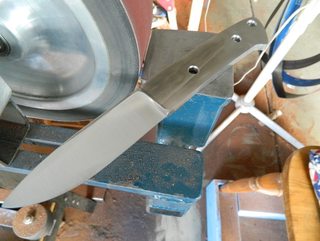
 
If I could jump into this discussion I would advise the obvious thing; that the best 220 grit belt would be a "NEW" one. At this point in grinding a blade I do not want to do any damage to the work I have done so far and I too want to smooth and polish the plunge line of my blade because to me it is so important to the look of a finished knife. I like j-flex belts for this and slow speed. A quick pass or two on a cork belt will show me where I need a little more work before heat treat. I would rather use less expensive belts at this point and use them once and throw them away than spoil all my work. I cannot say that a Zirconium belt will do any better than an Aluminum Oxide belt at this point and speed for me. Using new belts is always a better choice for me. Once again, It's only my opinion, Larry P.S. An A45 Gator belt run over the edge of your 8 or 10 inch contact wheel by about an 1/8th inch and rolled over that edge with a piece of round bar to form it into a little radius will clean up a plunge line to almost a mirror finish at this point. If you are grinding stainless you can go to finer grits before heat treating and have minimal finishing to do after heat treat. LL

vUcbKh2m.jpg
 
Last edited:
Being new to knife making I read a lot and compare advice in the shop with my own hands. So far the best single piece of advice is:

Use belts like they were free.

This has made more difference in my finished product than anything.
 
I sometimes grind post-HT, too. :) Usually only chef knives, though, but that's not always the case. My point, though, is as you get better at grinding, I think you'll find you can use higher speeds with certain belts and your results will improve. Also remember that this discussion arose regarding 220 grit, specifically. The speed I use an 800 grit belt at is a whole lot slower than I use at 220...

This thread and quote has just changed the way I will grind from now on.
I threw caution to the wind the other day and went faster and tossed a belt for a new one MUCH sooner than I normally would and the results were unexpectedly good.
Way less time in front of the grinder and with more even results.
Don't be afraid to evolve your grinding style and re-teach your brain!
 
This thread and quote has just changed the way I will grind from now on.
I threw caution to the wind the other day and went faster and tossed a belt for a new one MUCH sooner than I normally would and the results were unexpectedly good.
Way less time in front of the grinder and with more even results.
Don't be afraid to evolve your grinding style and re-teach your brain!

A lesson we all have to learn. The moment you think "this is not grinding like it should" that is the time to put on a new belt.
 
yes, change a belt when it is worn out. but belts are not free. usually belts are the largest expense when making a knife except for labor. finding the best combination of belt speed, pressure, wet/dry makes a difference in the bottom line. on the subject of 220 belts, bought 50 3M 707E belts for $40 delivered.
 
Back
Top