What is the Term for This Feature?

Joined
Jun 15, 2008
Messages
169
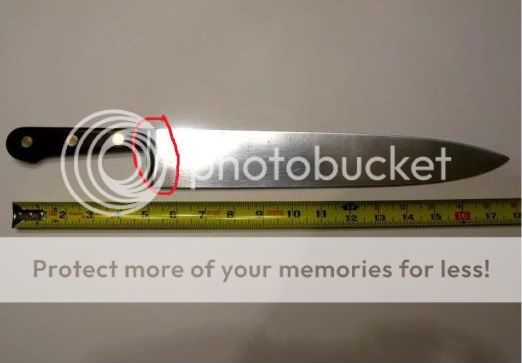
the thicker portion just before the tang on some chef knives. what's that called? i mean if i wanted to go into a shop and get that kind, what would i tell them i was looking for?

pommel.jpg
 
the thicker portion just before the tang on some chef knives. what's that called? i mean if i wanted to go into a shop and get that kind, what would i tell them i was looking for?

pommel.jpg

that is an integral bolster that runs the full height of the blade.

usually frowned upon in high end knives as repeated sharpenings will bring the useful edge above the bolster making contact with your cutting board less useful.
 
Yeah, you really don't want that "feature". You want to be be able to a) use, and b) sharpen the entire length of the cutting edge and that bolster will prevent that. Even if you wish to go higher end than Forschner (I really like them) take a look at them and you will see a blade geometry that is perfect.

See also all of the custom kitchen knives in this sub-forum. You won't see any with that design.
 
It's not just a bolster, it's also an edge-guard for when that pinch grip didn't pinch enough. At least one of my friends feels a lot more comfortable using knives that have one of those instead of feeling the thin stock of a bolsterless knife dig into the side of his middle finger.
 
It is not unheard of to grind those down or completely off. You can round off the exposed part after grinding off the bolster so the thin stock doesnt dig into your finger as much. Get the top rounded while you are at it. I have a great knife but after a few hours of steady use, the sharp angles on the top of the knife start to dig into me.
 
Chiming in as a chef: we call that a "return." Stupid feature that was popular in french knives before the 1970's or so. Can create an interesting action when cutting (and using it as a return (that is to say, knocking what you just cut back away from the handle)), but from a knife makers point of view, just bad design. Also (as stated above) from a user stand point, only good until you need to resharpen it a couple times, then you have an offset from your cutting board.
 
Well, I've had my Whustof 8" Chef knife since 03". I used it in a resturant, and at home all this time. I've sharpened this knife a bit, very easy, and have gone to sandpaper/strop. I have had no issue with my bolster, getting in the way.
In fact, I find I can drag it on the sandpaper, I've kept it even with the edge.
The pinch grip, index finger and thumb infront of the bolster is a nice technique. It's the balance point of my knife. Also, if a thick spine adds stability to a thin knife, so does a thick bolster.
That said, I don't think I would buy the same design. I've seen some customs that I'd love to try.
 
I make forged-integral kitchen knives, so I'm set up with an integral sander and have had at least 30 people bring me their Whustof knives to have that full-length bolster ground off. Every one of them has said it's like getting a brand new knife, that, and I sharpened it awesomely too :-)

So, I'm just a dumb maker and not a chef, but I'd have to agree that it isn't a good feature to have on a knife.

My two cents. -M
 
When I was at Ashokan last fall I overheard a couple veteran makers say that a full length bolster should never be on a kitchen knife. From listening to their conversation I got the distinct impression that these type of bolsters, plunges lines, choil, etc., were mainly for show and serve no purpose other than making it harder to sharpen. I'm not sure about it, but I do know that it's easier to make a tip-to-heel knife without these features.
 
Oh thank heavens I finally found someone to agree with me. I've got 2 knives like this to recondition, polish, and put new handles on. They were old cooking school knives, and were left without care for years I suppose. I've been debating about grinding these things off. Mostly, I didn't want to have to match the little radius under them for the handles, but it always seemed to me they would get in the way. I know on the kitchen knives I sharpen for other people, they always seem to leave a dull spot at the base of the blade, no matter how much I grind on them.
 
Back
Top