What makes a hamon nice/special?

Joined
Aug 13, 2002
Messages
5,703
What people see as a nice hamon seems to differ from one individual to the next. Is there an “official” list of characteristics that define a nice hamon? I personally like a lot of movement as well as a lot of contrast, like in Salem's recent integral WIP :thumbup:
But a more ”wispy” hamon seems to get more attention. Probably because of the mount of work needed to make it come out and the right steel and treatment to get it in the first place.

So is there a general consensus or is it just a matter of personal preference?
 
I like several different looks, Don Hanson's are of course super great, but my favorites are the really well-polished ones with lots of complex activity, like you'd see on more traditional Japanese swords. I'd describe it as "translucent" maybe, like you can look into the steel.

The American knife maker that comes to mind for me is Don Fogg. Some of his 1095 blades are astounding. Like the Yakuza Bowie in his site gallery. Wow.
 
Patrice Lemée;9363180 said:
....and the right steel and treatment to get it in the first place.

That's it right there.

I've had countless people ask me what to do to make their hamon SHOW BETTER, and I can only say that you can't display what's not there.
They'll say, "Well, I was using some, I think, 5160 with furnace cement and quinced in salt water. I'm sure I have a hamon but have been etching in old apple sauce and sanding over and over for a week but can't make it come out. What kind of sand paper do you use?"

You can't display what's not there.

If your steel and methods were even close to creating a decent hamon, you can make it JUMP! with only a few minutes of work.

BruceRipperb-1.jpg


SJW2-1-1.jpg
 
I understand and appreciate that a wavy/complex hamon is harder to get then a rather simple flowing line.
But on some knives I like an alegante, flowing line better.
To much can be to much IMHO

I think it has to do with the total package.
 
I like several different looks, Don Hanson's are of course super great, but my favorites are the really well-polished ones with lots of complex activity, like you'd see on more traditional Japanese swords. I'd describe it as "translucent" maybe, like you can look into the steel.

The American knife maker that comes to mind for me is Don Fogg. Some of his 1095 blades are astounding. Like the Yakuza Bowie in his site gallery. Wow.

I do like the traditional Japanese polish, showing lots of translucent, wispy activity.
And Don Fogg is the man here in the US!!!

I tend to do something in-between a hybrid polish/etch and the high polish, to
show more contrast. It's also not quite as time consuming.
 
Patrice Lemée;9363180 said:
But a more ”wispy” hamon seems to get more attention. Probably because of the mount of work needed to make it come out and the right steel and treatment to get it in the first place.

So is there a general consensus or is it just a matter of personal preference?

yeah i like the more whispy ones too and if its got a false edge it should turn back on itself ;)
 

Attachments

  • 001 (24).jpg
    001 (24).jpg
    78.6 KB · Views: 86
I like the thicker, cloudier hamon's myself..but like it was said, has to be the overall package. I am in love with Don Hanson's stuff...and if i ever have a lot of money, i will own one :) I just attempted my first one, and it really isn't as hard as i was prepared for, but i think the overall characteristics add aesthetics as well as the knowledge that a proper heat treat process was done.
 
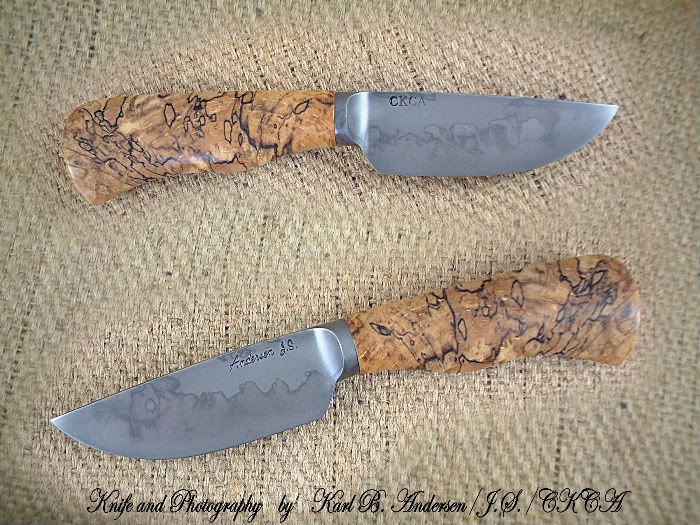
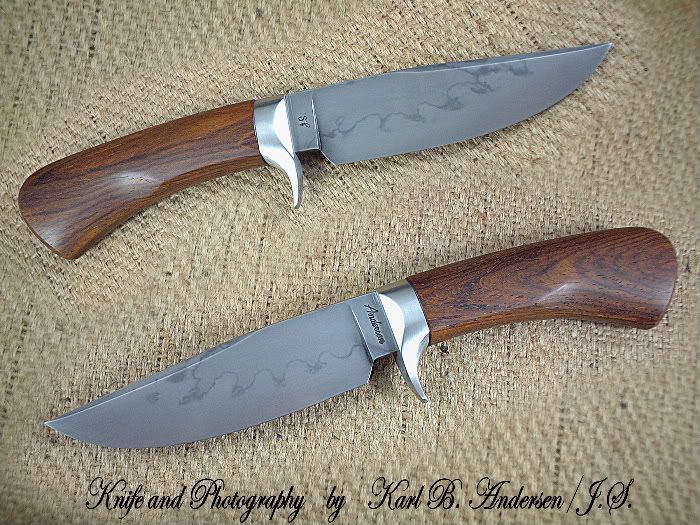
Those are some very elegant knives, Karl. They look just right to me. Are those 1095?

Don, re-reading my earlier post, I don't mean to suggest that your blades are NOT well-polished or complex- they are certainly both. But I'm sure you know what I meant. It's interesting that you say Fogg's blades can be less dramatic in person than in photos, usually it's the other way around, hamon photography being what it is. I've noticed myself though, that you can with care and light make a hamon look more intense almost in a photo. The detail in Don's steel is what I'm personally light years away from getting yet, both in steel or a photo.

Sorry Patrice, if this is thread drift.
 
Not at all Salem, I find the in person/photo thing interesting too.
Thanks for your input guys. Looks like it's a personal preference thing more than an established set of rule thing.
 
Is there a list of which steels will/won't produce a hamon, all other things being equal? Or, is it a case of "Do this to 1095, but you have to do this to 1080"? I always thought the presence of Manganese prevented it, but some recent research shows that 1095 has Manganese but still seems to be the best for a hamon.
 
Zaph, 1095 is much like W2 and some other "hamon" steels. They are not all created the same, very small differences in alloy from one melt to another can make a big difference in outcome. There is 1095, and 1095.

That's why Don Hanson's W2 is sought after. It's just right for clear detail, very shallow hardening. Aldo had some melted to the exact same chemistry as Don's steel on purpose for hamon.
 
I would guess a couple reasonable rule-like ideas might be...

  • Hamons, and the processes of producing hamons, should in no way diminish the working qualities of the steel, especially the cutting edge.
    .
  • Typically hamons would not "invade" the edge area of the blade.
    ..
  • As hamons are a heat treatment as well as an aesthetics issue, it is important to consider their proportion of and placement on the blade.
 
Those are some very elegant knives, Karl. They look just right to me. Are those 1095?

Don, re-reading my earlier post, I don't mean to suggest that your blades are NOT well-polished or complex- they are certainly both. But I'm sure you know what I meant. It's interesting that you say Fogg's blades can be less dramatic in person than in photos, usually it's the other way around, hamon photography being what it is. I've noticed myself though, that you can with care and light make a hamon look more intense almost in a photo. The detail in Don's steel is what I'm personally light years away from getting yet, both in steel or a photo.

Sorry Patrice, if this is thread drift.

No offense. I know what you mean. Mine are not taken to as high a polish as Don Fogg's and I do a more harsher etch.

What I mean about the highly polished blades in person, is you usually have to get the light just right to see the hamon. But the high polish brings out more activity. Fogg's blades are very dramatic, but he has learned to make the hamon very dramatic in photograph. I have looked at a few of his blades in person and his work is what got me into this hamon mess. It's a sickness :D
 
Is there a list of which steels will/won't produce a hamon, all other things being equal? Or, is it a case of "Do this to 1095, but you have to do this to 1080"? I always thought the presence of Manganese prevented it, but some recent research shows that 1095 has Manganese but still seems to be the best for a hamon.

For most active hamon, W2, W1, 1095. Rule of thumb, is find a simple carbon steel with the lowest manganese and very little chromium. Very shallow hardening.

Manganese is the big alloy that makes steel deeper hardening. W2 is the best, with Mn around .020. 1095 has around .040. Around .050 Mn is doable but less is better.

1075,1080,1084 really have too much manganese. 1050,1060,1065 have a lot of Mn, but because the carbon is so low, these steel will usually throw a nice hamon.

I have used some W2 that didn't give much activity, so like Salem said, not all steel is equal, even if it's supposed to be the same.
 
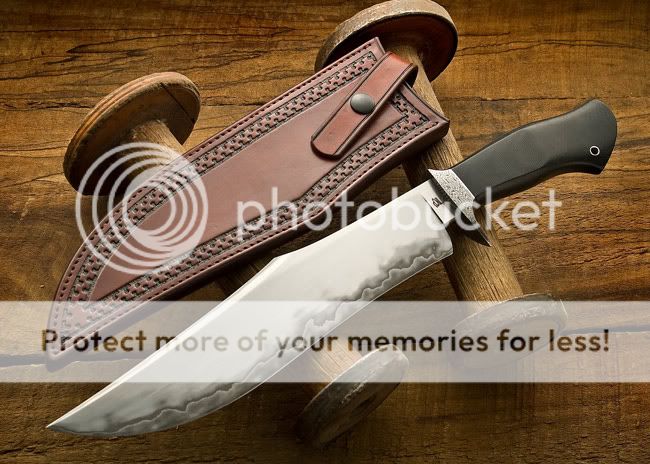
I remember that Burt Foster knife. It's incredibly awesome, I wish I'd made it but it's so cool that I'd never try. I feel the sincerest form of tribute to that knife would be to strive for an unrelated stunning achievement, not a sad imitation.

I mean, the blade is so amazing that it's saying a LOT about the rest of the knife that the design is equally standout. The lines are so snarky, kind of sophisticatedly sinisterly top-of-the-food-chain. And set off by the relatively understated materials.

OK, I'm done gushing now.
 
Back
Top