What makes a knife a "Loveless Style"?

Joined
Jun 20, 2007
Messages
1,361
I hear that term kicked around quite often. This knife is a "Loveless Style"!

I am not talking about the man himself, I know who he was and I realize they are paying tribute to the man by using his design but not taking credit for something that wasn't there design, with making that statement!

So what exactly about the design is it that defines it as a "Loveless Style" to you?
Is it the shape of the blade, the ricasso, the handle, etc., etc..

Because usually when I look at the knives that use this terminology to describe there knife, they are simialr but different! So are they just captilizing on the name or is there something I am missing that they are trying to bring out in there choosen pieces?

This is a serious inquriy and if you want to use pics, I like visual aids too!:D
 
There are a lot of features that were common to his most famous work. Pioneering the use of high-quality stainless steels (not just the crap they make butter knives out of) is a big one. Tapered tangs, hollow grinds, bolsters, rounding off the bottom of the ricasso and of course the blade profiles come to mind right away. But of coourse there's more subtleties to his genius, as well.

Read that book in the Count's link above, it's pretty darn interesting :thumbup:

Cool thread Dixie, I'm looking forward to others' thoughts.
 
The Count! First time I heard that...

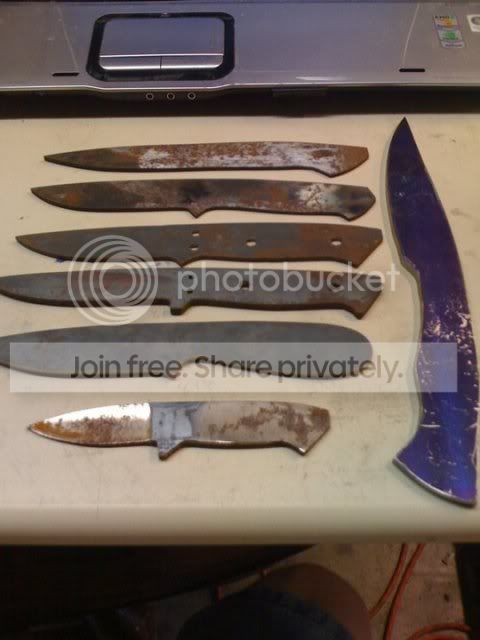
I agree with him as well. It's the style that Loveless used that is so very distinct. The picture below is the WIP for me right now. I'd say that 5 out of the 7 are "Loveless style" knives.
WIP_062011.jpg


Charlie
 
So this is kind of what I am talking about.


This blank I am working on here

Grindercart.jpg


would you call it a (LS) I am getting tired of typing it so I am going to refer to Loveless style as LS from here on.

The shape of this blank I have profiled out reminds me somewhat of what the LS.
I have plans of doing nickel/silver bolsters on this one and with the shape it seems like it might fit the bill as a LS. Now mind you I am not looking for a conscience clearing statement that would allow myself to make a poor copy to be identified as a LS.


This blade I have profiled out it is not SS. However I have seen one the other day that was referred to as LS and it was a 1090.

Does the fact that the knife is not quality SS or even SS exclude such a knife from being a "Loveless Style".


I am truly looking for the things that each and every one of you see in a particular knife shape, fit and finish that defines that piece as an LS!

Is the term to widely bantered around now. Don’t just say that at least five of these fit that bill for LS, explain why you feel that way. I won’t shoot you down I just want to hear different opinions on this subject

Inquiring minds want to know!
 
Your blade shape is reminiscent of a LS. The significant difference it the handle. As recommended above I would look at as many books and pictures as I could and get much closer before I used the term LS. Maybe Loveless inspired?

In Charlie's post above the 4th from top would be closest to a DP hunter.

With regards to stainless vs. non; Mr. Loveless early on used carbon steels in his knives and in the How to Make Knives book he recommends O1 as a good blade steel. At the link below you can see one of Ian Bailey's chutes in 1095.

http://www.bladeforums.com/forums/showthread.php/857780-Chute-knife.

David Sharp
 
Last edited:
OK after starting another thread in the Custom and Handmade knives forum I was provide a link to this thread!

http://www.bladeforums.com/forums/showthread.php/473592-Real-Loveless-Food-for-Thought

This is the orgional questions asked by that thread:
So my question is; how many of you could identify like knives from the top five or so Loveless style knife makers? Are there obvious differences between each? What are some? Obviously, the first giveaway, for a less skilled maker are the grinds, however I find the grinds very close between the top few.


After spending time this morning reading thru the link above and its 6page connection to the Loveless Style. Well let’s just say it is a passionate subject. So I am sure some will agree as to what I am about to say and as many others will disagree!

The following is not meant to agree or disagree with any one or to talk about anyone or their knives, famous or not. If it makes you offended then I suggest you may need to look at the reason you are offended.

However for me this still goes back to my original question. What is it about a knife that makes it a LS or “Loveless Style”. From what I have been able to actually find out, it may be easier to say than to define

The other thread rambles back and forth as to a lot about the person and how much of the LS is Loveless Style and how much is collaboration. Collaboration is really something I did not know a lot about till reading the other thread.


Some traits of the LS that seem define more the style of the LS than others have come forward in my reading. I will attempt to list some of them, as I see them!

Collaboration- of a LS has to do with the actual knife itself. While it is generally accepted that Loveless had his own style, fit and finish of the man who actually was working on the knife in Loveless’s shop has to do with the final finish. There are examples of the traits that show thru on a given knife that make that will define that knife as a LS finished by a given smith.

Shape- very hard to define, but it has as much to do with the overall knife as a given shape of a particular piece. In other words Loveless had certain traits that define one of his knives. Use of bolsters, chosen steel, etc., etc., but the one thing that stuck in my mind is the shape of the handle but again it is all these things together that make it a LS!

stock removal - LS knives are stock removal and I have no intention in getting into the age old discussion about forged and stock removal.

Blade grind – This is from the other thread: The grinds, fit, and finish of a Loveless knife is unique to that maker. When you examine the best of the best(Kressler, Johnson, Herron, the Japanese makers....) each has a slightly different style. Loveless knives are so deeply hollow ground that Bob has actually gone through the other side on occasion. The grind follows the belly of the knife; there are very few "straight" grinds on a Loveless knife.


Ricasso – I have noticed that there is no drop down from the end of the plunge cut or cutting edge. The cutting edge seems to transitions into the ricasso more or less straight on. Also and I am not sure if this is LS trait or some copying his work but have noticed some with a choil

Handles – This is from the other thread: handle subtleties to the grip contour. Where the palm swell is placed. It is missed the most by the others. The sweep into the guard. Both on the tang, and the contour blending from the spine area of the tang to the sides of the grip and palm swell. Depth of the concave contour extending from the palm swell to the butt. The thickness to the tang. The contour of the little finger area of the lower tang and the blending going up the side of the grip to the flared grip, and the gentle curve from the bottom of the tang and the top of the tang. It changes at different locations of the handle. Especially the bottom of the grip to the center.


I find that the terms “LS” or “Loveless inspired” are quite possibly being bantered around by some makers who would like to sell a particular knife. Because even some of those who have chosen to use the term LS to describe on of their knives, can say it much more easily than if they were forced to sit down and actually define the term LS, or what it is about their particular piece that warrants the term LS.

I am sure there is more criteria that defines the term LS and I would love to hear more from anyone that wants to list such items. However after doing this research I think I will have to refrain from the using of the term “Loveless Style or Loveless inspired” to describe one of my knives.
Not only because at this time my quality of work does not reach up to that level. The idea of wanting to be copying another’s work does not appeal to me. Now I would not be so naïve as to think that we are all producing originals out there.
For example when I first was starting in knife making I designed a knife blade that I was sure was totally unique! I had never seen anything like that shape that I could remember. Then one day I was reading thru some info on the net and run across a picture of blade that had been dated back to the late 16th century. It was almost identical to the shape of the blade I was sure that no one had ever done!. That burst my bubble and I realized there are few true original ideas.

However there is original work and even though my design of a given blade may be similar to another. The end product is mine and that is why I think I would be hesitant to referring to one of my blades as a “Loveless Style”. Not to demean anyone or look down on anyone who has made such a stipulation, I want to try and achieve my own uniqueness!!!!!!!!!!

.

 
I think you need to see many more pictures of Lovelace knives to realize what you want to know. Lovely work Butch !!! Frank
 
Butcher block that is a good lookin piece.

Frank I tend to ask the hard questions and I usually do it with no malice in my heart, I just really want an answer!

For example, I am into black powder guns. No not the modern ones but the really old ones, flintlock and caplocks. Now when I first got interested I bought me a kit and put my first one together. Which taught me just enough to be dangerous enough to ask another question that was not easily answered. What makes a true Hawken rifle a Hawken? Or too make it easier what makes today's copies not compare to a true Hawken?

The purists in the field of BP (Black Powder), got all offended that a newb would even ask such a question. But it became apparent early on that many would have liked to have had themselves looked on as experts were not experts and most couldn't name one thing that was an exclusive trait of a true Hawken rifle!
It took asking this question several times in different ways to actually get an expert to open up and reveal the things I was really looking for. when the damn actually burst I had several who begin to reveal the true traits of the rifle.

Now to try and put this discussion back on track. This question is not about the man or whether he collaborated on his knives! There was something about the knife blank (I pictured early in the thread) that reminded me of a LS. Honestly I am not sure what but it got me to thinkning and that prompted the thread and the question.

Now I realize it is the completed package that denotes a knife as LS, and I am not by any means trying to compare any of my work to that of Bob Loveless. How ever I see that term LS bantered around quite easily by some when describing one of their pieces. So it got me to thinking. Is this just a marketing tool or can the details of a piece that is classed as a LS actually be listed.

I seem to be having as hard a time getting such a list on a Loveless style knife as I did on a Hawken rifle! My intent is not to demean anyone here, rather to enlighten myself and others that would read this thread.

Since no one would try to make a list or even name the things about a picture of a particular knife that they had posted, as to what they felt made it a LS I tried to list a few things that popped out at me in my research.

To me this is not about being right or wrong on the subject it is about learning. And isn’t that the reason we all, go to the well, to drink from it.

Any opinions I shared in this thread are mine and any information I shared well that belongs to everyone. It is information that I found when I looked into the subject.

I still have the question to throw out there though. What makes a knife a “Loveless Style”?
Be bold throw a pick of a knife you made or of a true Loveless up there and point out the aspects of the given knife that you think, denote it in the Loveless Style! Like I said there is not right or wrong, you are not being graded and the most anyone can do is disagree with you, they can't eat you!:D
 
Your wanting to learn is fine. and a good tining. Some things cannot be learned by just the written word. I have been trying to pass along information on the simplest grinding system there is that will work on blades that are hollow or flat ground. I did not do pictures and as simple as the system is and how enthused I am to pass it along, for free of course, I have done very poorly.
Okay, you were into the black powed thing, - copies of the original stuff. Try to describe a Hawken . You will never be able to do that in twenty thousand words. Describe a Renoir painting or a Matisse. We are back to the knives and Mr. Lovelace's work. It's how it's made completely. No one is giving you a bad time. You are in fact asking someone to accomplise a near impossible task. Go into the dealer sites and find his knives and look hard. When you UNDERSTAND the quality of design and function together, then you are started on the way to have your answer. I may help to show you what you are over or under doing in your own work. There are no easy answers. Frank
 
Back
Top