What makes FRN molds pricy?

Joined
Oct 27, 2008
Messages
857
I keep reading that FRN moulds are initially very expensive (quoted prices in the 5-6 digits).

I know next to nothing about how the FRN moulding process works, and I'm interested to learn what exactly makes these moulds so expensive?
 
Last edited:
IIRC Sal said it was the cutting of the initial mold that was extremely pricey. Skill maybe?
 
As I recall, injection molding of FRN is done at temperatures around 500 degrees F and pressures around 10,000 PSI. The molds have to be able to withstand those temperatures and pressures without cracking or deforming, and at the same time must be dimensionally stable and precise. They have to be engineered to flow smoothly without trapping air or leaving voids. They are not molding a single piece at a time, either. I don't know how many pieces a single gang mold produces, but I would guess 50 to 100. All that precision doesn't come cheap.
 
Fascinating.... thanks for the info.

As I recall, injection molding of FRN is done at temperatures around 500 degrees F and pressures around 10,000 PSI. The molds have to be able to withstand those temperatures and pressures without cracking or deforming, and at the same time must be dimensionally stable and precise. They have to be engineered to flow smoothly without trapping air or leaving voids. They are not molding a single piece at a time, either. I don't know how many pieces a single gang mold produces, but I would guess 50 to 100. All that precision doesn't come cheap.
 
As I recall, injection molding of FRN is done at temperatures around 500 degrees F and pressures around 10,000 PSI. The molds have to be able to withstand those temperatures and pressures without cracking or deforming, and at the same time must be dimensionally stable and precise. They have to be engineered to flow smoothly without trapping air or leaving voids. They are not molding a single piece at a time, either. I don't know how many pieces a single gang mold produces, but I would guess 50 to 100. All that precision doesn't come cheap.

10,000 PSI?

Not to be a disbeliever but that is incredible pressure. Why would a molded piece of plastic need that much pressure to flow into the mold in a liquid state?
 
Because it has to fill the entire mold before it begins to cool, I guess. I've never done it myself, but those were the numbers I recall from someone who had been in that business. I thought it sounded awfully high myself, but from what little I have seen of the process, the entire gang mold is filled in about one second, and it takes a lot of pressure to deliver that kind of volume in that little time.
 
I worked in mouldmaking and took the mouldmaking technician course.
It's a hell of a lot of work which goes into making a plastic injection mould(MANY hours), not to mention you have to pay the guys that design the mould(engineers).
Not a simple thing. Costs a bunch.:eek:
 
50 to 100 pieces at a time... that thing must be huge!
I've always imagined a machine using a single mold at high speed, but I guess if you can make 100 pieces in virtually the same time, well that makes sense.
 
The molds are precision-milled out of solid steel, I believe. Not cheap. The engineering and tooling costs add up quickly.

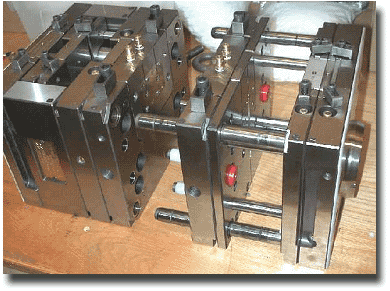
Examples of injection molds I found off of Google- so you can get a basic idea of what we're talking about.

injection_mold___11.jpg

molding_plates.gif

injection-mold.jpg
 
You could always watch "How it's made", they have injection molded stuff on there, very cool stuff and easy to see where the cost comes from.
 
I keep reading that FRN moulds are initially very expensive (quoted prices in the 5-6 digits).

During last 15 years I was working with several plastic suppliers. The parts, which we bought from them were used in medical or gun industries. Size of the parts comparable or larger than handles for folder. The most expensive mold, I can recall was about 80 K, but complicity of that parts were few levels up to compare with handles. The most molds were in 40-50K range, but again, parts were with much more complicated geometry and tighter tolerances, which is reflected in cost.
In the beginning of this summer I had a meeting with two people who work for molding company. One of the is the person, who does quotations. During our lunch I pulled my Caly3 and asked them how much can cost two cavity mold (so you can produce left and right handle at the same time) to make this kind of handles from FRN. The answer was "about 5 - 7K", for better idea, he needed print. Company located in CT, state with very high labor cost

A I don't know how many pieces a single gang mold produces, but I would guess 50 to 100.
Quantity of cavities determine how many pieces the mold produce in one shot.
Keep in the mind more cavities, more expensive mold would be, also you will need a bigger press.
Personally, I never saw 50-100 cavities mold. I saw parts from 32 cavity mold, but parts were very small, about .150" for longest dimension.
Few factors determine number of cavities, most important production quantities and size.
The most of the molds I was receiving parts from had (have) from one to four cavities.

 
During last 15 years I was working with several plastic suppliers. The parts, which we bought from them were used in medical or gun industries. Size of the parts comparable or larger than handles for folder. The most expensive mold, I can recall was about 80 K, but complicity of that parts were few levels up to compare with handles. The most molds were in 40-50K range, but again, parts were with much more complicated geometry and tighter tolerances, which is reflected in cost.
In the beginning of this summer I had a meeting with two people who work for molding company. One of the is the person, who does quotations. During our lunch I pulled my Caly3 and asked them how much can cost two cavity mold (so you can produce left and right handle at the same time) to make this kind of handles from FRN. The answer was "about 5 - 7K", for better idea, he needed print. Company located in CT, state with very high labor cost


Quantity of cavities determine how many pieces the mold produce in one shot.
Keep in the mind more cavities, more expensive mold would be, also you will need a bigger press.
Personally, I never saw 50-100 cavities mold. I saw parts from 32 cavity mold, but parts were very small, about .150" for longest dimension.
Few factors determine number of cavities, most important production quantities and size.
The most of the molds I was receiving parts from had (have) from one to four cavities.
I've never been able to find the post, not even sure if it was on the Spyderco Factory Forum or here, but IIRC a couple years back Sal mentioned that the molds cost in the $35,000 to $40,000 range. Don't recall the number of cavities ever being mentioned.

Paul
bar_02.gif

My Personal Website - - - - - - A Beginners Guide to Spyderco Collecting - - - - - - Kiwimania
Dead horses beaten, sacred cows tipped, chimeras hunted when time permits.
Spyderco Collector # 043 - - WTC # 1458 - 1504 - 1508 - Never Forget, Never Forgive!
It's easy to grin when your ship comes in and good fortune and fame are your lot, but the man worthwhile is the man who can smile with his shorts twsited up in a knot. - Morey Amsterdam
 
I've never been able to find the post, not even sure if it was on the Spyderco Factory Forum or here, but IIRC a couple years back Sal mentioned that the molds cost in the $35,000 to $40,000 range. Don't recall the number of cavities ever being mentioned.

I would have sworn he said $250K. :confused: Better wait for him to chime in, it could have been 25 and my mind is adding an extra zero.
 
Last edited:
I think the $250,000 he was talking about was the cost to bring a model to market. That would be design, engineering, prototyping, testing, refining, more prototyping and testing, tooling up, and pilot run to debug production. Once that cost is sunk, you can add the expense of actually manufacturing the first production run. Yet people are always suggesting all new models as Sprint Runs. :confused:
 
Injection mold costs vary considerably depending on where they are made.

Other influencing factors are how many parts will it take to make the completed part and how many completed parts will be in the mold. The complexity of the form also has influence such as the texture on our newer models (eg: Endura).

Sometimes checking first articles show errors or needed improvements, which means pulling, welding and reforming a heat treated mold. also expensive. ($5K- $15K)

Mold costs in the US are gong down a bit due to the high volume of offshore mold-makers now competing, such as in China. We have paid as much as $95,000 for a mold, but they are usually about $25K - $35K for a knife handle mold. Japanee molds are competitive with US molds. Chinese molds may run a third of that for the same mold.

Currently, it is possible to get molds made in China at even lower costs.

The quality of the mold then comes into play. We've been working with Seki makers for a long time and we have our own mold makers and part shooters that we've learned with. They are among the best in the world.

sal
 
This was very insightful, I thank every one of you for chiming in. Looking at the pictures of molds and reading what is involved, it is easy to see why they are so expensive.
 
I guess I should add that Blackie Collins designed the first production FRN knife with no liners. It was the Gerber LST.

sal
 
Back
Top