What thickness/grind/ etc of blade for the outdoors

silenthunterstudios

Slipjoint Addict
Joined
Feb 2, 2005
Messages
20,039
Do you want a sharpened prybar, like a Busse or Swamp Rat? Or would you be okay with a small carbon steel butcher knife? I hear from some camps that the huge sharpened prybar is the only way to go. Others, that you can get by with something like an Old Hickory butcher knife, its what the mountain men survived with. Basically, I have come to the opinion that you find out what suits you through practice.

I have heard from some also that a single blade is all you need, from others that you need several. I subscribe to the second theory. But what type of edge suits you best? What type of blade grind? Geometry? Is a thin blade better? If you're just going to be camping, and enjoying nature, do you carry something different? The big chopper, or are you going to baton through a tree with a branch and your folder? Basically, what type of blade do you need for regular camping? Not pulling into a paved campground and hooking up to a generator, and sleeping in a tent, but actual camping.

Right now I have the following fixed blades that I use for civilized camping, what are your thoughts on them?

Becker BK7 that I'm stripping the coating and modding the handle
Swamp Rat Camp Tramp, coating being removed by a maker
Swamp Rat Howling Rat, coating being removed by a maker
Western W36
BRKT Sandstorm


Out of all of these, what would be ideal for camping purposes? I'm trying to stick with carbon and tool steels for camping purposes.
 
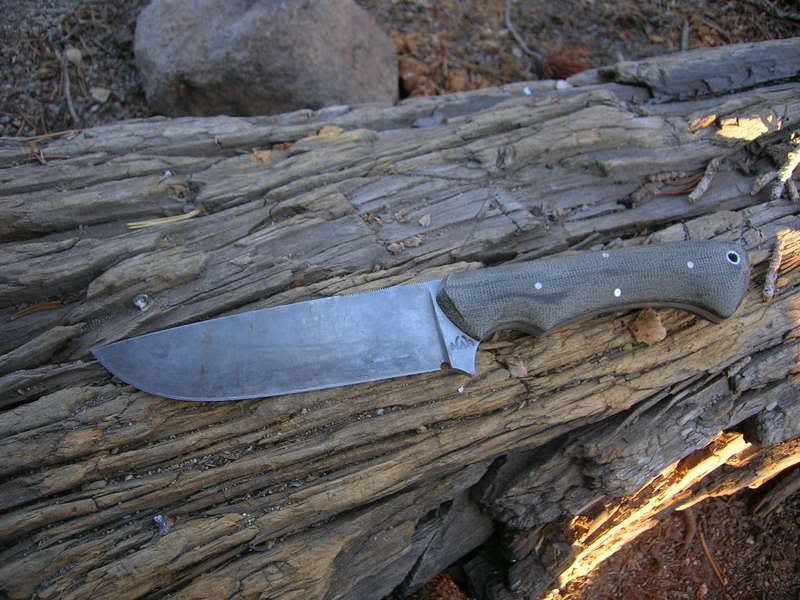
I'm really finding that a knife with about a 5" blade, flat ground and about 3/16ths of an inch fits the bill nicely. Maybe I'm biased, but I have been using the hell out of this NWA knife, and can't find a thing it's missing.
Inyo07019.jpg

The BRKT Bravo 1 also suits me well. It's thicker at almost 1/4", but it's still small and light, and balanced nicely. If I need a chopper, I still like my BK9Everybody has their own version of the perfect knife though, your choices look great too.
 
Basically there are two camps on wilderness and/or survival knives:

Those who favor big/thick knife as a chopper - Busse/SRKW and those who favor smaller/thin knifes like the F1, Mora etc. Then there are those I'd call the "compromise .40 cal" knives - that try to do both as an "all around wild/survival knife".

People get things mixed up when considering purchasing and/or selecting a knife; they start with their mindset out of sequence. What I mean is the conventional wisdom is to ask "What knife should I get/use?" when the first question or series of questions one should ask is "What is my mission? Why do I need a knife? How will I use it? What is it primary & secondary task for this knife? What do I need this knife to do that cannot be accomplished with another piece of gear?”

You’ve got to weigh and consider all the known and unknowns regarding your mission…then, and only then, can you make a rational, intelligent choice on the type of knife you need. Once this is done then you can select a knife and the “type” of knife – chopper vs. smaller knife.

So, consider what your mission is; then identify what are the primary and secondary tasks you need to accomplish on this mission relative to your tools and then make your selection based upon the task at hand and not on the latest trend in knives or what we think. Opinions are like elbows…everyone has one…but when it comes to your personal survival it doesn’t matter what we think…you have to live with your decision if you’re stuck in the wild with a tool that isn’t going to perform what you need done.

So for "civilian camping" what does that mean to you? In other words what is your mission? Car camping, backpacking, ultra lightweight backpacking, one day camping, two week camping, are you going to be catching fish, building a crawdad trap...you see what I mean? If I'm backing my car upto a spot then I'd take one type of knife...if I'm backpacking into a lake to fish I'd probably have other needs...so ID the mission and tasks and then the knife choice will be clearer and more obvious.

I know...I know...it would have been much easier if I just said “take the Becker you won’t regret it!”
 
I perfer 5/32" thickness for my fix blades with a blade lenght from 3 1/2" to 5"

For blades longer than 6" I like a thickness of 3/16"

I like carbon for my fix blades, and stainless for my folders
 
Because of the mindset of LEOs and people here, I usually go out for a day with nothing but a SAK (Vic OH) as a cutting tool. Over a short period of time, I learned that I don't have need for anything else. It handles the fire duties just fine. Sharpens sticks, cleans fish and quail and prepares them for cooking.

Would I like a fixed blade? Yeah I would, if for no other reason than backup.
 
Because of the mindset of LEOs and people here, I usually go out for a day with nothing but a SAK (Vic OH) as a cutting tool. Over a short period of time, I learned that I don't have need for anything else. It handles the fire duties just fine. Sharpens sticks, cleans fish and quail and prepares them for cooking.

Would I like a fixed blade? Yeah I would, if for no other reason than backup.

Longbow,
I like your style :thumbup:
 
Quoting quirt here.....
People get things mixed up when considering purchasing and/or selecting a knife; they start with their mindset out of sequence. What I mean is the conventional wisdom is to ask "What knife should I get/use?" when the first question or series of questions one should ask is "What is my mission? Why do I need a knife? How will I use it? What is it primary & secondary task for this knife? What do I need this knife to do that cannot be accomplished with another piece of gear?”


I you are carrying a knife incase of a Survival Scenario you will not know what tasks it might have to do.
I think basically as long as your knife will not break then it doesn't matter about the size ( within reason ) as you will make what you have work !!!
 
I'm starting to go for convex edges now, but the knives you listed you top notch outdoors blades, and I wouldn't feel underknifed carrying just 1 of those knives into the bush.:thumbup:
 
I just do both.... a small thin knife like the OH Trekker (I ground out
the serrations, much better) and a
larger knife like the Becker CU/7. This combination can
pretty much tackle anything. I've been thinking of getting a larger
chopper but the chopping ability of the Becker is pretty high, esp.
after I thinned out the edge.

If I could only bring one knife then it would probably be the Becker.
It can do a wide range of tasks and will stand up to a lot of
punishment. I don't think it is overly thick. With the high
flat grind it's just right.
 
I think everyone should carry what they like, and are comfortable with. I like thick stock on a wide blade just fine, since it maintains good slicing geometry. I like longer chopping blades as a camp knife, since I also carry smaller Blade(s) to do fine tasks.
 
I usually like a relatively thin knife for camping because they slice better, and my main thing I do is food prep.
 
I'm from the multiple knives camp. One blade is around 5". It's used for fire building, cordage cutting, whittling, and if need be, emergency shelter building. So it's thick enough to baton and pry with, although I try not to do that.

I also carry a smaller blade, around 3", as a back up and for food prep.

Of course, I also always carry a leatherman. Don't leave home without one.

The only time I dislike the knives people are carrying, is when they aren't carrying one at all.
 
"What is my mission? Why do I need a knife? How will I use it? What is it primary & secondary task for this knife? What do I need this knife to do that cannot be accomplished with another piece of gear?”

That's the right questions. Here's my choice:

1) A pocket knife folder for light tasks, it will slice and pushcut sticks, ropes, food. For me it's the Spyderco cal. jr., thin blade, flat grind, edge retention for a great cutting ability, short blade for precision. Many other folders could fit the tasks. To each his choice.

2) A fixed blade. 4 inches. Could be longer but no more than 6 inches. For usual tasks including light chopping, batonning, prying small logs. Fallkniven F1. No need to tell you more about , you all know that knife.

That's what i carry when the weather is warm enough to don't have to make fire for heating. If the temps are hot i replace the F1 with a Mora (lighter in my bag). In winter, even for a one day hike, THE tool i never forget to take with me ( i would prefer to forget the F1):

3) An hatchet. 14 inches handle length. The tool i like to use for chopping. Granfors Bruks. A 8 inches blade could be better in somes occasions; that's what many people say in this forum and i don't have any reason to doubt about their argues. I will have to try but a 40 years habit is hard to fight.

dantzk.
 
I don't want a sharpened prybar for any use. When I need a prybar, I use an actual prybar. It's certainly not any more expensive and not much more impractical than carrying around an enormous and extremely expensive knife. ;)

For the outdoors, if I had to choose just a single knife (which is very unrealistic, of course), I'd go with something "small" by I suppose American standards and "normal" by Scandinavian ones, meaning something with a blade in the 3" - 4" range, like a Fällkniven F1 or pretty much any traditional scandi knife (not counting leukus). Thickness under 5 mm, scandi or convex ground, plain edge.

Realistically, though, on any longer trek to the great outdoors I would have two knives and possibly a hatchet or an axe. In addition to the afore-mentioned "small" knife, I'd take a larger knife in the vein of a M.95 sissipuukko, Fällkniven A1 or any decent traditional leuku in carbon steel. Blade length would be around 8" max, normally around 6". 6 mm is about the maximum thickness I can stand in a knife.

Knives like this can handle anything I'd ever want to do while outdoors, even in survival situations. I'm not partial to chopping concrete or stabbing through car doors for amusement.
 
I carry a 3" fixed blade about .125 thick I think, an SAK Farmer, and a tomahawk. Perfect setup IMO. I don't really care for really thick blades. I like medium thickness not "OMG" or "I'm gonna break this." Kind of like poridge...:D

Elen: Well said!
 
i used to carry a big chopper for all of my wilderness needs. it tended to do everything i needed to do just not very efficiently.

then i got smart and layered my tools. i got a tomahawk, saw, and a small knife. the hawk will outchop the the big knife and the saw is very fast at taking down saplings. the small knife is very efficient and now i understand why all the classic woodsman prefer a small thin blade.
 
I don't want a sharpened prybar for any use. When I need a prybar, I use an actual prybar. It's certainly not any more expensive and not much more impractical than carrying around an enormous and extremely expensive knife. ;)

For the outdoors, if I had to choose just a single knife (which is very unrealistic, of course), I'd go with something "small" by I suppose American standards and "normal" by Scandinavian ones, meaning something with a blade in the 3" - 4" range, like a Fällkniven F1 or pretty much any traditional scandi knife (not counting leukus). Thickness under 5 mm, scandi or convex ground, plain edge.

Realistically, though, on any longer trek to the great outdoors I would have two knives and possibly a hatchet or an axe. In addition to the afore-mentioned "small" knife, I'd take a larger knife in the vein of a M.95 sissipuukko, Fällkniven A1 or any decent traditional leuku in carbon steel. Blade length would be around 8" max, normally around 6". 6 mm is about the maximum thickness I can stand in a knife.

Knives like this can handle anything I'd ever want to do while outdoors, even in survival situations. I'm not partial to chopping concrete or stabbing through car doors for amusement.

In a perfect world I would agree 100% with what you are saying, however it is the unexpected like when you baton some wood and your knife gets stuck. You then have to wriggle the knife about to free it thus applying un-natural forces upon your blade and this is when a thin stock blade can break. I once read about the person who had to use his Cold steel SRK as an emergency piton to climb out of a valley, once again this is when a thinner stock knife can break !
I don't think there is a set answer to this question but for me I wouldn't like to rely totally on anything less than a 3/16" blade.

tknife's blade seems pretty what I would consider ideal !!!
 
I alway carry a sak, either a fieldmaster,hiker,farmer,tekker etc.and find this handles most work.

I usally carry a fixed blade with a 4in or so blade,mora,buck queen etc,for cleaning fish and heavier carving etc.

And if I think their be a need a small axe ,hatchet or machete

I've tried more expensive knives,but I found I enjoy a good quality,simple blade like a mora or sak,more than the knives costing hundreds of $
 
Here we go again.

I carry several, of all shapes and sizes, although I found the grinds on Scandi (pueko, lueko, mora) knives lacking. I greatly prefer a full flat grind.
 
Summer: SAK, Becker Necker, Machete (if needed)
Winter: SAK, F1, hatchet or saw (depending on my mood)
 
Back
Top