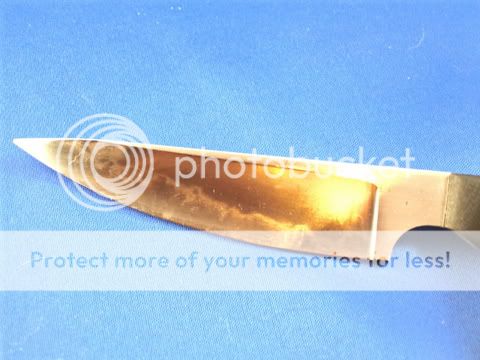
What to look for in a good hamon???

Joined
Jul 10, 2002
Messages
839
I saw the other thread about Hamon, but did not want to hijack it. So here is my question. What Are you supposed to look for in a GOOD Hamon?

I was finishing up a blade and had clay coated and quenched, sanded pretty well, then etched with lemon Juice (I haerd that will make the hamon white and that is what i wanted) and polished it with Mother's Mag polish. It was looking good with some fire like glistenings at the top of it. But oit wasn't as white as i wanted so i etched and polished some more, tying to get it whiter. Well it got whiter, but the fire went away and the hamon started looking like a satin finish almost with no transition type of line from the hard to the softer metal. Which is not what i wanted, but is that what others look for?
 
humm.....I think what ever looks good to you is important. Good thing about etch and polish...you get to repeat untill you get the happy medium :)
Try it again......then take a picture :)
 
leatherbird said:
I like to look at Don Fogg's hamons.:cool:
What he said:D Take a close look at Foggs hamons and you'll see what we strive for.

I am never completely satisfied with mine and spend way too much time on them but hey, they're adictive and mighty cool:p
 
Ditto what leatherbird and sunfishman just said. Then check on the web for Yoshindo Yoshihara's swords, and if you're really up to it, obtain and purchase Master Yoshihara's book - the Craft of the Japanese Sword - it has a lot of sensible (and understandable) information in it about the intricacies of hamons and even wonder-of wonders !!! TECHNIQUES described. Jason.
 
In my opinion a good hammon reveals the true nature of the heat treat and the grain structure of the steel as it was developed.
 
In my way of thinking ( and what I have learned from reading texts on Japanese sword smithing) A hamon that is a bright,sharp line is not the nicest.It should be a subtle thing,with wisps and ghosts.The true hamon is seen at an angle of about 30 degrees in reflected light.Many hamons will not show well until properly polished,which can be a daunting task,and is never quickly done.As Ed Fowler stated,the hamon shows the different steel structures and how they formed.If all you wanted was a bright line,you could mask off the blade and etch one in (like those fake Chinese swords).
 
I dunno what happened to my account..but anyway...

I've wonderd the same about a hamon. I usually sand mine up to about 1200grit, then etch in warm cider vinegar--after that I polish with flitz and a paper towel for about 30min.
I will say this, taking a pic of the sucker sure is difficult:(
karma5.jpg
 
I was probably a little brief in my original reply on hamons.

I wanted to qualify that first and foremost, a hamon is an effective, visual representation of the features of a selective hardening process, pretty much what Ed Fowler is saying. For many bladesmiths (and opinions will differ), the selective hardening process is a means of imparting certain performance characteristics to a blade. Looking at the visible hamon will allow you to make some assessment of the blade's intended performance.

The hamon can then also become an expression of the craftsman's skill in precisely applying these heat treatment techniques, and therefore is an artistic endeavour. And most people associate beauty with function. (Eg.- even some very ugly sportscar's are "beautiful" because they do their job very well...if you get my drift).

There comes a point where the extreme display of artistic skill in say, developing a really detailed hamon with all the details - utsuri, ashi, notare, etc. DOESN'T ACTUALLY GIVE ANY IMPROVED performance attributes to a blade, compared to a simpler hamon. But it could be done, simply because the artisan is able to. (I do becasue I can... etc.)

I hope this mumbo-jumbo makes some sense :p ;) :D , in terms of my philosophy regarding art and function.

By the way, SShepherd, that is some awesome hamon ! Jason.
 
Thanks guys. I really like one like in SSheapard's picture, and that was sort of the way mine was when i first etched and polished it, unfortuanately after more etching and polishing that thin transition line from the hardened to the softer that shows up in his pic, doesnt seem to be on mine any more, now mine is a definate whiter but more satiny harder part and then the shinier softer part, but no transition area. I tried taking a couple pics of it today, but couldnt get a good one to show. So i will probably try resanding it and starting over. :(
 
wow !:) Thanks guys, I might have actually done 2 things "well" this month:o

Any tips on how to take better pics of the beastie?
I tried a light backgroung in a lightbox:
karma2.jpg


This way it just didn't come out as well.
 
Terry..you can always re-etch the blade;)

When I took mine out, the edge was grey and the part that was coated with satanite was black. I went straight from there with the papertowel and flitz.
 
I am resanding it now, and will try a lighter etch tommorrow, i am still going to use the lemon juice to get the white hamon, which i liked. :o
 
You should try to avoid it dipping too low toward the cutting edge as well.

If I get one that runs closer than 3/8," I'll readily re-heat-treat. Usually less than 1/2"

There are a few in the past I didn't do that on, but I don't let them out of the shop like that now.
 
Back
Top