
What would cause this?

Joined
Aug 28, 2009
Messages
7,951
I just got some O-1 blades back from HT and the first one has these hazy marks on it.
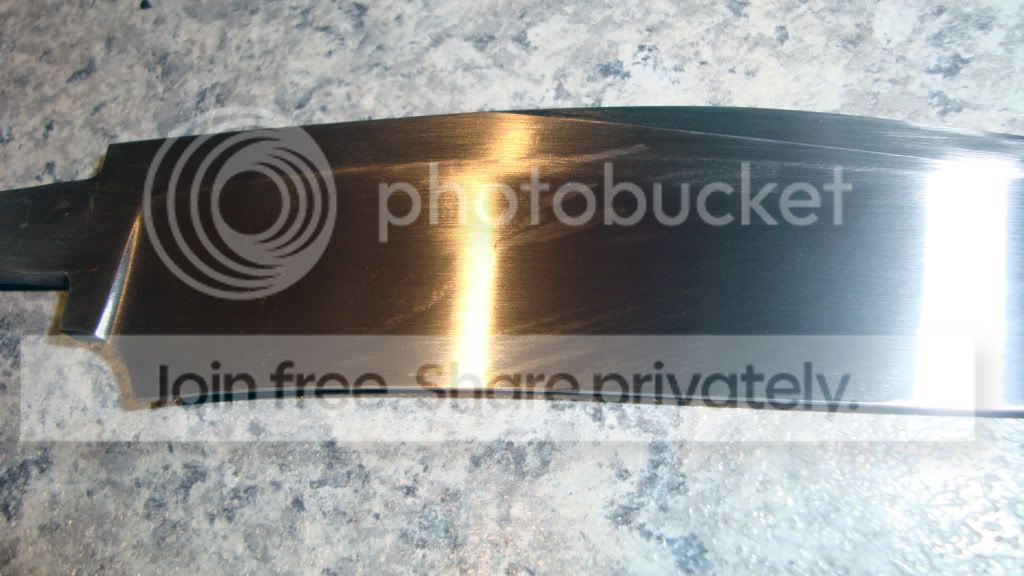
DSC02667.jpg

I spent the whole day trying to sand through them but they are still there. I have looked at them through a 10X eye piece and they are not scratches, or impressions that I can see, just a hazy discoloration. They even have the same scratch pattern as the rest of the blade so they are getting sanded. I can make them almost invisible at 600g with the scratch pattern going tip to tail but one I hit 800g it doesn't matter what way the scratches go they show up just like in the picture. The picture was taken at 400g BTW.

I didn't do the HT so I can't answer questions on that, but what do you think could have caused this?
 
just a shot in the dark, but maybe some acid got spilled then heat treated to make it worse.....

you sure you didn't have anything laying around that could have got on the blade before you sent it off?? maybe just didn't realize or obviously see it..

to state the obvious it appears etched into the steel, I'm sure someone will chime in with a solution (literally) as I think it needs to be soaked in something.. baking soda does wonders wet sanding :) only thing that comes to mind..
 
this isn't just on the surface, I sanded all day and I can still see the marks. I am hoping the one of the pros come along with some insight to what may have happened.

As for what was done to them before being sent out I ground them and sanded to 600g, washed them down with acetone wrapped them up and shipped them out.
 
Ive had similar haze marks on D2 blades I have sent out for heat treat too. Did you just hand sand or go back to the grinder? I found I had to go back to the grinder and clean up the blade a bit more.

I figured it was either a imperfection in the steel or something I had done with the pre heat treat sand (420g) or some sort of scale left over from the heat treat.
 
I never took this one back to the grinder, it's a recurved bowie that I am working on and after I ground it, it took a lot of filing to get the grind lines more less even and smooth. I had hand sanded it to 600g so I am leaning towards that as the problem. There are marks on both sides of the blade but the other side it is little dash marks. The marks on this side are only visible when the blade is twisted in the light now but the other side they just jump out above 800g.

Because of the marks on the opposite side I am only going to do a 600g satin finish on this one. I say only because I am only going to sand it out to 1500 then back it down to 600 as apposed to taking it all the way to 2500 and buffing it.
 
Reading your last post leads me to wonder... when you say you spent the whole day trying to sand the problem away, which grits did you use? Did you try going back to, say, 80 or 150?
 
I only backed up to 400g, because at that grit the marks are not visible from any angle, leading you to believe that are gone. For the amount of material I removed yesterday I could have gone back to 220g and got to the same point faster:o I just finished doing the side in the picture at 800g and I can't see any marks, but that side was less prominent at 600g. I am getting ready to start the problem side right now, but had to make a couple of phone calls so I checked this thread before I got back into it. If I am lucky this time around the marks will be gone.

What I am more interested in is what could have caused them in the first place, so I can try avoid it next time.
 
The way you describe "it" the problem sounds like something that is in the steel. Most things that etch steel do not go thru the steel only lay on the surface however working under that theory it may be etched deeper into the steel than you think. You would need to grind away the surface. If you don't want to attempt to grind it away and believe me I do understand that fear. Then you may want to consider a slightly different finish than the original finish.

A mustard patina would give it an aged look. My favorite is one that another fine veteran knife maker uses. He takes it down to a fine sanding and then does a cold blue on the metal and then a bath in bleach and finally a baking soda bath and scrub down to neutralize the whole thing. It ends up with a wonderfully aged look with out the motley look that you usually get with the mustard treatment, and the severe pitting of heavy bleach. Just a thought take it for what it is worth!
 
Thanks for the input, I was just talking to RichardJ about this and there are a few things that could have caused it, but the steel itself seems to be the most prominent possibility of it. If I can't get the marks out or well/completely hidden with a satin finish I will do some testing on your suggestions to see if I like the look of it.

BTW the knife in question is the bottom one in the picture, that is what it looked like with a dirty 600g finish just before cleaning it sending it out for HT, so a rustic look could suit the knife. The top one is the othre blade that went out for HT, but I haven't worked on it yet, I am waiting on my new belts to get here. That one I will take to the grinder because it is just a flat grind and I can pull that off without too much trouble, the recurve is just too easy for me to completely mess up with the grinder:o

DSC02634.jpg
 
They are both good looking knives! Several years back a terrible batch of ATS-34 was sold. I ended up with some. It had soft spots in it that would finish up looking like very small surface marks. Frank
 
I mentioned that that is what it was like some place, might have been in a PM with someone about it. Either way with the 600g finish it is passable, I have to look very hard to see them now, and I know where they are. I didn't buy this O-1 from my normal supplier, only because of the postal strike, and I think that may be why I had the troubles with it. I am sure most knife making suppliers get their steels from tried and true sources.
 
Unky,

I have had similar problems with O-1 over the years. Most batches worked fine, but occasionally I had one that looked similar to yours. It might be a bit of alloy banding, or something similar. I know one thing, O-1 likes a longer soak at temperature than most steels.

Because of the somewhat higher alloys in the O-1 mix, it is probably next to impossible to get completely the same melt from batch to batch. Higher end producers lessen this problem, but even they may not achieve the same end results from day-today.

Where is Kevin Cashen when we need him?

Robert
 
I would suspect either some sort of alloy banding or other steel composition variation.

My suggestions are:
Clean the blade really good, and give it a good etch in FC. What does the surface look like? Did the marks get more distinct or less? Are there new ones?
Then ........
Take it back to 220 grit and completely re-sand it. You have to take off the entire surface at least .005"/.100mm to get beyond any surface artifacts, decarb, or other HT features. Go back up to 400 and when well sanded out, give it a quick etch. Is it gone? If so, go up the grits amd see if the problem is taken care of.
If it is still there ....
Try etching the blade in FC for a deep etch. Does this make it go away? If so, consider an etched blade look.
If not......
Try a satin finish. Does that work? If so, that may be the finish to use, or go for a bead blasted look.
If not...........
Send me the bad blade to play with, and start over on a new one for yourself.
 
Why does everyone want my knives first Tia Goo now you:confused: I went with the satin after repeated resandings, the worst part is that my KITH blade is made from the same stuff and there is no way I am going have that as a KITH knife, I want that one to be perfect. I have some 1/8" 1084 and W2 coming in next week and if the third blade does the same thing I have a back up, and at the same time I send the KITH blade in for HT I will order some more 3/16" stock as a back up to the backup

I have a full weekend of basement cleaning to do so I can get my tools moved indoors for the winter and my mother can have her garage for her car. Monday I will be cleaning up the second blade from that piece of O-1 to see what it looks like underneath the scale/decarb, if it is bad looking too then I will jump right into making a new KITH knife.

One question is there any chance that the integrity of the blade has been compromised by this? I really wish I had some FC to try the etching thing, but I would have to go into Ottawa to get it and I don't have a way there for a few weeks now:(
 
You could try etching in warm distilled vinegar to see what happens, but FC will be better for this case.
If there is a hardware store in town, you could get some muriatic acid and dilute it about 50:1 and try that. You may have to add more acid to find the correct ratio, but start weak and gradually increase the concentration until it etches the way you want. Muriatic etches a lot different than FC, but works.
It is easy to order the dry FC powder by post and make the liquid yourself. Ebay and other places sell the powder for $8-10/500g ( $6-8/Lb). Dissolve the powder in water at two parts water to one part FC powder ( by weight). 500 grams makes one liter of stock solution ( 1Lb/Qt). Dilute this 3:1 for use. Do all the mixing outside with good ventilation. The solution will get hot when first combined, so use a good glass container to mix in, and transfer to a good plastic container after it cools. Add the powder to the water slowly and let it dissolve, stirring a bit as needed. Let it sit loosely covered for a few hours before sealing up tight. Do not breath the fumes, as they are really bad for you.
 
Unfortunately all we have is a small lumber store. I am liking the looks of the satin finish on this one so I may just leave it as is, as long as the blade is still going to be solid. Once I get the next one cleaned off on Monday I will give the warm distilled vinegar a try if it has the similar marks. There were three blades that came out of this piece of steel so I am pretty sure that all three will suffer the same problem to some extent.

I had FC while I was in Winnipeg, but the movers wouldn't take it so I had to dispose of it. I can get it in Ottawa no problem and its only a 1 hour drive, I just wont have a ride to Ottawa for a couple of weeks, just a little longer than it would take to mail order it so I might as well wait till then and pick up a few other things I want/need at the same time, like some leather crafting supplies and shaving supplies.
 
So I cleaned up the second one today and while it looked better before clean up it was much worse underneath. Being that this one is a flat grind I am working on it slow but sure with a 220g belt on the grinder. The steel started off life at .185" and right now it is at .173". I am not sure what it was at when I started grinding, but I am probably put it aside till me new belts show up this week and get back at it with some ceramics.

My conclusions to this experience are 1, never buy steel from that place again, Rob's is much better, and 2, a grinder makes the clean up much easier. Thanks a lot everyone I learned a lot more than I could ever have on my own:thumbup:
 
Back
Top