what?

Joined
Aug 6, 2010
Messages
2
Hello
Hi boys, I'll start with a knife handicrafts again and I need your good advice.
what should I invest in and in what order.
now I live in Sweden so this is not the same opportunities for you in the States.
but I'll fix that. So you are knowledgeable and skilled, what can you give me advice?
I see that google translate is not always so good. But I hope you understand me
 
Welcome to the forum, I'm sure some of the more experianced members will be along shortly to add to what I have here. If you are looking to make knives from scratch, you don't really need a whole lot.

A couple of files, a hacksaw and some spare blades, a drill (drill press is best) and some bits, and piles of sand paper in various grits from course to fine should get you started.

I just started myself, and this is pretty much the equipment I use. I have mostly used the steel from old files found at yard sales and wood from handles from other broken tools (axe handles, ect.) to build my knives from, and you can turn out a very usable blade with this set up.

Hope it helps
 
www.brisa.fi
That's a good european on-line webshop. Friendly people.
Everything that you can't get around a normal hardwareshop is sold by them.

Invest in a good quality vice and good hand files.
(bahco will do but isn't top quality)
Next a drillpress.
Handy can be an angle grinder or a dremel
You can't do without a coffeemaker and a radio
 
Welcome aboard creepy!

I learned a long time ago that the tools used don't necessarily make a better product as much as the person using the tools. My recommendation is the same as dfarm's. Start with basics and work your way into the more expensive tools as you master the basics. I'm amazed at how much I still use hand files and sandpaper even though I have a belt grinder in my shop now.

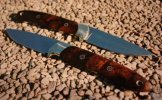
Here is a picture of two knives that I made back in 2002 with the simple hand tools that dfarm mentioned in his post. The only additions to his list that I used for these knives was a Dremel motor tool that I used as a buffer and as many different types of light sources you can get. I recommend at least some florescent and halogen lights in addition to incandescent lights. The different types of lighting will help you find scratches that are difficult to detect with just one type of light source. I guess another sugestion would be to use some sort of magnification to inspect your work. A "Magnivisor" or at least +2 or 3 magnification reading glasses will help find scratches that need attention.

Good luck and keep us informed as to how you are doing.

Rick
 

Attachments

  • Twins.JPG
    Twins.JPG
    26.7 KB · Views: 14
Back
Top