
-
The BladeForums.com 2024 Traditional Knife is available! Price is $250 ea (shipped within CONUS).
Order here: https://www.bladeforums.com/help/2024-traditional/
You are using an out of date browser. It may not display this or other websites correctly.
You should upgrade or use an alternative browser.
You should upgrade or use an alternative browser.
Whats The Difference Between DA And SA ...
- Thread starter dig-it
- Start date

- Joined
- Dec 2, 2001
- Messages
- 453
A double action gun uses the trigger pull to cock the hammer. So, every time you pull the trigger it will have a long heavier pull like a double action revolver. With a single action auto like a Colt 1911, you have to cock the hammer for the first shot, and the slide cocks the hammer for each subsequent shot. I remember reading that the double action autos were made that way because you could avoid carrying them cocked with the safety on and also because the trigger pull would have to be more deliberate like a DA revolver. I don't know if that's true but there ya have it.
dig-it said:semiautomatic handguns? I know SA revolvers have to have the hammer pulled back to fire and with the DA, the trigger can be squeezed or the hammer pulled back.
I was curious about the difference with something like a 1911 type handgun.
Well, the 1911 is SA and needs the hammer cocked on the first round. So if someone points one at you that isn't cocked, like they do on TV all the time, just thumb your nose and ears at him and urinate on his shoes because the boob won't be able to shoot you. Is that what you were asking?

With most DA semi-autos, there are two different trigger pulls that need to be learned. Generally, a DA semi-auto is fired double action for the first shot, and all subsequent shots, without decocking the hammer, are fired single action. Having two different trigger pulls in a single handgun can be troublesome for training, and I believe that is what has lead to the creation of DA-only semi-autos. A DA semi-auto can also be used *exactly* like a SA semi-auto if one racks the slide and starts with the hammer back.
GeoThorn
GeoThorn
LOL, like I`ll have any left in my bladder from soaking my shorts.mycroftt said:Well, the 1911 is SA and needs the hammer cocked on the first round. So if someone points one at you that isn't cocked, like they do on TV all the time, just thumb your nose and ears at him and urinate on his shoes because the boob won't be able to shoot you. Is that what you were asking?

Any of you folks have a 1911 type and if so, did you go for a DA or a SA? What made you choose and are you satisfied with your choice?
I`ve handled a couple in a gunshop, but never fired a 45. Size and weight wouldn`t be an issue as I`m not going to carry it.
I`ve handled a couple in a gunshop, but never fired a 45. Size and weight wouldn`t be an issue as I`m not going to carry it.
A "1911 type" is basically a single action semi-auto, and those started back in 1911. The first double action semi-auto that I'm aware of is the Walther P38, from approximately 1938.
Myself, I have a "1911 type" single action semi-auto. I chose to purchase a SA because it has the same trigger pull, each and every time, rather than having a "throwaway" DA first shot because the DA trigger pull can be so heavy and deliberate. Most semi-autos that are produced these days are of the DA variety.
GeoThorn
Myself, I have a "1911 type" single action semi-auto. I chose to purchase a SA because it has the same trigger pull, each and every time, rather than having a "throwaway" DA first shot because the DA trigger pull can be so heavy and deliberate. Most semi-autos that are produced these days are of the DA variety.
GeoThorn

- Joined
- Mar 26, 2000
- Messages
- 14,444
mycroftt said:Well, the 1911 is SA and needs the hammer cocked on the first round. So if someone points one at you that isn't cocked, like they do on TV all the time, just thumb your nose and ears at him and urinate on his shoes because the boob won't be able to shoot you.
And you better pray he hasn't had a DA conversion done on his 1911.....


- Joined
- Jan 15, 2003
- Messages
- 1,690
Heya. This thread caught my interest 'cos i have a firearms, fires and explosives exam next week. Since handguns are banned in the UK most of the stuff we do learn is just theory. Not really helpful. Anyway, does anyone have any websites that explain how DA and SA function?
I don't quite get it from your descriptions.
WHat's the difference between the hammer and the firing pin?
I don't quite get it from your descriptions.
WHat's the difference between the hammer and the firing pin?
Currently there are a number of "DA only" autos, which only function with the relatively long and heavy trigger pull. Primarily for safety, or at least that's the idea.
I understand the Glock (which our department issues) action is sort of mid-way, with the striker being partially cocked at all times.
I understand the Glock (which our department issues) action is sort of mid-way, with the striker being partially cocked at all times.


- Joined
- Sep 29, 2003
- Messages
- 519
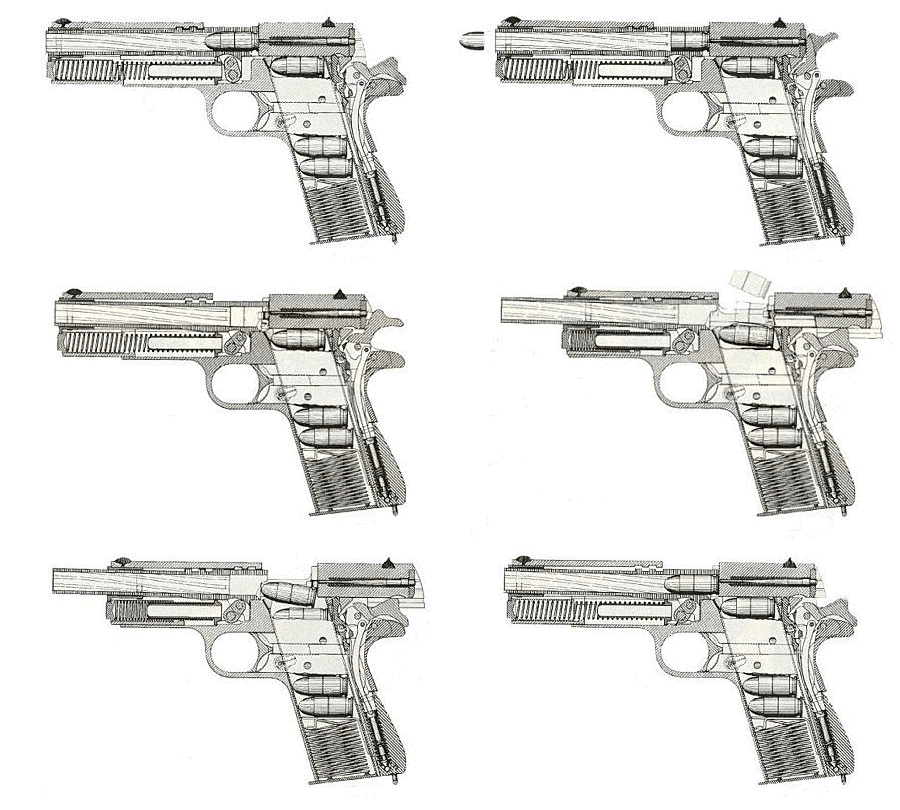
The hammer drives the pin forward sharply into the primer, the little cap set into the bottom of the brass cartridge. This goes off (I used to set offprimers in empty brass by setting the brass on a dart in the garage wall, and popping it with a bb gun. Til mom caught me.), and travels through a little hole in the brass to the actual powder charge in the brass.
With a single action, basically you pull the slide back, which cocks the hammer. When the slide goes back forward, it strips a round from the top of the magazine and snugs it into the chamber. Pulling the trigger releases the hammer, which slaps into the firing pin. Recoil drives the slide back to start the cycle over. The trigger is reset, and it takes just a very light pull to drop the hammer each time.
With a double action/ single action, you have a much longer, heavier trigger pull that cocks the hammer, in effect simulating racking the slide to get the hammer back,after that the cycle above is enacted, and givign you a much easier trigger pull than the one on the first shot.
The trigger on a DA only pistol does this each time, so you have a constant trigger pull on every round. This can be helpful on a misfire or a light primer strike, sometimes a round doesn't get tapped hard enough by the pin, with a DA only, you just pull the trigger again, it might go boom that time. A single action won't do that unless you manually pull the slide back again.
The above is all pretty basic, and various proprietary mechanisms tweak things around in various ways, but thats pretty much how it breaks down.
*I am not a gunsmith, nor do I play one on TV, so take it with a grain of salt, and please feel free to set me straight or add to the above if warranted.
With a single action, basically you pull the slide back, which cocks the hammer. When the slide goes back forward, it strips a round from the top of the magazine and snugs it into the chamber. Pulling the trigger releases the hammer, which slaps into the firing pin. Recoil drives the slide back to start the cycle over. The trigger is reset, and it takes just a very light pull to drop the hammer each time.
With a double action/ single action, you have a much longer, heavier trigger pull that cocks the hammer, in effect simulating racking the slide to get the hammer back,after that the cycle above is enacted, and givign you a much easier trigger pull than the one on the first shot.
The trigger on a DA only pistol does this each time, so you have a constant trigger pull on every round. This can be helpful on a misfire or a light primer strike, sometimes a round doesn't get tapped hard enough by the pin, with a DA only, you just pull the trigger again, it might go boom that time. A single action won't do that unless you manually pull the slide back again.
The above is all pretty basic, and various proprietary mechanisms tweak things around in various ways, but thats pretty much how it breaks down.
*I am not a gunsmith, nor do I play one on TV, so take it with a grain of salt, and please feel free to set me straight or add to the above if warranted.


- Joined
- Sep 2, 2003
- Messages
- 11,650
I may be going somewhat off track here but this is something I've often wondered ...
If people carry semi autos around, and if they have them cocked with the safety on, does this eventually wear out the spring, (or whatever is going to push/pull the hammer forward)?
I guess what I'm saying, does the spring tension become less from being in a constant state of stretch or compression?
It would be a bugger if you had to fire the gun and the spring is no longer able to activate the hammer sufficiently to fire the gun!
If people carry semi autos around, and if they have them cocked with the safety on, does this eventually wear out the spring, (or whatever is going to push/pull the hammer forward)?
I guess what I'm saying, does the spring tension become less from being in a constant state of stretch or compression?
It would be a bugger if you had to fire the gun and the spring is no longer able to activate the hammer sufficiently to fire the gun!
- Joined
- Apr 3, 2004
- Messages
- 879
Well I don't think that's should be a real concern Gajinoz. When the hammer is cocked (in a 1911 type gun) it compresses the main spring. Pulling the trigger pivots the sear so that the hammer is released to fall forward & it is pushed forward by the released main spring. I think the factory main spring is rated at 19 lbs., which is overkill. Most gun smiths doing trigger jobs will reduce the main spring (by replacing it or clipping coils) to 9 lbs. (The theory being that the heavier spring causes movement- I may be off on the spring weights). Anyway I have never heard that that has led to misfires so I would expect that carrying a 1911 cocked and locked with a factory spring would not increase the odds of a misfire.
- Joined
- Jan 15, 2003
- Messages
- 1,690
aaaahh...that was a superb diagram!!!
Now i understand.
Let me clarify though. Correct me if i'm wrong.
For SA, you pull the hammer back and when you pull the trigger the hammer hits the firing pin. To cock the gun, you either pull the hammer (if there's already a round in the chamber?) or you pull the slider back which loads the round as well as cock the hammer?
For DA, the trigger pull actually pulls the hammer back and cocks it automatically just before you fire. So the hammer is never permanently in the cocked position?
I've fired a handgun before but it was my dad's H&K and i think it's one of those P7 types that gollnick mentioned. Thing is i don't remember it having a hammer type thing. It's been awhile since i last used it at the range but i do remember the grip being quite hard for me to press and aim accurately with just one hand (without steadying it with another).
Does the p7 even have a hammer? Does the grip just cock the firing pin?
Damn...so many questions.
Now i understand.
Let me clarify though. Correct me if i'm wrong.
For SA, you pull the hammer back and when you pull the trigger the hammer hits the firing pin. To cock the gun, you either pull the hammer (if there's already a round in the chamber?) or you pull the slider back which loads the round as well as cock the hammer?
For DA, the trigger pull actually pulls the hammer back and cocks it automatically just before you fire. So the hammer is never permanently in the cocked position?
I've fired a handgun before but it was my dad's H&K and i think it's one of those P7 types that gollnick mentioned. Thing is i don't remember it having a hammer type thing. It's been awhile since i last used it at the range but i do remember the grip being quite hard for me to press and aim accurately with just one hand (without steadying it with another).
Does the p7 even have a hammer? Does the grip just cock the firing pin?
Damn...so many questions.
there are lots of diff types DA pistols ie glock, para ordanance LDA, the springfield armory XD pistols, kahrs, and of course the std DA's like a walther P38. and they are all diff to one degree/another.
i like the glock and kahrs myself FWIW, i did not like the HK P7 myself, did not like the cocker thing.
1911's are great too of course, i really prefer the std 1911 to the LDA.
i like the glock and kahrs myself FWIW, i did not like the HK P7 myself, did not like the cocker thing.
1911's are great too of course, i really prefer the std 1911 to the LDA.
- Joined
- Sep 29, 2003
- Messages
- 519
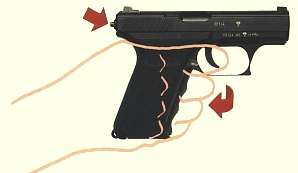
Couldn't find a animation on a quick run, but this site will break down the type Chuck is talking about. Neat, innovative mechanism with a solid reputation for accuracy and reliability.Gollnick said:And don't forget, just for completeness, squeeze-cockers like the H&K P7. The safety of a DA and the consistent and light trigger pull of an SA.
P7 (squeeze cocked pistol) cycle of fire
- Joined
- Sep 29, 2003
- Messages
- 519
Pretty muchPoint44 said:aaaahh...that was a superb diagram!!!
Now i understand.
Let me clarify though. Correct me if i'm wrong.
For SA, you pull the hammer back and when you pull the trigger the hammer hits the firing pin. To cock the gun, you either pull the hammer (if there's already a round in the chamber?) or you pull the slider back which loads the round as well as cock the hammer?
depends on the make, but on DA only pistols this is the normFor DA, the trigger pull actually pulls the hammer back and cocks it automatically just before you fire. So the hammer is never permanently in the cocked position?
Don't learn to shoot from movies. You should train with either hand for the just-in-cases, but focus on a good stable stance and a two handed grip. You can learn to shoot and move after you get that down. IDPA is a great way to do that, on the off chance you're able to do that where you are.I've fired a handgun before but it was my dad's H&K and i think it's one of those P7 types that gollnick mentioned. Thing is i don't remember it having a hammer type thing. It's been awhile since i last used it at the range but i do remember the grip being quite hard for me to press and aim accurately with just one hand (without steadying it with another).
No. Yes.Does the p7 even have a hammer? Does the grip just cock the firing pin?
Damn...so many questions.
P7s seem to be love/hate, but the lovers really dig them.
- Joined
- Nov 2, 2002
- Messages
- 497
Woops! The HK website seems to advocate cocking the P7 with a finger in the trigger guard

"Smithers, release the lawyers"