What's traditional?

Joined
Jan 13, 2001
Messages
10,970
To you I mean. For a lot of people that means a scout knife, stockman, or jack of some sort. But I have a confession to make. Despite the fact that slipjoints are widely considered traditional around here, they are far from traditional to me. Nobody in my family carried one, with the exception of the occassional SAK. The men in my family used bolos and balisongs, which is understandable given the fact that my family is not that far removed from the old country.

I guess what I'm trying to say is that the definition of traditional is determined by the culture and background of a person. For Finns, the puukko is traditional. For the Nepalese, it would be the khukuri. The Argentines have their Gaucho knives and other Latin Americans have the machete.

What about you guys?

- Christian
 
I'm in the US, so its slipjoints to me.
I know fixed blade knives such as Bowie's are traditional here also. But my father had 10 brothers, and when I was young I never seen any of them, or anyone else, EDC'ing anything but a slipjoint.
 
Traditional has always differed from culture to culture. For some kid born and raised in rural America, it may be a two bladed jack of some sort, while in Italy or Sardinia it will be one of those horn handle friction folders. On the streets of Paris, a workman may have an Opinel, a man in Sweden will have the standard wood handle mora.

My own background is Anglo-Saxon with a bit of the Celt in the mix. For me, growing up in the U.S. post WW2, it was slip joints. Just slip joints. Two blade jacks of all types;barlow, serpentine, cigar, old issue TL-29's, and my boy scout knife. The only lockblades around were the James Dean bad boy switchblades.

Men who went out and hunted and fished a lot, had a stacked leather handle little finn by either Case, Kabar, or Western.

Carl.
 
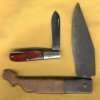
If I go back two generations, this is a traditional knife - this one carried by my Sicilian Grandfather.
GiuseppesKnife.jpg

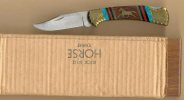
One generation, and it's a Buck lockback, of which my Dad had several over the years. This was his, purty, but he owned plainer ones that he carried. He carried a Stag-handled Case pen knife a lot also, in the 40s-70s.
BuckYH.jpg
No pic of the pen, but Dads favorite president was Eisenhower, and his pen was a case model named after Ike!!
For hunting, he always carried fixed blade knives by Harry Morseth.

I carried and abused a lot of Camillus and Imperial-made scouts, and later Barlows and SAKS.
I saw a lot of Stockmen, but didn't own or carry one until after University, in my 20s and beyond.

I wish I new more about traditional cutleries in my formative years.
 
traditional=Old school. Simple tough strong construction made by craftsmen for working people.
 
it's the knife my grandpa carried.

SAK in the pocket, jigged bone slippie usually in the tackle box.
 
When I think traditional, I think of stag and jigged bone, and stacked leather handles.
Very few knives seem to have these materials that I wouldn't call traditional.

The first knife I ever used, or even remember seeing, was this Imperial Prov of my dad's from the mid '50s.
Dadsknife.jpg
 
Well, I guess it is natural...traditions change from place to place, and the very concept of traditional (knife or anything else) does change.
Of course I have a concept of what's generally considered traditional in (American) knife culture.
But (I wrote it once on some thread here), if I stop and see the world through the lens of my own knife culture, any locking blade, or slipjoint with a backspring, isn't really traditional to me.
I was born and grew up in a land of friction folders. To me, this is the only deeply traditional knife: a Sardinian resolza

dsc0411ht.jpg


Fausto
:cool:
 
As many have said here, if it walks like a duck, it's a duck. If it looks like a traditional to me, it's a traditional.
 
Hi to all,

I grew up in Tuguegarao City, Cagayan Valley, in the northern part of the Philippines. My grandpa was an American citizen who lost all of his papers during World War 2, and so he settled in Cagayan Valley. Now, grandpa grew up in Hawaii, and lived for sometime in the US, so he had a few traditional slipjoints, such as Case and a few more (sadly all lost), which he used on a daily basis, and he used to show me how to use these knives. When I was about 11 years old, he gave me my first good pocket knife, a SAK Champion. He gave a Kabar fighting knife to one of my brothers, which had a leather handle. All traditional, from my point of view.

However, having said that, I was also exposed to a lot of local and very traditional knives in Cagayan, my home province. The usual everyday use knife is a bolo, about 12-16 inches long, usually made from the vehicle leaf springs (we call them Molye, I think), and usually with Carabao/water buffalo horn for a handle. Usually had a nice patina on it, and they would sharpen it on a carborandum stone, or on a sharpening wheel. Farmers in Cagayan usually carry one to the field, a long one, about 15-20 inch blade. For lighter work, we also had a shorter version of the bolo which the locals call a "Dutchal" (I'm just spelling it as they pronounced it). Again Carbon steel as abovementioned, with Carabao/water buffalo horn for a handle, sometimes wood for the cheaper versions. In my hometown, you can still go to the local market and pick out a bolo or dutchal or cleavers (I forget the local name). Some fancier ones will have wooden or leather sheaths, but the everyday use ones will be wrapped in newspaper and plastic bag as soon as you purchase it.

Nowadays, I mostly have traditional knives (a Case soddy, Buck Stockman, etc.), but I never forgot those old traditional fixed knives from my province, and I had my dad buy me a few for use around the house... I use them mainly for pruning leaves off plants, chopping bamboo, and a couple are used in the kitchen. Still the same as I remember them.

Sam
 
if you want to break it down, probably most post WWII men had carried a Case, Imperial, Schrade or Buck slipjoint.
 
To me, a traditional is anything with traditional materials. Carbon steel, bone, horn, wood, brass, leather, and nickel silver.
That spans everything from balisongs to slippies to khukris.
 
Sometimes it's easier to say what traditional is not. It's not painted black, serrated, or spring assisted (switchblades being the exception not the rule).
 
Back
Top