Where/How to test Rc

Joined
Apr 5, 2009
Messages
169
I'm going to be getting some equipment soon and moving away from the easily heat treated 1080 over to W2 to start making a few Chef knives. Until this point I have only been tinkering around with smaller knives on a HF 1x30 grinder and heat treating with a torch without a forge. I would do the heat treat at night so I could see even color in the blade at non-magnetic and quench in heated Canola oil. This has strictly been for my own enjoyment as a hobby.

I'll be getting a better grinder and hand building a small forge with a PID/thermocouple to get my temps right on the W2 to properly heat treat it.

My concern is that I see people throwing out RC numbers on all their knives. I wonder if this is their "theoretical" RC guess or is it actual tested numbers?

Once I get a feel for grinding the knives correctly I want to make a set of two or three knives and have them tested to see if I'm doing everything right. I don't just want to say, "Well I heated to 1450 and held for 5 min, then quenched in 160F oil. Temper at 450F for an hour. So I KNOW its RC 61!"

Any recommendations?
 
I think, quite honestly, that for most folks it's a guestimate. One would hope, that it's AT LEAST an educated guess based on what they did to the steel from beginning through temper, and Rc values pulled from a heat-treat chart.

Many of us have bit the bullet and purchased a tester. I searched for over a year for a good Wilson, and finally decided to buy an import. After finding a sale at Enco, having a customer appreciation discount code, etc... I got mine delivered to the door for about $700 (IRC!) For a hobbiest, that's a lot. For me, doing this as a career... it's a pretty wise investment.

I know for a fact, that there is a local machine shop (30 minutes from me) that will test blades on a $5,000 ish Wilson tester for a buck or two per blade. That's stupid cheap. It costs more to drive there. I highly doubt that all machine shops offer this service, but if one in a dinky town does, surely others do as well. :)

Rc is not everything either. It's a tool to help evaluate things. It has changed my opinion on some of my processes though. I think if it's used simply as a PART of the overall process, then it's quite valuable. It can be seen as a problem though, if you have, let's say a new maker send their blade off to Bos or Peter's, get it back and grind it like an ax but then brag that their blade is professionally hardened to 59/60 Rc. Yay for you, you have a 59/60 Rc splitting wedge. ;)

My short answer, call your local machine shops and see if they'll do it and for how much $$$.

Remember, most testers need a flat/parallel piece to get an accurate reading. :)
 
As far as a "flat" piece goes how would that work with a knife? Would I have to just do my normal heat treatment on a blank bar and see what it comes out to? Wouldn't the bevel and edge side of the knife heat treat differently then the spine?

I've made knives out of 1080 and use them quite often for work and they have held up great. However I have nothing really to compare them too (as far as high carbon steels go) so I don't even know if I did THAT heat treatment correctly.

Maybe people just have a "feel" for when a heat treatment goes correctly. I'm thinking I might just get to the point where I'm happy with a few knives and send them out to knowledgeable people here on the forum to use and comment on as part of my prototype process.

I have no delusions that the first knife off of my new grinder/forge will be a $1000 knife. I just want to always be taking steps in the right direction.
 
I believe Nick showed in one of his threads testing in the Ricasso area. Makers I know that do test tend to test at the Ricasso or on full tang knives under the handle slabs.

David Sharp
 
That makes sense. I just took a look at the link in Nicks profile and it shows him doing it like that. I guess I'll have to call around to some machine shops and see if they have a tester. Thanks guys!
 
Just remember NOT to test in the area where you grab it with tongs to quench because that area won't give a true reading. It will be softer in that area than others. I suggest making a couple of 1"x4" flat test pieces. Mark them so you will know which end you handled them on. Leave one untempered and temper the other then have them both tested. Then after they've been tested you can break them and check out the grain structure. At least thats how I do it when I begin working with a new steel. Good luck.

Darrin
 
Syvmn, I will test a few samples for you. Just send in a box I can use to return them in and a priority mail return label filled out by you and just enough cash to cover the postage back. My e mail is on my web site. I need a clean flat place on the blade at least 1/2 by 1/2. best if it is surface ground. Measurements will be +/- 1 point depending on the finish and flatness. I will also check test blocks to see if they are calibrated to the standard if someone wants. I do this so we will all be working on the same sheet of music when we compare notes. Phil
 
That would be GREAT Phil. I'm still a few weeks out from a running forge but once that is going I will do a few test pieces and shoot you a PM to figure out details. Thanks!
 
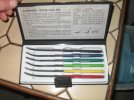
Hi syvm, i make guestimates on my high carbon blades i use a simple set of tsubosan files, those files give the guess at the rc, and edge rentention testing using antler, brass rod, and extreme point drops, give me the faith in my blades, i wil as nick said invest in a real tester at some point and 700 is a SWEET DEAL i made a note about enco!
 

Attachments

  • knives.jpg
    knives.jpg
    55.1 KB · Views: 13
Back
Top