
-
The BladeForums.com 2024 Traditional Knife is available! Price is $250 ea (shipped within CONUS).
Order here: https://www.bladeforums.com/help/2024-traditional/
You are using an out of date browser. It may not display this or other websites correctly.
You should upgrade or use an alternative browser.
You should upgrade or use an alternative browser.
Which Emerson in the CQC line has the beefiest lock?
- Thread starter Folderguy
- Start date

- Joined
- Jul 26, 2005
- Messages
- 2,027
The HD series.


- Joined
- Aug 27, 2004
- Messages
- 12,957
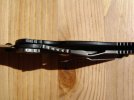
Both the frame lock models the HD7 and 12 appear beefy but when you take into account the lock cut in the rear of the lock they end up being weaker than many of the liner locks in his line up if not all of the current models because I think he has beefed up the lock side on the entire line in recent years. The strongest knife Ernie sells is probably the CQC13 with the thicker lock, as opposed to the older models that had thinner ones as did many of the models pre-07 but in my opinion the best knife he offers at this writing for overall balance, and strength for the size of the knife is the mini A100 model. For such a small knife the lock appears beefy and overall the lock, hardware, and build all come together to form what I think is his best model but thats just my opinion.
Again, the frame locks are all looks. When you look at the sub .040 thickness lock cuts in the rear what you really have is a weak link there and it doesn't really matter how beefed up it may appear at the contact, the fact is that strength is not the frame lock's forte` its real claim to fame is the perceived higher reliability that is probably more than just perceived. It probably is going to be more reliable as a locking system in the hand compared to a liner lock that the scale blocks the hand from physically contacting. The trade off is a loss in some strength though because in order to make the thicker slab models work as easy as the liner locks he takes that great amount of material out at the rear. Personally I wish he did the lock cuts more like the Sebenza models that are left quite thick at these cuts by comparison and every little bit helps but it is what it is.
STR
Again, the frame locks are all looks. When you look at the sub .040 thickness lock cuts in the rear what you really have is a weak link there and it doesn't really matter how beefed up it may appear at the contact, the fact is that strength is not the frame lock's forte` its real claim to fame is the perceived higher reliability that is probably more than just perceived. It probably is going to be more reliable as a locking system in the hand compared to a liner lock that the scale blocks the hand from physically contacting. The trade off is a loss in some strength though because in order to make the thicker slab models work as easy as the liner locks he takes that great amount of material out at the rear. Personally I wish he did the lock cuts more like the Sebenza models that are left quite thick at these cuts by comparison and every little bit helps but it is what it is.
STR
Attachments

Kaizen1
Gold Member
- Joined
- Jan 4, 2006
- Messages
- 6,314
Both the frame lock models the HD7 and 12 appear beefy but when you take into account the lock cut in the rear of the lock they end up being weaker than many of the liner locks in his line up if not all of the current models because I think he has beefed up the lock side on the entire line in recent years. The strongest knife Ernie sells is probably the CQC13 with the thicker lock, as opposed to the older models that had thinner ones as did many of the models pre-07 but in my opinion the best knife he offers at this writing for overall balance, and strength for the size of the knife is the mini A100 model. For such a small knife the lock appears beefy and overall the lock, hardware, and build all come together to form what I think is his best model but thats just my opinion.
Again, the frame locks are all looks. When you look at the sub .040 thickness lock cuts in the rear what you really have is a weak link there and it doesn't really matter how beefed up it may appear at the contact, the fact is that strength is not the frame lock's forte` its real claim to fame is the perceived higher reliability that is probably more than just perceived. It probably is going to be more reliable as a locking system in the hand compared to a liner lock that the scale blocks the hand from physically contacting. The trade off is a loss in some strength though because in order to make the thicker slab models work as easy as the liner locks he takes that great amount of material out at the rear. Personally I wish he did the lock cuts more like the Sebenza models that are left quite thick at these cuts by comparison and every little bit helps but it is what it is.
STR
There was a local knife shop to my last apartment that had an HD-7 with a ridiculously thin cut out, way thinner than the one you have up in the picture.
You would think that if one is concerned with making a framelock easy to disengage like a liner lock, one might simply make the cutout to have the same thickness as the liner lock rather than make it thinner. That would seem to keep the reliability of the frame lock without compromising the strength. Another problem I think with the failed folder in the picture is in the placement of the cut out. It looks like there's a compromise in overall strength due cut out being on the inside.

- Joined
- Nov 9, 2009
- Messages
- 44,314
Both the frame lock models the HD7 and 12 appear beefy but when you take into account the lock cut in the rear of the lock they end up being weaker than many of the liner locks in his line up if not all of the current models because I think he has beefed up the lock side on the entire line in recent years. The strongest knife Ernie sells is probably the CQC13 with the thicker lock, as opposed to the older models that had thinner ones as did many of the models pre-07 but in my opinion the best knife he offers at this writing for overall balance, and strength for the size of the knife is the mini A100 model. For such a small knife the lock appears beefy and overall the lock, hardware, and build all come together to form what I think is his best model but thats just my opinion.
Again, the frame locks are all looks. When you look at the sub .040 thickness lock cuts in the rear what you really have is a weak link there and it doesn't really matter how beefed up it may appear at the contact, the fact is that strength is not the frame lock's forte` its real claim to fame is the perceived higher reliability that is probably more than just perceived. It probably is going to be more reliable as a locking system in the hand compared to a liner lock that the scale blocks the hand from physically contacting. The trade off is a loss in some strength though because in order to make the thicker slab models work as easy as the liner locks he takes that great amount of material out at the rear. Personally I wish he did the lock cuts more like the Sebenza models that are left quite thick at these cuts by comparison and every little bit helps but it is what it is.
STR
As a knifemaker do you prefer the cut out on the outside or the inside?

mongomondo
SUPPRESSING FIRE
- Joined
- Sep 17, 2006
- Messages
- 3,290
I was also surprised by how flimsy the framelock felt on my CQC12. The cut out on the lock is way too thin.
Kaizen1
Gold Member
- Joined
- Jan 4, 2006
- Messages
- 6,314
As a knifemaker do you prefer the cut out on the outside or the inside?
I know you weren't asking me, but Rick Hinderer says he puts the cut out on the outside precisely because of the type of failure seen in the Emerson pic above (paraphrasing of course).
- Joined
- Nov 9, 2009
- Messages
- 44,314
I know you weren't asking me, but Rick Hinderer says he puts the cut out on the outside precisely because of the type of failure seen in the Emerson pic above (paraphrasing of course).
No problem Kaizen, I'm always interested in opinions on these things. Thanks. it makes sense for being a tougher knife. I wonder why CRK doesn't use the exterioir cutout.
 Might be aesthetically based.
- Joined
- Aug 27, 2004
- Messages
- 12,957
As a knifemaker do you prefer the cut out on the outside or the inside?
It makes absolutely no difference at all one way or the other which side the lock cut is on in my experience testing some of them done both ways. Sal has confirmed this from Spyderco. We both saw nothing to indicate that where it is even really had any hint of dictating how the energy was transferred or how the lock would defeat. The lock cut, no matter where it is, is the weak link in the chain so to speak.
As for where I prefer it as a maker. I personally find that being the pocket clip guru that I am that lock cuts on frame locks on the outside when tip up carry mode is used tend to get caught on the pocket rim as you extract the folder causing people to either temporarily lose the knife or dislodge it partially or flat out drop it on the ground. I've also found that it can catch the pocket the same way going in at times. When I'm asked to take a frame lock that came tip down and flip the clip to tip up carry by drilling and tapping new holes I have to be very careful about placement of the clip on these because that lock cut on the outside can be problematic for me. For example I have made clips to fit the Ti frame lock JYDII in SG2 blade steel for folks only to have to listen to them complain about this even after I thought I finally got it right. At times I've had to make clips for these folders with lock cuts on the outside as many as three times in various lengths before I found one that worked to where it did not snag on the pocket.
For that matter I've had a Strider PT that I had to physically lift the clip from the factory up on to remove the tension so the clip tail end no longer touched the frame because when it was as it came where it really grabbed the pocket hard this snag problem happened and it got caught on my pocket at times via the lock cut which caused me to drop the knife on one occasion that I remember well. And it was just as it came from the factory! So if you ask me which I prefer I will hands down say lock cuts on the inside only on frame locks and just for this reason alone and no other. Personally to me the way I carry 90% of my folders is tip up so most of the time even if I like a frame lock and the lock cuts are on the outside I don't buy it. As for the theory of the lock cut being better on one side or the other for how the lock behaves though, well I don't buy it. I cannot find anything in testing to prove it out that it matters one iota.
STR

- Joined
- Jun 28, 2010
- Messages
- 1,952
Both the frame lock models the HD7 and 12 appear beefy but when you take into account the lock cut in the rear of the lock they end up being weaker than many of the liner locks in his line up if not all of the current models because I think he has beefed up the lock side on the entire line in recent years. The strongest knife Ernie sells is probably the CQC13 with the thicker lock, as opposed to the older models that had thinner ones as did many of the models pre-07 but in my opinion the best knife he offers at this writing for overall balance, and strength for the size of the knife is the mini A100 model. For such a small knife the lock appears beefy and overall the lock, hardware, and build all come together to form what I think is his best model but thats just my opinion.
Again, the frame locks are all looks. When you look at the sub .040 thickness lock cuts in the rear what you really have is a weak link there and it doesn't really matter how beefed up it may appear at the contact, the fact is that strength is not the frame lock's forte` its real claim to fame is the perceived higher reliability that is probably more than just perceived. It probably is going to be more reliable as a locking system in the hand compared to a liner lock that the scale blocks the hand from physically contacting. The trade off is a loss in some strength though because in order to make the thicker slab models work as easy as the liner locks he takes that great amount of material out at the rear. Personally I wish he did the lock cuts more like the Sebenza models that are left quite thick at these cuts by comparison and every little bit helps but it is what it is.
STR
Was that yours by chance STR? I just picked up an HD-7. Any story on what kind of use the HD-7 was put to when it failed?
- Joined
- Aug 27, 2004
- Messages
- 12,957
Was that yours by chance STR? I just picked up an HD-7. Any story on what kind of use the HD-7 was put to when it failed?
It wasn't mine no. It is an HD7 though. I believe it happened while he was splitting some shavings of small logs to make a fire as I recall. As for the details though I cannot tell you that. He may have been using a baton but I really don't recall that. Truthfully if I ever suffer a lock defeat of a folder in use I hope that is the way it happens. Its not the most catastrophic defeat a lock can have let me tell you. No one was hurt when that lock folded. The lock did its job and secured the blade so by the way it defeated its evident the maker did his homework correctly for the design and you know the contact was correct at the correct angle or the lock would have gone the other way and a serious injury would have resulted. In my experience the contact pitch angle has much more to do with how the lock behaves under load than the lock cut in the rear does. Much more!
STR

- Joined
- Sep 17, 2007
- Messages
- 21,359
In my experience the contact pitch angle has much more to do with how the lock behaves under load than the lock cut in the rear does. Much more!
STR
Oh yeah, that's for sure.
I'd like the CQC-12 to have a thicker cut-out anyway though.
- Joined
- Jun 28, 2010
- Messages
- 1,952
It wasn't mine no. It is an HD7 though. I believe it happened while he was splitting some shavings of small logs to make a fire as I recall. As for the details though I cannot tell you that. He may have been using a baton but I really don't recall that. Truthfully if I ever suffer a lock defeat of a folder in use I hope that is the way it happens. Its not the most catastrophic defeat a lock can have let me tell you. No one was hurt when that lock folded. The lock did its job and secured the blade so by the way it defeated its evident the maker did his homework correctly for the design and you know the contact was correct at the correct angle or the lock would have gone the other way and a serious injury would have resulted. In my experience the contact pitch angle has much more to do with how the lock behaves under load than the lock cut in the rear does. Much more!
STR
Thanks for the response STR. Like you say, if a lock were ever to fail, one hopes it would be like this where there is no injury.
Not that I'd be able to do it at this point due to lack of funds at the moment, but would it be possible to have this modded with another ti lock side that has a thicker cut, with the correct contact pitch angle? Also would anybody be able to point me in the right direction if this is possible?
- Joined
- Aug 27, 2004
- Messages
- 12,957
The pitch angle is correct so I would not change that. Again just to explain the trade offs here. The lock cut varies in how its done, how many times, how deep it goes and which side its on as already discussed and in other ways from model to model and knife to knife. Some like the Mission knives took a major portion out of the lock for about the three quarters of the length but left it .070 to .075 thick all the way down with another line down the middle on the outside that maybe took another .010 to .015 or so off the thickness for an even smaller slice so to speak but that slice ran the length of the lock also In short it was still thicker than most made.
Others like Strider, take their cuts pretty far in one big surface area in one spot as I've measured some at .033 or so and then they stabalize the lock with the Hinderer lock stabalizer giving it some added rigidity it would not have otherwise. Some of the Emersons as has been pointed out and shown can also be quite thin as I've seen many .040 and others thinner still and those can vary from year to year in various ways like how big a swatch for example. http://www.bladeforums.com/forums/attachment.php?attachmentid=101695&d=1214777197
My small Sebenza by comparison has two lock cuts each going from .1235 thick down to .054 on each one at the thinnest point but another smaller slice is in the middle maybe taking that down just slightly more perhaps the thickness of a very thin washer and if you really study it you notice there are also now two outside slices very narrow side by side on the outside right under the clip. Taking all that into account even at its thinnest its still thicker than most. Here is a Emerson 12 http://www.bladeforums.com/forums/attachment.php?attachmentid=63384&d=1164952855
Here is one I did a few years ago for a customer. http://www.bladeforums.com/forums/attachment.php?attachmentid=111855&d=1224947328
Its the only one I've ever made of this size. Its a big knife for me compared to what I usually made but still not as big as a 12.
Now as you can see the lock cuts can be left thicker. But, and its a big but, you have some things that accompany that thicker lock. One is the lock is disctintly harder to manipulate and will have greater resistance. That greater resistance typically means it will shove that detent ball in the blade pretty good so jump starting the blade can be a little more effort to get it opened.
According to my records those slabs are .140 each for thickness. The lock cut was stopped at .074-.075 making for a very stout lock. Warning is that it can be more than people bargain for. On others I've made in recent times I've used .095 or .100 thickness slabs and put no lock cut at all in them. Some have kept them and love them, others sent them back asking for a little cut to thin it some. Here is one that stayed and is loved by the owner. .095 lock and non lock sides and no lock cut at all in the lock. http://2.bp.blogspot.com/_MYXTkwJICJ4/SiKu9kv_GwI/AAAAAAAAAbE/Lc7ssQZxkpw/s1600-h/DSCF0021.JPG
Again, the trade off is a stiff lock that can wear even a stout thumb right out. Thats the obvious. Whats not so obvious is that hyper extending the lock when its done this thick is next to impossible unless you grab a lever and really tweak on the lock. So, this type of knife could easily be carried in the pocket clip less without fear of losing your spring from overextending the lock out the wrong way.
Honestly though long as this has been to explain, if I had a production knife company of my own, I'd be doing things similar to what I see these other companies doing. If I did them thicker then the lock cuts would be complained about and knives would be returned. If people can't sit around flicking their folder opened and closed all day comfortably using it like a worry stone, or replacing nail biting they simply won't like it. When dealing with masses of customers you have to do what works. No one complains about the way the knife works when they are done like you see them. Oh they may voice some issue with it wishing it was thicker but the knife is not returned in that case so I'm sure its deemed the 'lesser of the two evils'. As my dad used to say you can wish in one hand and crap in the other and see which one gets filled first!
STR
Others like Strider, take their cuts pretty far in one big surface area in one spot as I've measured some at .033 or so and then they stabalize the lock with the Hinderer lock stabalizer giving it some added rigidity it would not have otherwise. Some of the Emersons as has been pointed out and shown can also be quite thin as I've seen many .040 and others thinner still and those can vary from year to year in various ways like how big a swatch for example. http://www.bladeforums.com/forums/attachment.php?attachmentid=101695&d=1214777197
My small Sebenza by comparison has two lock cuts each going from .1235 thick down to .054 on each one at the thinnest point but another smaller slice is in the middle maybe taking that down just slightly more perhaps the thickness of a very thin washer and if you really study it you notice there are also now two outside slices very narrow side by side on the outside right under the clip. Taking all that into account even at its thinnest its still thicker than most. Here is a Emerson 12 http://www.bladeforums.com/forums/attachment.php?attachmentid=63384&d=1164952855
Here is one I did a few years ago for a customer. http://www.bladeforums.com/forums/attachment.php?attachmentid=111855&d=1224947328
Its the only one I've ever made of this size. Its a big knife for me compared to what I usually made but still not as big as a 12.
Now as you can see the lock cuts can be left thicker. But, and its a big but, you have some things that accompany that thicker lock. One is the lock is disctintly harder to manipulate and will have greater resistance. That greater resistance typically means it will shove that detent ball in the blade pretty good so jump starting the blade can be a little more effort to get it opened.
According to my records those slabs are .140 each for thickness. The lock cut was stopped at .074-.075 making for a very stout lock. Warning is that it can be more than people bargain for. On others I've made in recent times I've used .095 or .100 thickness slabs and put no lock cut at all in them. Some have kept them and love them, others sent them back asking for a little cut to thin it some. Here is one that stayed and is loved by the owner. .095 lock and non lock sides and no lock cut at all in the lock. http://2.bp.blogspot.com/_MYXTkwJICJ4/SiKu9kv_GwI/AAAAAAAAAbE/Lc7ssQZxkpw/s1600-h/DSCF0021.JPG
Again, the trade off is a stiff lock that can wear even a stout thumb right out. Thats the obvious. Whats not so obvious is that hyper extending the lock when its done this thick is next to impossible unless you grab a lever and really tweak on the lock. So, this type of knife could easily be carried in the pocket clip less without fear of losing your spring from overextending the lock out the wrong way.
Honestly though long as this has been to explain, if I had a production knife company of my own, I'd be doing things similar to what I see these other companies doing. If I did them thicker then the lock cuts would be complained about and knives would be returned. If people can't sit around flicking their folder opened and closed all day comfortably using it like a worry stone, or replacing nail biting they simply won't like it. When dealing with masses of customers you have to do what works. No one complains about the way the knife works when they are done like you see them. Oh they may voice some issue with it wishing it was thicker but the knife is not returned in that case so I'm sure its deemed the 'lesser of the two evils'. As my dad used to say you can wish in one hand and crap in the other and see which one gets filled first!
STR
Last edited:
- Joined
- Aug 27, 2004
- Messages
- 12,957
Here is a good view of what I was referring to with the Mission knife which seen here is the MPF-3 that I own. Thats one tough knife there! http://www.bladeforums.com/forums/attachment.php?attachmentid=143638&d=1252807574
And here is the long cut down the middle from the outside I referred to. http://www.bladeforums.com/forums/attachment.php?attachmentid=143636&d=1252807496
STR
And here is the long cut down the middle from the outside I referred to. http://www.bladeforums.com/forums/attachment.php?attachmentid=143636&d=1252807496
STR
Here is a good view of what I was referring to with the Mission knife which seen here is the MPF-3 that I own. Thats one tough knife there! http://www.bladeforums.com/forums/attachment.php?attachmentid=143638&d=1252807574
And here is the long cut down the middle from the outside I referred to. http://www.bladeforums.com/forums/attachment.php?attachmentid=143636&d=1252807496
STR
Thanks to STR and all the others who've chimed in on this thread. It's been a veritable education for me.
Reading all this led me to get out my micrometer caliper, and to measure the thicknesses of the liners and frame locks that I have and are easy to measure.
Here's what some of the knives specced out at:
Zero Tolerance 0300, .164 at contact point, .041 at cutout
Benchmade 755 frame lock, 0.106 above cutout, .030 at cutout
Kershaw Scallion, liner lock, 0.042, no cutout
Gerber paraframe, .085 at contact point, .036 at cutout
Of these knives, the only one that Jim Ankerson has done his hard use videos on is the Zero Tolerance knife, which is quite a beefy knife.
The Strider he tested passed all the tests. However the Spyderco Manix 2 failed the spine whack test 5 times in a row, and the Benchmade with axis lock also failed the spine whack test.
The Cold Steel knives he tested, the American Lawman, with the Tri-Ad lock had no issues, and the CS Recon 1 folder, even though it loosened up a bit, did not fail.
I suppose that part of the deal in buying an Emerson after reading all these posts is not to consider it really a hard use knife, (such as the Strider or the Zero Tolerance 0300 series, or the Cold Steel knives with the Tri-Ad lock,) but to consider it an excellent knife well within the norms for a high quality knife, which it certainly is.
The ZT 0300 that I have is definitely harder to release the lock on, no doubt about it, and it's very noticeable. The Benchmade 755 MPR is way easier to unlock, but it doesn't seem near as strong.
Would I want all my knives to be as difficult to unloct as the ZT 0300? No, I sure wouldn't. However, I know that if I ever had to use it really hard, it would probably do just fine. Ditto for the knives with the Tri-Ad lock.
Just yesterday the Cold Steel Black Rhino with the Tri-Ad lock that I ordered came in, and it has become my favorite. However, it's so friggin' big, I really can't consider it an EDC for me. That's ok... it's still plenty awesome.
A question for you, STR. You said that all things considered, "in my opinion the best knife he [Emerson] offers at this writing for overall balance, and strength for the size of the knife is the mini A100 model. For such a small knife the lock appears beefy and overall the lock, hardware, and build all come together to form what I think is his best model but thats just my opinion."
Do you recall what the thickness of the lock is?
Thanks for all the info!
Folderguy
- Joined
- Aug 27, 2004
- Messages
- 12,957
It was .064 on the one I owned and the lock side was thicker than the non lock side as I recall. I gave that plain edge mini A100 knife to my brother. Had I known at the time that it was going to be so dang hard to get another one I'd have kept it.  You never see them for sale around the forums, and they don't show up on ebay all that often either. Its a small knife.
A knife has to be convenient as well as offer all that you are looking for in a folder. The 13 is not a small folder by any means and its measurements tell the story that its bigger than the ZT you mention, yet the 13 will carry easier and not take up as much room in the pocket due to the thin profile. Personally I like the 13 with the beefy lock. Its a great knife. I don't know how strong the tip would be in an Ankerson test but it should do well in the other areas.
For frame locks there is another thing to consider. The lock cuts being thin does not keep many users from using them dang hard and overall for most uses the knives hold up fine. I think the hand actually helps the lock to absorb some of the shocks from hard use too, acting somewhat as a cushion and stabalizer in its own right. There are a lot of liner locks that would prove stronger than most frame locks in static load tests. But in the human hand, during real world use, which is something a static load test cannot possibly replicate, I feel the frame lock has the advantage even with the lock cuts thinned down as they are on so many in the industry. I know I'd sooner hard stab a frame lock than a liner lock any day of the week, thin lock cut or not. For whatever that is worth to you.
STR
You never see them for sale around the forums, and they don't show up on ebay all that often either. Its a small knife. A knife has to be convenient as well as offer all that you are looking for in a folder. The 13 is not a small folder by any means and its measurements tell the story that its bigger than the ZT you mention, yet the 13 will carry easier and not take up as much room in the pocket due to the thin profile. Personally I like the 13 with the beefy lock. Its a great knife. I don't know how strong the tip would be in an Ankerson test but it should do well in the other areas.
For frame locks there is another thing to consider. The lock cuts being thin does not keep many users from using them dang hard and overall for most uses the knives hold up fine. I think the hand actually helps the lock to absorb some of the shocks from hard use too, acting somewhat as a cushion and stabalizer in its own right. There are a lot of liner locks that would prove stronger than most frame locks in static load tests. But in the human hand, during real world use, which is something a static load test cannot possibly replicate, I feel the frame lock has the advantage even with the lock cuts thinned down as they are on so many in the industry. I know I'd sooner hard stab a frame lock than a liner lock any day of the week, thin lock cut or not. For whatever that is worth to you.
STR
Last edited: