
- Joined
- Jan 1, 2012
- Messages
- 197
Like the title says I just bought some cheap traditionals and am looking to restore/clean them up into EDCs. I thought I would ask first to see if any are worth more un-restored just to be safe. I can take more pictures if needed.
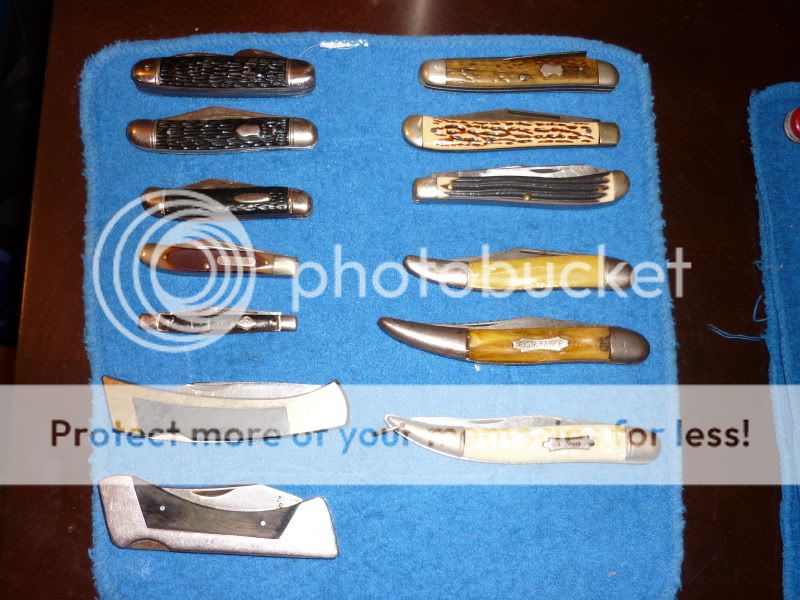
From top to bottom:
Left Row:
Hammer Brand USA
Only marking is USA and then a ton of numbers on the smaller blade
Imperial Ireland
I removed the old timer after the first picture as it does not need restoring. I had it sitting there by mistake.
Imperial Diamond Edge 852DE
Gerber Portland OR 97223 USA
Sharp 200
Right Row:
Shapleigh St. Louis USA
Colonial Prov USA
Queen Steel #24? (It is very worn in the blade where someone grinded it)
Hammer
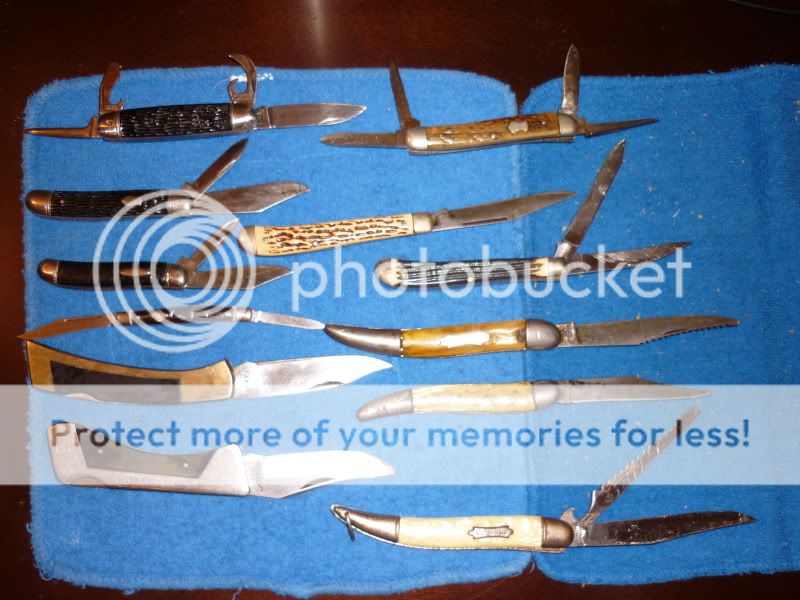
Colonial Prov. RI Pat. Pend. [Fish Knife on scale] [I just realized this one and the above are switched in the second picture)
Only Markings is Made in Germany and the scales say Fish Knife
I also was wondering how to best clean them up? All lock well and all but two have no play in the blades. I think think the majority of them just need to have the grime and rust removed from the joint etc. to be great users again. There are also some loose scales that I might either glue down or replace (on the larger knives).
I did some reading on here in these threads:
http://www.bladeforums.com/forums/showthread.php/909606-Little-Restoration-Project?
http://www.bladeforums.com/forums/showthread.php/914588-Restoring-Old-Timer?
What I noted is some things to try: warm water and dish soap, mineral oil and 0000 steel wool very carefully on any rust spots/pits, cloth and a wooden shim in the joint, 3-in-one oil in the joint to get a nice smooth action (Can also use mineral oil?), don't try to take it apart and stay away from using WD40 as a lubricant.
What else do you fellas recommend? Can I use Flitz on the old Gerber and Sharp knives to polish up the handles? What can I do about the knife with the blades uneven from someone using a grinder?
Also, is mineral oil the same kind people use for digestive issues or is there a different type that is preferred for knives?
I hope I didn't ask too many questions and thank you for the help.
From top to bottom:
Left Row:
Hammer Brand USA
Only marking is USA and then a ton of numbers on the smaller blade
Imperial Ireland
I removed the old timer after the first picture as it does not need restoring. I had it sitting there by mistake.
Imperial Diamond Edge 852DE
Gerber Portland OR 97223 USA
Sharp 200
Right Row:
Shapleigh St. Louis USA
Colonial Prov USA
Queen Steel #24? (It is very worn in the blade where someone grinded it)
Hammer
Colonial Prov. RI Pat. Pend. [Fish Knife on scale] [I just realized this one and the above are switched in the second picture)
Only Markings is Made in Germany and the scales say Fish Knife
I also was wondering how to best clean them up? All lock well and all but two have no play in the blades. I think think the majority of them just need to have the grime and rust removed from the joint etc. to be great users again. There are also some loose scales that I might either glue down or replace (on the larger knives).
I did some reading on here in these threads:
http://www.bladeforums.com/forums/showthread.php/909606-Little-Restoration-Project?
http://www.bladeforums.com/forums/showthread.php/914588-Restoring-Old-Timer?
What I noted is some things to try: warm water and dish soap, mineral oil and 0000 steel wool very carefully on any rust spots/pits, cloth and a wooden shim in the joint, 3-in-one oil in the joint to get a nice smooth action (Can also use mineral oil?), don't try to take it apart and stay away from using WD40 as a lubricant.
What else do you fellas recommend? Can I use Flitz on the old Gerber and Sharp knives to polish up the handles? What can I do about the knife with the blades uneven from someone using a grinder?
Also, is mineral oil the same kind people use for digestive issues or is there a different type that is preferred for knives?
I hope I didn't ask too many questions and thank you for the help.
